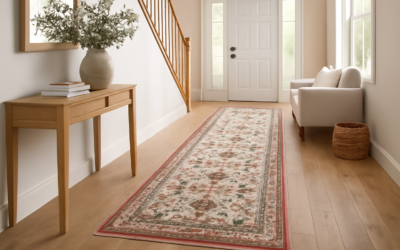
A hallway that feels cold, echoey, and unfinished usually just needs one thing. An 8ft runner rug is the workhorse length of the runner world, long enough to define a real path of travel, short enough to fit the medium hallways and galley kitchens most homes actually have. Get the sizing right and it warms the space, protects the floor, and quiets footsteps. Get it wrong, buy too long or leave no border, and it looks like carpet that was cut off at the wrong spot. This guide covers exactly where an 8-foot runner belongs and how to make it look intentional.
Where an 8-Foot Runner Fits Best
Eight feet is the sweet spot for spaces that are longer than they are wide but not endless. Consider it for these spots:
- Medium hallways: A corridor of roughly 9 to 10 feet leaves a clean border at each end.
- Galley kitchens: Run it down the center aisle between opposing counters to cushion the spot you stand in most.
- In front of a sink or range: Softens the hardest-working stretch of kitchen floor.
- At the foot of a bed: Laid crosswise, an 8-foot runner spans the end of a queen or king to add texture.
- Entryways and mudrooms: Catches grit right where you come in the door.
The unifying idea is a defined lane of foot traffic. Wherever people walk single file in a straight line, a runner belongs, and eight feet covers the most common of those lanes without special ordering.
The Sizing Rule That Prevents Mistakes
Runners live or die on their borders. The goal is a balanced strip of exposed floor framing the rug so it reads as a deliberate accent rather than a botched wall-to-wall install. Follow two simple targets: leave roughly 4 to 5 inches of bare floor at each end, and a few inches, ideally 4 to 8, on each long side.
Put that into practice. For an 8-foot runner, you want a hallway that measures about 8’8″ to 9’6″ long so the end gaps land in that comfortable range. Width-wise, a standard 2 to 2.5-foot-wide runner suits a hall that is roughly 3 to 4 feet across. If your hallway is much longer than nine feet, an 8-foot runner will float and look stranded, size up to a 10 or 12-foot runner instead. Measure before you buy, every time.
Common Runner Widths and How to Choose
Length gets the attention, but width determines whether a runner looks proportioned. Most 8ft runners come in one of these widths:
- 2 feet (24 inches): The classic hallway width; disappears nicely into narrow corridors.
- 2.5 feet (30 inches): A more substantial look for wider halls and kitchen aisles.
- 3 feet (36 inches): Best for generous entries or as a bold statement in a wide passage.
Pick the width by dividing your space’s width so you keep those few inches of border on each side. A 2-foot runner in a 4-foot-wide hall leaves a foot of floor on each side, which is too much and makes the runner look skinny; a 30 or 36-inch runner fills that hall far better. Matching width to the space is what separates a runner that looks tailored from one that looks like an afterthought.
Materials Built for High Traffic
Runners take a beating. They sit in the busiest, most concentrated foot-traffic lanes in the house, so material durability matters more here than almost anywhere else. Your strongest choices:
- Wool: Naturally resilient, stain-resistant, and springy underfoot; it hides dirt and bounces back from crushing, making it the gold standard for hallways you will keep for years.
- Polypropylene (olefin): The value champion, highly stain- and moisture-resistant, easy to clean, and ideal for kitchens and entries where spills happen.
- Flatweave and low-pile: A tight, low-profile weave resists tracking, vacuums easily, and lets doors clear the floor; reversible flatweaves also last longer because you can flip them.
- Nylon: Extremely durable and resilient, a solid pick for the highest-traffic runs.
In a kitchen, lean toward polypropylene or a washable construction that shrugs off grease and drips. In a dry entry hall or bedroom, wool or a wool blend gives you softness and longevity. Avoid deep, plush shag in a runner; long pile crushes into a traffic path within months and shows every footprint.
Keep It From Slipping
A runner that slides is both an annoyance and a genuine fall hazard, and on hard floors an 8-foot runner will absolutely creep without help. Always pair it with a non-slip rug pad cut a touch smaller than the runner, so the pad hides just inside the edges. A quality gripper pad also adds a thin layer of cushion that makes the runner more comfortable and protects hardwood, tile, or vinyl underneath from grit.
For kitchens and entries where moisture is common, choose a pad rated for hard floors and resistant to the plasticizers in some vinyl flooring, which can react with cheap pads and stain the surface. Check the pad occasionally and shake it out, dust trapped underneath is what usually breaks the grip over time.
Layering and Styling an 8-Foot Runner
Runners are not only practical, they are a design opportunity in narrow spaces that otherwise get ignored. Layer a patterned wool 8-foot runner over a larger natural-fiber rug in an entry to add depth, or run a bold, colorful runner down a plain hallway to give an otherwise blank corridor a focal point. Stripes and long directional patterns exaggerate a hallway’s length in a pleasing way, while a busy all-over pattern is forgiving of the dirt and footprints a high-traffic lane inevitably collects.
Keep the runner centered in the space, equal border on both sides, and squared to the walls. In a hallway with doors opening off it, make sure the pile is low enough that doors swing clear, and stop the runner short of any doorway threshold so it does not bunch when the door closes.
Caring for a High-Traffic Runner
Because a runner absorbs the most concentrated foot traffic in the house, a little routine care goes a long way toward keeping it looking new. Vacuum along the length once or twice a week, dirt and grit work down into the fibers in a walking lane faster than anywhere else, and that embedded grit is what actually wears a rug out, acting like sandpaper against the pile with every step.
Rotate the runner end to end every few months so wear spreads evenly instead of carving a bald patch at the busiest point. Blot spills immediately rather than rubbing, which pushes stains deeper and frays the pile. In a kitchen, shake or hose off a washable runner regularly to clear grease and crumbs, and check the pad underneath, dust that collects there is the usual reason a gripper stops gripping. For wool, a professional cleaning every year or two restores loft and lifts ground-in soil that home vacuuming leaves behind.
Making the Right Call
An 8ft runner rug is the length to reach for when you have a defined walking lane in the 9-foot range, a medium hall, a galley kitchen, an entry, or the foot of a bed. Measure your space first, aim for that 4-to-5-inch end border, match the width to keep a clean side reveal, and choose a durable wool or polypropylene weave sized to survive constant foot traffic. Add a good non-slip pad and you get a runner that stays put, protects your floor, and turns one of the plainest stretches in the house into a finished, intentional space.