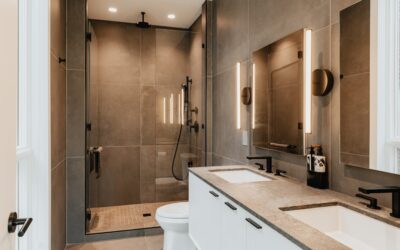
If your kids duck to rinse their hair while you crane your neck upward, the fixed 78-inch shower arm builders default to is the problem. An adjustable height shower head solves it by letting the spray head slide up or down a track, so a 4-foot-tall child and a 6-foot-4 adult both get a comfortable rinse from the same fixture. It is one of the cheapest bathroom upgrades that people actually notice every single day.
Part of our Bathroom Remodeling & Flooring guide — explore the full guide →
The idea is simple, but the hardware comes in three distinct styles, and the wrong one can mean patching tile or drilling into a wet wall. Below is how each system works, what it costs, and how to pick the setup that matches your bathroom without hiring anyone.
- Why a Standard Shower Arm Falls Short
- The Three Main Adjustable Systems
- Water Pressure and Flow Rate Considerations
- Materials and Finish That Last
- How to Install a Slide Bar in Under an Hour
- Accessibility and Aging in Place
- Handheld vs. Fixed Adjustable Options
- Common Installation Mistakes to Avoid
- What to Buy for Your Situation
Why a Standard Shower Arm Falls Short
The typical shower arm exits the wall at 72 to 80 inches off the floor and points down at a fixed angle. That height was chosen for an “average” adult decades ago, and it ignores everyone shorter or taller. Guests, aging parents who sit on a shower bench, and small children all end up compensating with awkward posture or a handheld sprayer they hold at arm’s length.
An adjustable system decouples the spray head from that single fixed point. Depending on the design, you get anywhere from 24 to 36 inches of vertical travel, which covers essentially every user in a family. It also lets you angle the water for cleaning the shower walls, filling a bucket, or rinsing a dog.
The Three Main Adjustable Systems
Slide Bar (Riser Rail) Kits
A slide bar is a vertical rail, usually 24 or 30 inches long, mounted to the wall with two brackets. A handheld shower head clips into a bracket that locks anywhere along the rail, so raising or lowering it takes one hand and about two seconds. Moen, Delta, and Grohe all sell complete kits for $60 to $150 that include the bar, the hose, and the sprayer.
Slide bars are the most flexible option, but they require drilling into tile or fiberglass. If you rent or cannot drill, look for kits with heavy-duty suction or tension-mount bars, though those hold less weight and can slip over time.
Adjustable Shower Arms and Gooseneck Extensions
If you want to change the head height without touching the wall, an adjustable or extra-long S-shaped shower arm is the no-drill answer. These screw onto the existing 1/2-inch threaded stub where your current arm attaches. A hinged or ball-jointed arm can raise a rain head 8 to 15 inches and swing it 90 degrees or more. Prices run $20 to $60.
The tradeoff is that adjustment is looser. You are repositioning a stiff joint, not clicking into locked detents, so it works best when the same one or two people use the shower.
Height-Adjustable Rain Heads
Some rain-shower kits combine a slide bar with an overhead-style disc, giving you a wide, drenching spray that still lowers for shorter users. These are the priciest at $120 to $300, but they blend the spa look of a fixed rain head with real flexibility.
Water Pressure and Flow Rate Considerations
Federal rules cap shower heads at 2.5 gallons per minute (GPM), and many states like California and Colorado limit them to 1.8 GPM. Moving a head up on a slide bar does not change flow, but it does add hose length, and a long, kinked handheld hose can drop perceived pressure. Choose a kit with a 60- to 72-inch reinforced hose and avoid tight coils.
If your home has genuinely low pressure, look for heads rated to perform at 45 psi or lower, or ones with a pressure-boosting turbine design. A 1.8 GPM head from a quality brand often feels stronger than a cheap 2.5 GPM unit because of how it shapes the water.
Materials and Finish That Last
Wet-mounted hardware corrodes if you buy the wrong metal. Solid brass slide bars and arms hold up far better than pot-metal or thin aluminum, especially in homes with hard water. For the finish, match your existing trim:
- Polished chrome hides water spots best and is the cheapest to replace.
- Brushed nickel resists fingerprints and pairs with warm bathroom palettes.
- Matte black looks sharp but shows hard-water film; wipe it dry to keep it clean.
- Oil-rubbed bronze suits traditional bathrooms but can wear at contact points.
Check that the hose is stainless steel with a brass or nylon nut rather than a plastic connector, which is the first thing to crack.
How to Install a Slide Bar in Under an Hour
Most homeowners can mount an adjustable height shower head system with basic tools. Here is the sequence for a slide bar kit:
- Hold the bar against the wall and mark the two bracket screw locations. Keep the bottom bracket around 48 inches off the floor so the lowest position still clears a bench.
- Drill pilot holes with a carbide or diamond bit rated for tile. Go slow and keep the bit wet to avoid cracking the glaze.
- Insert the supplied wall anchors, then screw the brackets tight.
- Wrap the shower arm threads with three or four turns of PTFE plumber’s tape and thread on the hose connector by hand, then snug it a quarter turn with a wrench.
- Clip the handheld into the sliding bracket and test at full pressure, watching for drips at each joint.
Total time is 30 to 60 minutes, and the only real risk is cracking tile, which slow drilling prevents.
Accessibility and Aging in Place
An adjustable height shower head is a core feature of accessible bathrooms. Pair a slide bar with a handheld wand and you have a setup that works whether someone stands, sits on a transfer bench, or needs a caregiver to direct the spray. For full ADA-minded design, mount a grab bar rated to 250 pounds nearby, use a hose at least 60 inches long, and choose a bracket you can operate with a closed fist rather than a fine pinch grip.
Handheld vs. Fixed Adjustable Options
Not every adjustable system involves a handheld wand. If you prefer the look and simplicity of a fixed head but still want height flexibility, a wall-mounted rain head on an adjustable arm keeps the clean overhead profile while letting you tilt and raise the spray. The handheld route, by contrast, gives you far more than height control: you can direct water precisely for rinsing, cleaning the enclosure, and bathing kids or pets. Most families end up preferring a handheld on a slide bar because it does double duty, serving both the height problem and a dozen everyday tasks a fixed head cannot.
There is also a hybrid worth knowing about. A dual system mounts a fixed head up top and a handheld on a slide bar below, fed by a diverter. You get the drench of a rain head and the flexibility of a wand, and each person picks the setup that suits them. It costs more and takes longer to install, but for a shared family bathroom it can be the best of both worlds.
Common Installation Mistakes to Avoid
A few errors turn a simple upgrade into a frustrating afternoon. Watch for these:
- Drilling too fast into tile. A dry, high-speed bit cracks glaze instantly. Go slow, keep the bit wet, and start with a smaller pilot bit.
- Skipping wall anchors. A slide bar carries the weight of a wet wand and repeated tugging. Screws alone into hollow tile backer will pull out; always use the supplied anchors or hit a stud.
- Forgetting plumber’s tape. Every threaded connection needs three to four wraps of PTFE tape, or you will chase drips for days.
- Mounting the bar too high. Set the lowest bracket position around 48 inches so a seated user or a child can still reach a comfortable spray.
- Overtightening plastic connectors. Snug plus a quarter turn is enough; cranking down cracks the nut.
Avoiding these keeps the job to under an hour and prevents leaks that show up weeks later.
What to Buy for Your Situation
For a family with a wide range of heights and a tile shower you can drill, a 30-inch slide bar kit from Moen or Delta at $80 to $130 is the best all-around value. Renters or anyone avoiding drilling should choose an adjustable S-arm plus a quality handheld for under $60. If you want the spa feel without losing flexibility, budget $150 to $250 for a rain head on a slide bar. Whatever you pick, buy solid brass, a stainless hose, and a finish that matches your faucet, and you will have a fixture that fits everyone in the house for a decade or more.