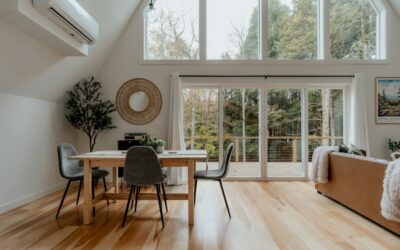
Choosing between hardwood, LVP, laminate, tile, and carpet feels overwhelming because each category has internal sub-types with different price points and performance profiles. This guide covers all flooring categories side-by-side, with real per-square-foot pricing, durability ratings, and the specific scenarios where each material outperforms the others. Treat it as a decision framework rather than a sales pitch.
Hardwood: Solid and Engineered
Solid hardwood is 3/4-inch thick across the board and can be refinished six to ten times over its life. Engineered hardwood layers a real wood veneer (1mm to 6mm thick) over a plywood or HDF core, refinish-able once or twice depending on wear layer. Pricing ranges $4 to $14 per sq ft for material, with installation adding $3 to $7.
Janka hardness drives durability. Red oak sits at 1290, white oak 1360, hickory 1820, hard maple 1450. Anything below 1000 (American walnut at 1010, cherry at 950) shows dents from pet claws and dropped objects quickly. For high-traffic homes, stick to oak or harder.
Luxury Vinyl Plank and Tile
LVP and LVT have taken over the mid-market because they’re waterproof, scratch-resistant, and visually convincing. Wear layers range from 6 mil (rental-grade) to 30 mil (commercial). For residential, 12 mil is the floor and 20 mil is the premium tier. Pricing runs $1.75 to $5.50 per sq ft material, $1.50 to $3.00 install.
Brands worth knowing: COREtec, Mannington Adura, Shaw Floorte, Mohawk SolidTech, Karndean. Avoid the deep-discount imports under $1.50/sq ft — wear layers under 6 mil show traffic patterns within a year.
Laminate Flooring
Laminate uses a photographic decor layer over an HDF core, topped with an aluminum oxide wear coat. AC ratings define abrasion resistance: AC3 for residential, AC4 for commercial/heavy residential, AC5 for commercial heavy. Pergo TimberCraft, Mohawk RevWood, and Quick-Step Impressive lead the residential market at $1.50 to $3.75 per sq ft.
The newest waterproof laminates (Mohawk RevWood Plus, Pergo Extreme) compete directly with LVP. They feel more like wood underfoot and resist dents better than vinyl, but the seams aren’t as forgiving when water sits for more than 24 hours.
Tile: Porcelain, Ceramic, and Stone
Porcelain absorbs less than 0.5% water and works on floors, walls, indoors, and outdoors. Ceramic is more porous (0.5%-3%) and best limited to interior walls and light-traffic floors. Natural stone — marble, travertine, slate — demands sealing every 6-18 months and is best in bathrooms and entryways where the patina earns the maintenance.
For bathroom floors, look for DCOF (dynamic coefficient of friction) of 0.42 or higher for safety. Material pricing spans $1.50/sq ft for builder-grade ceramic to $25/sq ft for honed marble. Installation labor for tile is the highest of any flooring at $7 to $15 per sq ft because of substrate prep.
Carpet
Carpet stages a quiet comeback in bedrooms after years of decline because nothing else delivers the same acoustic damping and bare-foot comfort. Nylon (Stainmaster, Mohawk SmartStrand) is the most durable face fiber. Polyester is softer and more stain-resistant but matts faster. Wool is luxury-tier and expensive.
Pile types matter too. Cut pile (frieze, Saxony) wears well in bedrooms. Loop pile (Berber) handles hallways and stairs. Patterned cut-and-loop hides traffic patterns in family rooms. Pricing: $2 to $8 per sq ft for material, $1 to $2 for pad, $0.50 to $1 for installation.
Cost Comparison Table
- Solid hardwood: $7 to $20 per sq ft installed
- Engineered hardwood: $5 to $15 per sq ft installed
- Luxury vinyl plank: $3 to $8 per sq ft installed
- Laminate: $2.50 to $6 per sq ft installed
- Porcelain tile: $9 to $20 per sq ft installed
- Natural stone: $15 to $40 per sq ft installed
- Carpet: $3.50 to $11 per sq ft installed
Picking By Room
Kitchens demand waterproofing. LVP or porcelain tile is the right answer for 90% of kitchens. Skip hardwood here unless you’re committed to wiping spills immediately and tolerating eventual cupping. Bathrooms are tile territory — porcelain or natural stone with DCOF over 0.42 and heated subfloor mats below.
Living rooms tolerate anything, but engineered hardwood or premium LVP gives the best resale return. Bedrooms benefit from carpet’s warmth and quiet, with nylon Saxony being the sweet spot. Basements with any moisture history must be SPC vinyl or porcelain — never hardwood or laminate.
Subfloor Realities
Every flooring decision starts with the subfloor underneath. Concrete slabs need moisture testing and often a vapor barrier or self-leveler. Plywood subfloors should be 3/4-inch thick and screwed (not nailed) every 6 inches. Out-of-flat conditions over 3/16-inch in 10 feet will telegraph through any thin floating floor, so factor in $1 to $2 per sq ft for prep on older homes.
Decision Framework
- Identify moisture exposure — slab, bathroom, basement, kitchen
- Estimate traffic — kids, pets, formal vs. daily-use rooms
- Set a realistic total budget including subfloor prep
- Match the material to both above
- Pick a brand with FloorScore or GreenGuard certification
- Buy 10% overage for cuts and future repairs
The best flooring choice is almost never the cheapest, but it’s also rarely the most expensive option in the showroom. Match the spec to the room’s actual demands and you’ll get 15-25 years of service from any of the materials above.
Lifespan and Refinishing Reality
The hidden cost in flooring is how often you have to replace it. Solid hardwood routinely lasts 50-100 years with two to four refinishes. Engineered hardwood with a 4mm+ wear layer matches that lifespan with one to two refinishes. Premium LVP at 20 mil wear runs 15-25 years before visible wear; mid-tier 12 mil lasts 8-15 years. Laminate AC4 gives 20-25 years; AC3 about 15. Porcelain tile installed correctly outlasts the house. Natural stone with proper sealing runs 50+ years. Carpet at 35-ounce density runs 8-12 years; cheap polyester two to five.
When you amortize the total installed cost over realistic lifespan, premium hardwood often costs less per year than budget carpet. That math should drive decisions more than the upfront sticker price. A $14 per sq ft engineered oak floor lasting 40 years costs $0.35 per sq ft per year. A $3.50 per sq ft carpet replaced every 8 years costs $0.44. The premium pick pencils out for forever-homes.
Prefer to explore on your own?
See how new flooring looks in your actual room in seconds — free, no signup.
Try the free Floor Studio →