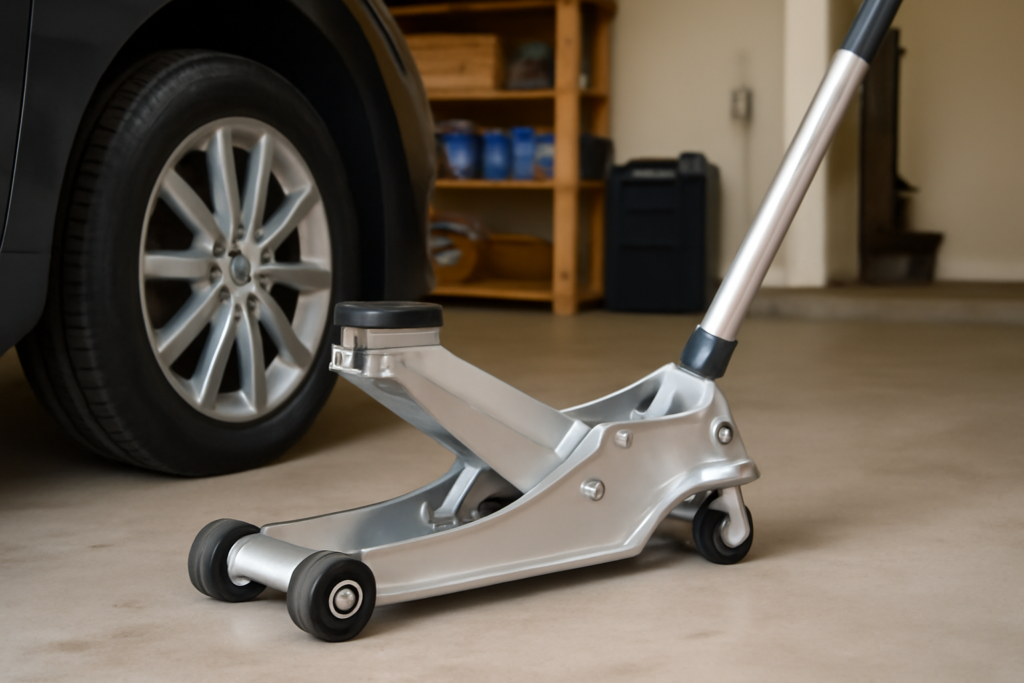
If you have ever wrestled a heavy steel jack out of a trunk, you understand why aluminum has become so popular in home garages. An aluminum floor jack delivers the same hydraulic lifting power as a traditional steel jack at a fraction of the weight, making it far easier to carry, store, and maneuver under a vehicle. For weekend mechanics and anyone who rotates their own tires, it is a genuinely useful tool.
That said, a floor jack is for lifting only, never for holding a vehicle up while you work beneath it. Understanding the features and, critically, the safety rules is what separates a smart purchase from a dangerous one.
What an Aluminum Floor Jack Is
A floor jack is a wheeled hydraulic lifting tool that rolls under a vehicle, then raises it by pumping a handle that drives a hydraulic ram. The aluminum version uses an aluminum frame and components instead of steel, dramatically reducing the overall weight while keeping the hydraulic lifting mechanism the same.
The appeal is mobility. A racing-style aluminum jack can weigh roughly half what a comparable steel jack does, which matters when you are lifting it into a trunk or rolling it across a garage floor repeatedly.
Key Features to Compare
When shopping, a few specifications determine whether a jack fits your vehicle and your needs.
- Lifting capacity: Commonly rated from 1.5 to 3 tons for passenger vehicles; choose a capacity well above your vehicle’s weight at the lifting point.
- Minimum height: How low the saddle sits matters for low-clearance cars; lower is better for sports cars.
- Maximum lift height: The highest the jack raises, which affects how much working clearance you get.
- Saddle design: A rubber pad on the saddle protects the vehicle’s frame and pinch welds.
- Lift speed: Dual-pump or rapid-lift designs reach the load faster with fewer pumps.
Aluminum Versus Steel
The choice between aluminum and steel comes down to priorities. Aluminum wins decisively on weight, which makes it the favorite for portability and for anyone who moves the jack often. Steel jacks, by contrast, are typically heavier but often cheaper for a given capacity and can be more rugged for heavy-duty or shop use.
Many enthusiasts keep an aluminum jack for trackside and trunk use and a heavier steel jack in the garage. For typical home tasks like tire rotations and brake jobs on a car, a quality 2-to-3-ton aluminum jack handles the work well.
Safety: Read This Before You Lift
A floor jack lifts a vehicle, but it must never be the only thing supporting it while you are underneath. Hydraulic jacks can fail or slowly lower, and a vehicle that drops can cause catastrophic injury. Follow these rules without exception:
- Always use jack stands. Once the vehicle is raised, place rated jack stands under proper support points and lower the vehicle onto them before doing any work.
- Never go under a vehicle supported by the jack alone. The jack is for lifting; the stands are for holding.
- Chock the wheels. Block the wheels that stay on the ground to prevent the vehicle from rolling.
- Work on firm, level ground. A solid concrete floor is ideal; never jack a car on dirt, gravel, or a slope.
- Set the parking brake when lifting the rear, and put the transmission in park or gear as appropriate.
- Lift only at the manufacturer’s designated points shown in your owner’s manual to avoid damaging the vehicle or slipping.
Confirm your jack and jack stands are rated for more than the load you are lifting, and inspect them for leaks or damage before each use.
How to Use an Aluminum Floor Jack
- Park on level concrete, set the parking brake, and chock the wheels that will stay on the ground.
- Roll the jack under the manufacturer’s designated lift point and center the saddle on it.
- Pump the handle smoothly to raise the vehicle to the needed height.
- Slide rated jack stands under the proper support points and adjust them to height.
- Slowly lower the jack until the vehicle rests securely on the stands, then remove your hands and confirm it is stable before working.
Choosing the Right Capacity and Size
Matching the jack to your vehicle is the first decision, and it starts with weight. You do not need a jack rated for your car’s full weight, since you only lift one corner or one end at a time, but you do want a comfortable safety margin. For most sedans and small SUVs, a 2-ton aluminum jack is plenty; for larger SUVs and light trucks, step up to 3 tons. Always choose more capacity than you think you need rather than cutting it close.
Clearance is the other key factor. Low sports cars need a low-profile jack whose saddle slips under the body, while trucks and lifted vehicles need a taller maximum lift height to reach useful working clearance. Check both the minimum and maximum heights against your specific vehicle. A jack that cannot fit under your car, or cannot lift it high enough to get a jack stand under it, is useless no matter how light it is.
Common Mistakes That Cause Accidents
Most jack-related injuries trace back to a few preventable errors. The deadliest is working under a vehicle held only by the jack, with no jack stands in place, so never do this under any circumstances. Lifting on soft or sloped ground is another major hazard, since the jack can sink or roll; always work on firm, level concrete. Placing the saddle on the wrong point can crush a fuel line, dent the body, or let the car slip off mid-lift.
Other mistakes include skipping the wheel chocks, overloading a jack beyond its rating, and using worn equipment with hydraulic leaks. Rushing the process or working alone on a big job adds risk. Treat every lift as a deliberate, checklist-driven procedure, and the odds of an accident drop dramatically. The jack and stands are inexpensive insurance only when you actually use them correctly every single time.
Maintenance and Storage
Keep your jack working safely with simple upkeep. Store it indoors to prevent corrosion, wipe it down after use, and periodically check the hydraulic fluid level per the manual. If the jack starts to lower under load or feels spongy, stop using it and service or replace it, since a failing seal is a safety hazard.
Lubricate the wheels and pivot points occasionally so it rolls and pivots smoothly. A well-maintained aluminum floor jack, paired with quality jack stands and disciplined safety habits, makes home auto work faster and safer for years to come.
Prefer to explore on your own?
See how new flooring looks in your actual room in seconds — free, no signup.
Try the free Floor Studio →