
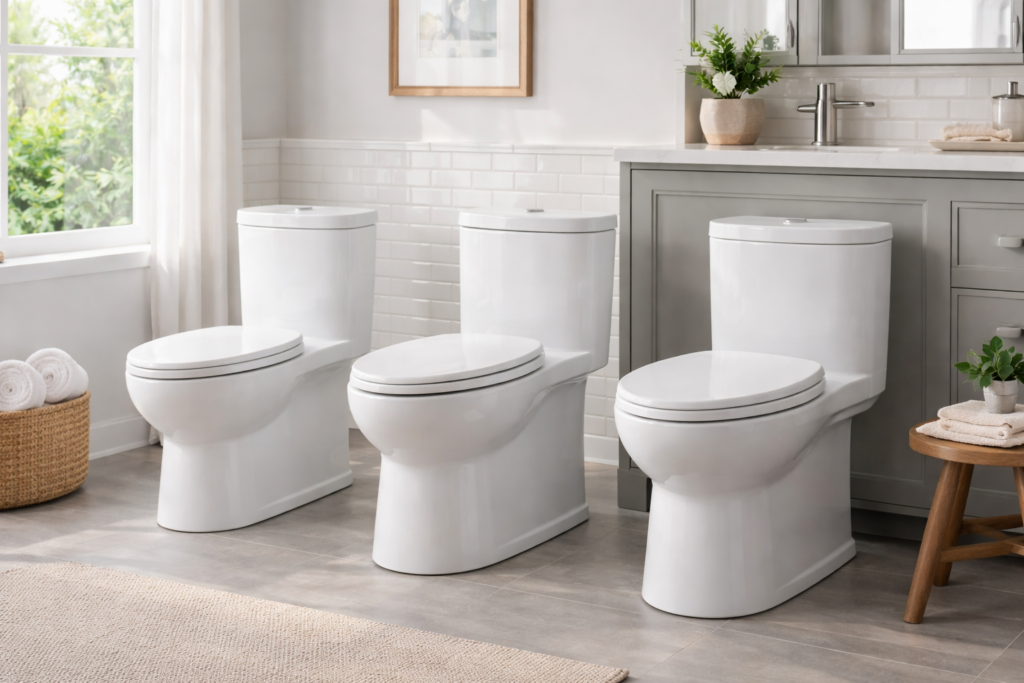
Most people shopping for an american standard skirted toilet want one thing: a bowl that wipes clean in seconds instead of a sculpted trapway full of curves that trap dust and splashes. American Standard builds that smooth-sided look into several families, most notably Studio S, Aspirations and the older Cadet 3 concealed-trapway line. Each one hides the S-shaped trapway behind a flat ceramic skirt, but they differ in flush system, bowl height, seat and how the bowl fastens to the floor.
Part of our Bathroom Remodeling & Flooring guide — explore the full guide →
The quick answer: if you want the most widely documented skirted model with full specs, start with the Studio S Skirted two-piece (model 226AA104.020), which uses 1.28 gallons per flush, fits a standard 12-inch rough-in and has a 2-inch trapway. If you want a taller, ADA-oriented bowl with a rimless-style cleaning design, look at Aspirations. If you need a budget replacement in an older bathroom, Cadet 3 concealed-trapway bowls still show up through plumbing suppliers. Model numbers and availability shift between the US and Canadian catalogs, so confirm the exact number on the current spec sheet before you order.
- American Standard Skirted Toilet Models at a Glance
- What "Skirted" and "Concealed Trapway" Really Mean
- Tools and Materials for Installation
- How Bracket Mounting Works on a Skirted Bowl
- Cleaning Pros and Day-to-Day Care
- Troubleshooting Common Problems
- Typical Cost Ranges
- When to Call a Plumber
- Frequently Asked Questions
This page lists the confirmed specs, explain how skirted bowls mount differently from traditional toilets, and cover cleaning, troubleshooting and when to bring in a plumber.
American Standard Skirted Toilet Models at a Glance
The specs in this table come from American Standard product pages (Canadian catalog) and supplier listings. Where a figure could not be confirmed, the cell says so. Always read the current spec sheet for the exact model you plan to buy, because the company refreshes seats, flush valves and finish codes over time.
| Model family | Example model no. | Key specs | Cleaning features |
|---|---|---|---|
| Studio S Skirted two-piece | 226AA104.020 | 1.28 gpf, 12 in rough-in, 2 in (50.8 mm) trapway, chair height, elongated | Skirted sides, PowerWash rim, EverClean surface, slow-close seat |
| Studio S Concealed Trapway (right-hand lever) | 226AA105.020 | 1.28 gpf, chair height, elongated; bowl 3712A100 with right-hand tank 4162A105 | Concealed trapway, slow-close seat |
| Aspirations two-piece concealed | 785AA801.020 | 1.28 gpf, 17 in bowl height with seat, described as ADA compliant | Skirted sides, CleanCurve rim, EverClean surface |
| Studio Skirted dual flush | Check spec sheet | 1.6 / 1.1 gpf dual flush, chair height | Skirted sides |
| Cadet 3 Concealed Trapway bowl | 3075000.020 | Bowl only, about 2-1/8 in glazed trapway | Smooth sides, concealed trapway |
| Studio Activate touchless | 2795119.020 (round front) | Touchless flush, concealed trapway | Listed as discontinued in the Canadian catalog |
Two practical notes jump out. First, several of these models are sold as separate tank and bowl components, so double-check that the tank you buy matches the bowl family. Second, warranty coverage is listed by part on the Studio S page: lifetime on the chinaware, 5 years on mechanical parts and 1 year on the seat. Other families may differ, so read the warranty page for your model.
What “Skirted” and “Concealed Trapway” Really Mean
Every toilet has a trapway, the curved channel that carries waste from the bowl to the drain and holds the water seal that blocks sewer gas. On a traditional toilet you can see that channel molded into the side of the base. A skirted toilet wraps the lower half in a smooth ceramic shell, so the sides run straight from the rim to the floor. A concealed trapway toilet does much the same thing, and manufacturers use the two terms almost interchangeably.
The payoff is cleaning. Instead of scrubbing around a series of bumps and recesses near the floor, you wipe one flat surface. The trade-offs are weight, a bigger footprint at the floor, and a mounting method that hides the bolts. On some American Standard models, the product page itself lists the trapway as exposed while describing the sides as skirted, which shows how loosely the language gets used. Look at the side profile photo and the dimensional drawing rather than relying on the label alone.
Tools and Materials for Installation
Whether you are swapping an old two-piece for a skirted Studio S or replacing a cracked Cadet bowl, gather these before you shut the water off:
- Adjustable wrench and a small socket set
- New wax ring or a foam/rubber wax-free seal
- New closet bolts or the bracket kit supplied with the toilet
- Braided stainless supply line sized for your shutoff valve
- Tape measure (for rough-in, wall to flange center)
- Level and plastic toilet shims
- Putty knife, rags, bucket and a large sponge
- Silicone caulk in white or clear, if your local code and floor type allow caulking the base
- Gloves and eye protection
Measure the rough-in before buying. The Studio S Skirted lists a 12-inch rough-in, which is the most common US setup. If your flange sits 10 or 14 inches from the finished wall, you will need a model built for that spacing, and a skirted bowl leaves less room to cheat the measurement than a traditional base does.
How Bracket Mounting Works on a Skirted Bowl
A traditional toilet uses two closet bolts that pass up through the base, topped with nuts and plastic caps. A skirted bowl has no exposed foot to bolt through, so it typically fastens with a bracket system: metal or plastic brackets screw to the floor or attach to the flange, and the bowl slides over them and fastens from the side with screws hidden behind small caps. American Standard calls its version on Aspirations the EasyMount installation system, designed to make bowl alignment easier, and that bowl is also built lighter for handling.
- Shut off and drain. Close the supply valve, flush, and sponge out the remaining water from tank and bowl.
- Remove the old toilet. Disconnect the supply line, remove the nuts and lift the toilet straight up. Scrape the old wax from the flange.
- Inspect the flange. It should be firmly attached, level with or slightly above the finished floor, and free of cracks. Repair or replace a damaged flange before going further.
- Dry-fit the brackets. Follow the template in the box. Mark bracket positions with the bowl centered on the flange and square to the wall.
- Fasten brackets. Screw them down into the subfloor or attach them to the flange as the instructions direct. On tile, use the recommended bit and go slowly to avoid cracking.
- Set the seal and the bowl. Place the wax ring or wax-free seal, then lower the bowl straight down over the flange and brackets. Press evenly to compress the seal.
- Secure the side screws. Drive the side fasteners into the brackets snugly, alternating sides. Over-tightening can crack vitreous china.
- Mount the tank. Install the tank bolts and gasket, tighten evenly until the tank sits level, and connect the supply line.
- Test. Turn the water on, let the tank fill, and flush several times while checking the base and supply for leaks.
- Finish. Snap on the screw caps, install the seat and caulk the base if your installation calls for it (many plumbers leave a small gap at the back so a future leak shows itself).
Read the specific installation guide for your model number. Bracket layouts differ between families, and a mistake in step 4 means lifting a heavy bowl twice.
Cleaning Pros and Day-to-Day Care
The main reason to buy an american standard skirted toilet is easier cleaning, and the company stacks several features on top of the smooth sides. The Studio S uses a PowerWash rim that sends a surge of water around the bowl on every flush, plus an EverClean surface that the company describes as resisting mold, mildew and stain-causing bacteria. Aspirations adds a CleanCurve rim intended to eliminate under-the-rim buildup and a SpinForce swirl action.
For weekly care, a standard toilet bowl cleaner and a soft-bristle brush handle the inside. Outside, a damp microfiber cloth with mild soap is enough for the skirt. Avoid abrasive powders and harsh scrubbing pads on glazed surfaces, and do not leave drop-in tank tablets with strong chemicals in the tank, since they can wear on flappers and seals over time. Check the care guide for your model, because some antimicrobial glazes come with their own cleaning recommendations.
Troubleshooting Common Problems
The bowl rocks slightly
Stop and fix it now. A rocking bowl breaks the wax seal. Check that the brackets are tight and that the floor is level. Plastic shims under the skirt can stabilize it, though they should not be visible once the base is finished.
Water shows up at the base
Leaks at the floor usually mean a failed seal or a loose flange. On a skirted bowl you cannot see the trapway connection, so pull the toilet, replace the seal and check that the flange height is correct before reinstalling.
Weak flush or double flushing
Low-flow 1.28 gpf toilets need the tank to fill to the marked water line. Adjust the fill valve float, clear mineral buildup from rim jets, and confirm the flapper or flush valve closes fully.
Constant running
A worn flapper or a fill valve set too high causes most running. Replace the flapper with the part listed for your model, since flush valves vary in size (the Studio S uses a 3-inch valve).
Typical Cost Ranges
Prices move constantly, so treat these as general ranges. A basic skirted two-piece from a mainstream maker usually runs a few hundred dollars, while premium skirted or one-piece models climb higher. Professional installation for a straight swap commonly falls in the low hundreds, more if the flange needs repair or the floor needs work. Budget extra for a new supply line, seal and seat if the toilet does not include them.
When to Call a Plumber
Swapping a toilet is a common DIY job, but bring in a licensed plumber if the flange is broken or rusted through, the subfloor feels soft, the rough-in measurement does not match any model you like, or you need to move the drain. Soft flooring around a toilet often means long-term leakage and possible rot, which is a bigger repair than the toilet itself. A plumber is also the right call if your shutoff valve will not close fully or leaks when turned.
Frequently Asked Questions
Is a skirted toilet harder to install?
A little. The bracket system adds a few steps, and the smooth base hides the seal, so careful alignment matters. Most handy homeowners manage it with the instructions and a helper for lifting.
Which American Standard skirted model fits a 12 inch rough-in?
The Studio S Skirted two-piece (226AA104.020) lists a 12-inch rough-in. Check each model’s spec sheet, because rough-in is not always published on every product page.
Are skirted toilets better for cleaning?
Yes, that is the main benefit. Flat sides mean fewer crevices for dust and splashes, so a quick wipe replaces scrubbing around the trapway curves.
Is the Studio S toilet ADA compliant?
The Studio S is a chair-height bowl, but its product page does not state ADA compliance. Aspirations is described on its page as ADA compliant with a 17-inch height including seat.
Can I replace just the bowl or tank?
Often yes, since several models are sold as components. Match the part numbers on the spec sheet so the tank and bowl fit together and flush correctly.


