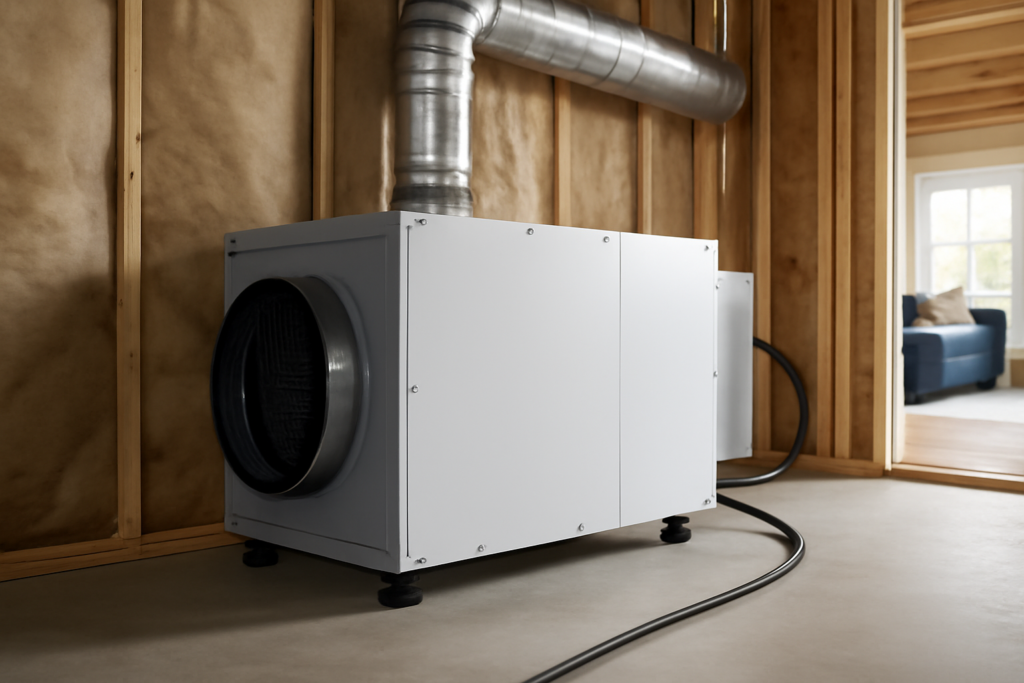
An Aprilaire whole house dehumidifier pulls moisture from the entire home at once, tying into your HVAC system rather than sitting in one room like a portable unit. Sized in pints of water removed per day and controlled by a humidistat, an Aprilaire whole house dehumidifier keeps the whole house at a set humidity, which protects finishes, deters mold, and makes summer air feel cooler at a higher thermostat setting. This guide covers models, integration, and installation.
- Why a Whole-House Unit Beats a Portable
- Aprilaire Models by Capacity
- How It Integrates With Your HVAC
- The Condensate Drain
- Electrical Requirements
- Why Professional Installation Matters
- Typical Costs
- Benefits You’ll Notice
- How to Size the Unit Correctly
- Aprilaire vs Portable Dehumidifiers
- Energy Use and Running Cost
- Maintenance
- Bottom Line
Why a Whole-House Unit Beats a Portable
Portable dehumidifiers work in one space, need manual emptying, and run loudly in your living area. A whole-house Aprilaire unit installs out of the way, usually in the basement or a mechanical room, drains automatically, and conditions every room through the ductwork. It also integrates with the furnace or air handler so it can circulate dry air throughout the home even when the AC isn’t running. For homes with damp basements, humid summers, or persistent musty smells, the whole-house approach solves the problem at the source.
Aprilaire Models by Capacity
Aprilaire sizes its dehumidifiers by pints of moisture removed per day, so you match the unit to your home’s size and moisture load:
- Aprilaire E070 / 1820 — about 70 pints/day: for smaller homes or a single problem area like a basement up to roughly 2,500 square feet.
- Aprilaire E080 / 1830 — about 80 pints/day: a mid-capacity workhorse for average homes.
- Aprilaire E100 / 1850 — about 100 pints/day: for larger homes up to roughly 4,400 to 5,500 square feet or high-moisture conditions.
- Aprilaire E130 / 1870 — about 130 pints/day: the largest, for big homes, very humid climates, or crawlspace-plus-house duty.
Oversizing slightly is generally fine and lets the unit reach the setpoint faster and cycle less. Undersizing leaves the home damp on the worst days.
How It Integrates With Your HVAC
This is what separates a whole-house Aprilaire unit from a plug-in box, and why it’s a professional installation. Integration options:
- Ducted to the return: the dehumidifier connects to the HVAC ductwork, typically pulling from and returning to the return-air duct, so dry air distributes through the whole home. This is the most common and most effective setup.
- Dedicated supply duct: the unit sends dried air to a specific area, useful for targeting a basement.
- Free-standing with ducting: installed in a basement drawing and discharging locally, still ducted rather than portable.
The unit ties into the air handler so its fan can move conditioned air. A control or humidistat, wall-mounted or on the equipment, sets the target humidity, usually 45 to 50 percent, and the dehumidifier runs to maintain it.
The Condensate Drain
Because the unit removes many pints of water daily, it must drain continuously, not into a tank you empty. Installation includes routing a condensate drain line to a floor drain, a condensate pump, or the HVAC condensate system. A proper trap and slope keep it flowing, and in freezing locations the line must stay protected. Getting the drain right is essential; a clogged or poorly pitched condensate line is a common failure point that can cause water to back up.
Electrical Requirements
A whole-house dehumidifier draws real power and typically needs a dedicated circuit. Most Aprilaire units run on 120 volts but should be on their own breaker rather than sharing a circuit with other equipment, and the installer wires it to code. This, combined with the ductwork and condensate work, is why professional installation is the norm rather than a DIY project. An electrician or HVAC installer handles the circuit, the duct connections, and the control wiring together.
Why Professional Installation Matters
Unlike a portable you unbox and plug in, an Aprilaire whole-house dehumidifier requires cutting into ductwork, running a condensate drain with proper slope and trap, and wiring a dedicated electrical circuit, plus setting up the humidistat control. Each of these done wrong causes problems: poor duct connections waste capacity, a bad drain floods, and improper wiring is a hazard. An HVAC professional sizes the unit to your home’s load, integrates it with the existing system, and commissions the controls. Budget for that expertise.
Typical Costs
- Unit only: roughly $1,000 to $2,200 depending on capacity, with the 70-pint models cheaper and the 130-pint models at the top.
- Professional installation: commonly $700 to $1,800 for ductwork, condensate drain, dedicated circuit, and control setup.
- Total installed: often $1,700 to $4,000 depending on complexity and how the unit ties into existing HVAC.
Benefits You’ll Notice
- Comfort at a higher thermostat: dry air feels cooler, so you can set the AC a few degrees warmer and still feel comfortable, saving on cooling.
- Mold and musty-odor control: holding humidity near 50 percent deters mold and dust mites.
- Protected finishes: stable humidity guards hardwood floors, doors, and furniture from swelling and cupping.
- Automatic, quiet operation: it runs unattended in the mechanical room, drains itself, and needs only occasional filter cleaning.
How to Size the Unit Correctly
Sizing by pints per day depends on more than square footage. Factor in your climate and how wet the space is:
- Moderately damp homes in average climates can use a 70 to 80 pint unit for typical square footage.
- Very humid climates like the Gulf Coast or Southeast push you up a size, since the unit runs harder for longer.
- Basements and crawlspaces add moisture load, so a home with a damp basement often needs 100 pints or more.
- Tight, well-sealed new homes trap moisture from daily living and can need active dehumidification even in mild climates.
An HVAC contractor calculates the latent load to size the unit, but as a rule it is better to size slightly up than down. An undersized unit runs constantly and never reaches the setpoint on the worst days, while a right- or slightly-oversized unit hits the target humidity and cycles off, using less energy overall.
Aprilaire vs Portable Dehumidifiers
A portable dehumidifier costs $200 to $400 and works for a single damp room, but it has real limits: you empty the tank by hand or run a hose, it runs loudly in your living space, and it only conditions the room it sits in. An Aprilaire whole-house unit costs far more installed but conditions every room through the ductwork, drains automatically, runs quietly in the mechanical room, and integrates with the humidistat so the whole home stays at one setpoint. For a single problem room, a portable is fine. For a whole-house humidity problem, damp basement, or a home where comfort and mold prevention matter throughout, the whole-house unit is the durable answer.
Energy Use and Running Cost
A whole-house dehumidifier draws power whenever it runs, but Aprilaire’s larger units are engineered to remove more water per kilowatt-hour than portables, so they are efficient for the moisture they pull. Because dry air feels cooler, you can raise the thermostat a few degrees in summer and still feel comfortable, which offsets much of the dehumidifier’s energy use through lower cooling costs. Running cost depends on your climate and how many hours it operates, but in a humid summer the comfort gain at a higher thermostat setting often makes the trade close to a wash while delivering far better air.
Maintenance
Whole-house dehumidifiers are low-maintenance but not no-maintenance. Clean or replace the air filter per the manual, usually a few times a year, check that the condensate drain runs freely, and confirm the humidistat holds your setpoint. Annual HVAC service is a good time to inspect the unit and drain.
Bottom Line
An Aprilaire whole house dehumidifier is the right upgrade for homes fighting summer humidity, damp basements, or musty air, because it conditions the whole house automatically through the HVAC system. Size it by pints per day to your square footage, expect ductwork integration, a continuous condensate drain, and a dedicated circuit, and plan on professional installation. All in, budget roughly $1,700 to $4,000, and you gain comfort, mold protection, and cooling savings that a portable unit can’t match.