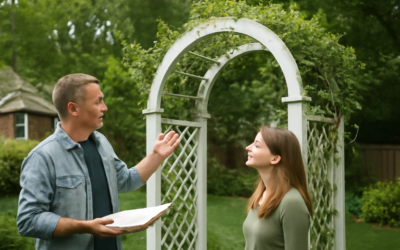
Walk through any well-designed garden and you will likely pass under one without even knowing its proper name. Understanding arbor meaning goes beyond vocabulary — it opens up design possibilities for your yard that add vertical interest, define spaces, and support climbing plants for a fraction of what a full pergola costs. An arbor is a freestanding garden structure that forms an archway or tunnel, typically covered with climbing vegetation, and it has been a staple of landscape design since ancient Roman gardens.
What Exactly Is an Arbor
An arbor is an upright garden structure consisting of two or more vertical posts connected by an overhead framework of beams, lattice, or arched crosspieces. Most arbors are narrow — typically 3-5 feet wide and 7-8 feet tall — designed for people to walk through rather than sit under. The overhead structure provides a framework for climbing plants like roses, wisteria, clematis, or grapevines to grow across.
The word arbor comes from the Latin “arbor” meaning tree, reflecting the original concept of a shaded walkway created by trained trees. In modern landscaping, arbors serve as garden entryways, path markers, focal points, and transitions between different outdoor areas.
Arbor vs Pergola vs Trellis
These three structures get confused constantly, but they serve different purposes. Knowing the distinctions helps you choose the right one for your project and communicate clearly with contractors.
- Arbor: Narrow archway structure, typically freestanding, designed as a walkthrough. Usually 3-5 feet wide. Cost: $150-$3,000
- Pergola: Larger, flat-topped structure designed to create a shaded seating or dining area. Usually 10-20 feet wide and often attached to the house. Cost: $2,000-$15,000
- Trellis: A flat, two-dimensional lattice panel used to support climbing plants against a wall or fence. Cost: $20-$300
Think of it this way: you walk through an arbor, sit under a pergola, and lean a trellis against something. An arbor is the middle ground — more architectural than a trellis, more affordable and compact than a pergola.
Common Arbor Materials
The material you choose affects durability, maintenance requirements, and cost. Cedar and pressure-treated pine are the most popular options for residential arbors.
Cedar naturally resists rot and insects without chemical treatment. It weathers to a silvery gray if left untreated or can be stained to maintain its warm, reddish tone. A cedar arbor kit costs $200-$800, and the material lasts 15-20 years outdoors. Cedar is lightweight, making it the easiest wood to work with for DIY installations.
Pressure-treated pine costs 30-40% less than cedar and lasts 20-25 years with the chemical preservatives. The trade-off is a green tint when new (it fades over time) and the need to wait 6-12 months before staining. Expect to pay $100-$500 for a pressure-treated arbor kit.
Vinyl arbors require zero maintenance and never rot, but they look distinctly synthetic. They work well in formal, manicured gardens where a crisp white finish fits the aesthetic. Prices range from $150-$600 for standard designs.
Wrought iron and steel create elegant, ornate arbors that complement cottage and traditional garden styles. Metal arbors cost $100-$1,500 depending on the complexity of the design. They require periodic rust treatment or powder coating to maintain appearance in humid climates.
Where to Place an Arbor
Placement makes or breaks an arbor’s visual impact. The most effective locations create a sense of passage or transition — a threshold between one space and another.
Garden entrances are the classic choice. Position the arbor at the start of a garden path, flanked by plantings, and it immediately signals that you are entering a designed space. Fence gates are another natural fit — an arbor over a gate adds height and formality to an otherwise utilitarian opening.
Along pathways, a series of arbors creates a dramatic tunnel effect, especially when covered with flowering vines. Even a single arbor midway along a path breaks up a long walkway and creates visual interest. Near seating areas, an arbor with a bench beneath it becomes a shaded retreat without the expense and footprint of a pergola.
Best Climbing Plants for Arbors
The right plant transforms a bare structure into a living feature. Choose based on your climate zone, sun exposure, and how quickly you want coverage.
- Climbing roses: Classic choice, blooms spring through fall in zones 5-9. Requires annual pruning and pest management
- Clematis: Produces stunning flowers in purple, pink, white, and red. Grows quickly in zones 4-9 and prefers roots in shade with foliage in sun
- Wisteria: Dramatic cascading blooms but aggressive grower — needs a sturdy arbor and regular pruning. Zones 5-9
- Jasmine: Fragrant white flowers and evergreen foliage in zones 7-10. Star jasmine is the most popular variety for arbors
- Trumpet vine: Fast-growing, attracts hummingbirds, thrives with neglect in zones 4-9. Can become invasive if not managed
DIY Arbor Installation
A basic arbor is a manageable weekend project for homeowners with moderate DIY skills. Most prefabricated arbor kits include all necessary hardware and can be assembled in 2-4 hours with a helper.
The critical step is anchoring. A free-standing arbor must be secured to the ground to resist wind. For soil installation, set the posts in 18-24 inch deep holes with concrete footings. For patio or hardscape installation, use post-mount brackets bolted into concrete with appropriate anchors. Never simply push arbor legs into loose soil — the first strong wind will topple it.
If you are building from scratch rather than using a kit, use 4×4 posts at minimum for the verticals and 2×4 or 2×6 lumber for the overhead beams. Space the posts 36-48 inches apart for a standard walkthrough width. The overall height should be at least 7 feet at the lowest point of any arch to allow comfortable passage.
Arbor Costs and ROI
Budget arbors start under $100 for a simple metal arch, while high-end custom cedar or hardwood arbors with integrated benches and planters can run $2,000-$5,000 professionally installed. The sweet spot for most homeowners is a $300-$800 cedar or vinyl kit that provides good looks, durability, and straightforward assembly.
From a home value perspective, well-placed garden structures like arbors contribute to curb appeal and landscaping value. While you will not recoup the cost dollar-for-dollar at resale, a mature arbor covered in flowering vines creates the kind of first impression that helps a home sell faster. Real estate agents consistently list landscaping among the top five factors influencing buyer perception, and an arbor is one of the most cost-effective ways to elevate a garden’s visual appeal.