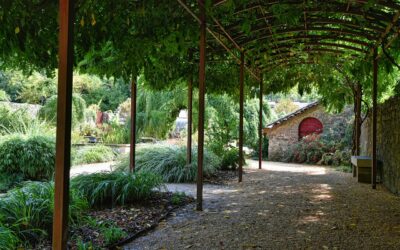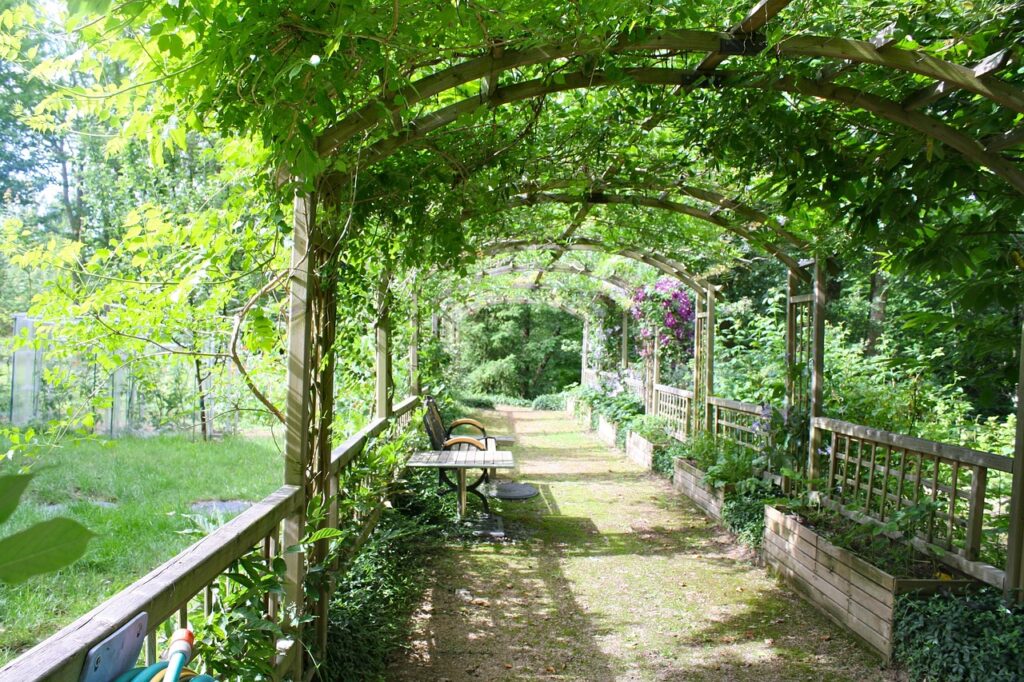
Most homeowners use the words arbor, pergola, trellis, and gazebo interchangeably — but in landscape architecture they describe distinct structures with different functions. To define arbor precisely: an arbor is a small, freestanding garden structure, usually arched at the top, designed to frame a walkway, pathway, or entry with climbing plants. It is narrower than a pergola, almost always open-sided, and meant to be passed through rather than lingered under. A well-placed arbor turns an ordinary gate or garden path into a destination, and most can be installed in a weekend for $200-$800.
- Arbor vs Pergola vs Trellis vs Gazebo
- Traditional Arbor Styles
- Common Materials and Lifespan
- Define Arbor Function in the Landscape
- Picking the Right Location
- Best Climbing Plants for an Arbor
- DIY Arbor Plans and Costs
- Prefab Arbors Worth Considering
- Maintenance and Longevity
- When to Build Something Bigger
Arbor vs Pergola vs Trellis vs Gazebo
The confusion between these terms comes down to size, function, and coverage.
- Arbor: Narrow (3-5 feet wide), arched or flat top, designed to be walked through; usually supports climbing plants
- Pergola: Large freestanding structure (8-20 feet across), flat open roof of rafters, designed for lounging beneath
- Trellis: Flat panel or lattice attached to a wall or freestanding; purely a plant support, not an architectural passage
- Gazebo: Fully enclosed roof (often octagonal), solid flooring, designed as a weather shelter
An arbor is the smallest and simplest of the four. You walk under it; you do not sit under it for extended periods.
Traditional Arbor Styles
The arched arbor is the classic English cottage form — a Gothic or Romanesque arch covered in climbing roses. A pitched-roof arbor has two sloping sides meeting at a peak, common in Craftsman and New England garden styles. A flat-top arbor (sometimes called a gateway arbor) is rectangular and simpler to build, often in Japanese or modern landscape designs. Moon gate arbors, with a fully circular opening, originate in Chinese garden tradition and have become popular in Zen-inspired American landscapes.
Common Materials and Lifespan
Pressure-treated pine is the budget choice. Expect 12-20 years of service life with annual staining. Western red cedar holds up longer (20-30 years) without chemical treatment and develops a silver patina if left unfinished. White oak and black locust last 30-50 years untreated but cost three to four times more than pine.
Vinyl arbors ($180-$500 from Home Depot and Lowe’s) need no maintenance but look plastic under scrutiny. Metal arbors in wrought iron or powder-coated steel ($200-$800) deliver a formal garden aesthetic and last 25+ years; look for rust-resistant galvanized or aluminum construction for wet climates.
Define Arbor Function in the Landscape
Arbors serve three main purposes. First, they mark transitions — the shift from front yard to backyard, from lawn to garden, from driveway to entry walk. An arbor placed at the edge of a lawn signals to the eye that the space beyond is different. Second, they support climbing plants that need vertical structure: roses, clematis, wisteria, grapes, and jasmine. Third, they frame views — walking through an arbor toward a fountain, a bench, or a distant tree turns the destination into a picture within a frame.
Picking the Right Location
The ideal arbor spot meets three criteria: it sits along a natural walking path, it has an existing destination on the other side, and the approach offers at least 20-30 feet of sight line to build anticipation. An arbor in the middle of a featureless lawn reads as random. An arbor where a gravel path enters a vegetable garden, rose bed, or patio anchors the whole scene.
Check sun exposure. Roses and clematis need 6+ hours of direct sun daily. Wisteria tolerates part shade but blooms most in full sun. Jasmine and climbing hydrangea succeed in partial shade.
Best Climbing Plants for an Arbor
- Climbing roses: ‘New Dawn,’ ‘Zephirine Drouhin,’ ‘Eden’ — all reach 10-12 feet
- Clematis: Pair with roses or on its own; hundreds of varieties in zones 4-9
- Wisteria: Spectacular but strong enough to crush a weak arbor over 15-20 years — build heavy
- Climbing hydrangea: White lacecap flowers, tolerates shade, slow but eventually vigorous
- Trumpet vine: Fast-growing native, hummingbirds love it, but invasive in some regions
- Jasmine (Jasminum officinale): Fragrant white flowers, zones 7-10
- Grape vines: Decorative and edible; pick disease-resistant hybrids for your zone
DIY Arbor Plans and Costs
A simple 4-foot-wide wooden arbor with an arched top costs $150-$300 in materials from a home center. Build plans are free online from sites like Family Handyman and Ana White. Basic material list for an 8-foot-tall cedar arbor: two 4x4x10 cedar posts (legs), two 2x6x6 cedar (top arches, cut with a jigsaw), two 2x4x6 cedar (top rails), one 4×8 sheet of 3/4-inch cedar lattice (cut into two side panels), 1/2-inch galvanized lag screws, post hole concrete, and stain or sealer.
Work time runs 8-12 hours for a DIY builder with basic tools. Dig post holes 36 inches deep, set posts in concrete, let cure 24-48 hours before attaching the top. Paint or stain all surfaces before assembly — much easier to reach every face with a brush when pieces are flat.
Prefab Arbors Worth Considering
If DIY is not in the plan, prefab arbor kits from Dura-Trel, New England Arbors, and Arboria arrive flat-packed with hardware. Installation runs 2-4 hours with basic tools. Mid-range cedar kits run $300-$600. High-end vinyl kits from Dura-Trel hold up 25-30 years without painting and cost $400-$900. Metal arbors from Achla Designs and H Potter range $150-$600.
Maintenance and Longevity
Inspect wood arbors annually for rot at the ground line — the first 6 inches of each leg sees the most moisture damage. Tap with a screwdriver; if it sinks in easily, the post needs replacement. Re-stain every 2-3 years with a penetrating oil-based stain. Trim climbing plants hard each winter to prevent them from overwhelming the structure. Wisteria especially needs twice-yearly pruning (July and January) or it can collapse an undersized arbor within a decade.
When to Build Something Bigger
If you want shaded seating, a grill shelter, or a spot to hang a hammock, an arbor is too small. Look at pergolas (for lounging), pavilions (for dining), or full gazebos (for enclosed outdoor rooms). Use an arbor purely as a passage and plant support. Trying to define arbor as a multi-purpose structure loses the scale and intimacy that make the form work in the first place.