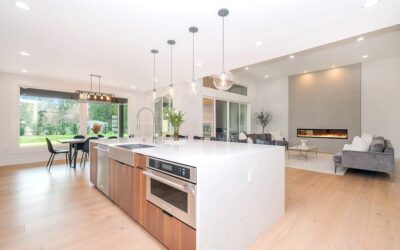
Bright white kitchens have dominated for over a decade, and engineered stone is how most homeowners get that clean look without the headaches of marble. Arctic quartz is the name several manufacturers use for their crisp, cool-white slabs with faint gray or translucent veining, and it has become one of the most requested colors in the countertop world. If you want the airy brightness of Carrara marble but need a surface that shrugs off wine, lemon juice, and a busy family, this style of quartz deserves a hard look.
Part of our Countertops guide — explore the full guide →
What Arctic Quartz Actually Is
Quartz countertops are engineered, not quarried. Manufacturers grind natural quartz crystals, blend them with roughly 7 to 10 percent resin and pigment, and press the mixture under heat and pressure into a dense, nonporous slab. The finished product is about 90 to 93 percent natural stone by weight, which gives it the hardness of quartz with the consistency of a manufactured material.
“Arctic” is a color designation rather than a single brand. You’ll find Arctic White, Arctic Gray, and similar names across lines from MSI, Silestone, and various importers. The common thread is a bright white base, sometimes with a faint blue-gray undertone that reads cooler than the creamy whites, occasionally accented with wispy veins or a light sparkle.
Why Homeowners Love It
The number one reason is maintenance. Because quartz is nonporous, arctic quartz never needs sealing, resists staining from coffee and red wine, and won’t etch from acidic foods the way real marble does. Wipe it with mild soap and water and it stays bright.
The second reason is consistency. Natural stone varies wildly slab to slab, so matching pieces for a big island is a gamble. Engineered white quartz repeats its pattern predictably, so what you see in the showroom sample is close to what lands in your kitchen. For anyone who wants a reliable, uniform white without surprises, that predictability is worth a lot.
Pros and Cons at a Glance
- Pros: nonporous and stain-resistant, no sealing required, hard and scratch-resistant, consistent color, bright and versatile, comes with strong manufacturer warranties (often 10 to 25 years or lifetime).
- Cons: not heat-proof (always use trivets above about 300°F), can scorch or yellow from prolonged UV in a sunroom, shows a slightly more uniform look than natural stone purists prefer, and premium white lines cost as much as low-end natural stone.
What It Costs
Installed, arctic quartz typically runs $50 to $100 per square foot including fabrication and standard edge profiles. A mid-size kitchen with 40 square feet of counter lands somewhere between $2,500 and $4,500 for most projects. Thicker 3cm slabs, waterfall edges, and intricate profiles push the price up.
Budget for extras: sink cutouts, faucet holes, and a full-height backsplash all add labor. Get a detailed quote that spells out slab cost, fabrication, edge profile, cutouts, and installation so you can compare fabricators fairly. The cheapest bid often skimps on seam quality, which is exactly where a bright white counter shows flaws.
Design and Pairing
Cool white quartz is a chameleon. Against navy or forest-green shaker cabinets it pops with contrast; against white cabinets it creates a seamless, gallery-clean kitchen. Warm wood tones and brass hardware soften the coolness, while black faucets and matte-black pulls lean modern and graphic.
For the backsplash, a simple white subway tile keeps things timeless, or run the quartz up the wall as a slab backsplash for a high-end, grout-free finish. Because the white is on the cooler side, pair it with warm lighting (2700K to 3000K bulbs) so the counters don’t read stark or blue at night.
Caring for Your Counters
Day-to-day care could not be simpler. Wipe with a soft cloth, warm water, and a little dish soap. Skip abrasive scrubbing pads and harsh cleaners like bleach, oven cleaner, or high-pH degreasers, which can dull the resin over time. For dried-on messes, let a damp cloth sit to soften the spot rather than scraping.
The one habit to build is heat protection. Quartz resins soften and can discolor or crack from thermal shock when a hot pan lands directly on the surface. Keep a couple of trivets by the stove and never set a pot straight from the burner onto the counter. Also wipe up standing water around the sink on a cool-white surface, since mineral deposits can leave faint rings that stand out on bright quartz.
Is Arctic Quartz Right for You
If you want the light, marble-inspired kitchen look with almost no upkeep, arctic quartz is one of the smartest choices on the market. It suits busy families, cooks who cut and spill, and anyone who does not want to seal a counter twice a year. If you crave the deep, one-of-a-kind movement of natural marble and don’t mind babying it, a natural stone may satisfy you more.
Before you sign, view a full slab in person rather than a two-inch chip. Whites vary in undertone, and seeing the actual slab under your lighting confirms the shade works with your cabinets and floor. Confirm the warranty, ask who fabricates and installs, and request that seams fall in low-visibility spots. Do that homework and arctic quartz will reward you with a bright, durable kitchen surface for decades.
Choosing the Right Edge and Thickness
Two fabrication choices shape both the look and the price. Slab thickness comes in 2cm and 3cm; the 3cm option feels more substantial, needs no plywood support at overhangs, and is the standard most kitchens choose, while 2cm saves money and suits a laminated edge that mimics a thicker profile. Edge profile is where you set the style. A simple eased or square edge reads modern and clean, a beveled edge is a classic middle ground, and an ogee or bullnose leans traditional. On a bright white, a crisp square edge keeps the look contemporary and shows off the slab’s flatness.
Ask the fabricator to dry-fit or template digitally before cutting, especially around the sink and cooktop. A good template catches wall irregularities so the finished counter sits tight to the backsplash without gaps a caulk line has to hide.
Arctic Quartz vs. Other White Surfaces
It’s worth knowing how it stacks up against the alternatives. Against marble, arctic quartz wins on maintenance hands down, since marble etches and stains while quartz shrugs both off. Against solid-surface materials like Corian, quartz is far harder and more scratch-resistant, though solid surface offers seamless, renewable joints. Against porcelain slab, quartz is thicker and warmer to the touch but slightly less heat-tolerant. For most homeowners who want a bright white counter that looks high-end and asks almost nothing in return, quartz remains the most practical pick, and the arctic tones give you that gallery-white look without the babying real marble demands. Weigh how you actually use your kitchen, how much maintenance you’re willing to do, and how bright you want the room to feel, and in most cases the answer points straight back to a durable, low-care white quartz that stays looking new for the long haul.