If you’ve scrolled through a hundred bright-white kitchen remodels, chances are you’ve seen this slab without knowing its name. Arctic White MSI quartz is one of the most popular engineered stone countertops in America, prized for its crisp, uniform white with just enough fine texture to avoid looking flat or sterile. It delivers the clean, airy look of white marble without the staining, etching, or sealing. Here’s what to know before you put it in your kitchen.
Part of our Countertops guide — explore the full guide →
What Arctic White Looks Like
Arctic White, part of MSI’s Q Premium Natural Quartz line, is a bright, consistent white with a subtle fine-grained texture running through it. Unlike bold, veined quartzes that imitate Calacatta or Carrara marble, Arctic White reads as a clean solid white with delicate speckling that gives it depth up close. From across the room it looks like a smooth, pure white surface; up close you notice the soft granular movement that keeps it from feeling like plain laminate.
That neutrality is its superpower. It works in nearly any style, modern, farmhouse, transitional, coastal, and pairs with any cabinet color, from crisp white shaker to deep navy or natural wood. It’s the definition of a safe, timeless choice.
It helps to know where Arctic White fits in MSI’s lineup. MSI is one of the largest quartz distributors in North America, and their Q Premium Natural Quartz collection spans everything from bold, heavily veined marble imitations to quiet solid colors. Arctic White sits firmly in the understated camp, a clean, near-solid white with fine speckling rather than dramatic movement. That positioning is deliberate: it’s designed to be a versatile workhorse counter that lets other elements, your backsplash, cabinet color, or hardware, carry the design, rather than demanding attention itself. If you want your countertop to be a calm, bright backdrop instead of the star of the show, this is exactly the kind of surface that delivers.
Why Choose Arctic White Quartz
- Bright and versatile: Reflects light to make kitchens feel larger and cleaner; matches any color scheme.
- Non-porous: Engineered quartz never needs sealing and won’t absorb wine, oil, or coffee like natural stone.
- Stain and scratch resistant: Stands up to daily kitchen use far better than marble.
- Consistent pattern: Unlike natural stone, slabs match closely, so seams and multiple slabs blend predictably.
- Low maintenance: Clean with mild soap and water, no special products or resealing schedule.
- The marble look, minus the fragility: Gets you the bright white aesthetic without etching from acids.
The Drawbacks to Know
Quartz isn’t flawless. It’s engineered from roughly 90 percent ground quartz and 10 percent resin, and that resin binder is sensitive to heat, a hot pot straight off the burner can scorch or discolor the surface, so always use trivets. It also can’t handle prolonged direct sunlight in some installations without risking slight discoloration over years, making it better indoors than on a sun-drenched outdoor island.
A pure, bright white also shows crumbs, coffee rings, and smudges more readily than a busy patterned stone, so it needs a quick daily wipe to stay pristine. And while durable, a sharp impact on an edge can chip it, though chips are repairable.
What It Costs
Arctic White sits in the mid-range of MSI’s quartz pricing. Expect these figures installed:
- Material only: roughly $40 to $70 per square foot.
- Installed (fabrication plus install): $55 to $100 per square foot.
- Typical kitchen (40 to 55 square feet): around $2,500 to $5,500 installed.
Final pricing depends on edge profile, number of seams, cutouts for sinks and cooktops, and your local fabricator’s rates. Get quotes from multiple certified MSI fabricators, prices vary widely by region and shop.
Arctic White vs. Similar Options
Vs. Natural Marble
Marble gives you genuine veining and prestige but stains and etches from lemon juice, wine, and vinegar, and needs regular sealing. Arctic White delivers a similar bright-white look with none of that maintenance, at a comparable or lower price. For a busy kitchen, quartz is the practical winner.
Vs. Other White Quartzes
Compared to veined quartzes like MSI Calacatta Laza or Miraggio, Arctic White is more uniform and understated. Choose Arctic White if you want a clean, solid look; choose a veined option if you want dramatic marble-style movement. Arctic White is also typically less expensive than the premium veined patterns.
Design Ideas
Arctic White is a blank canvas, so let the surrounding elements do the talking:
- Pair with navy, forest green, or black cabinets for a high-contrast modern kitchen.
- Combine with white or light-gray cabinets and brass hardware for a bright, airy, coastal feel.
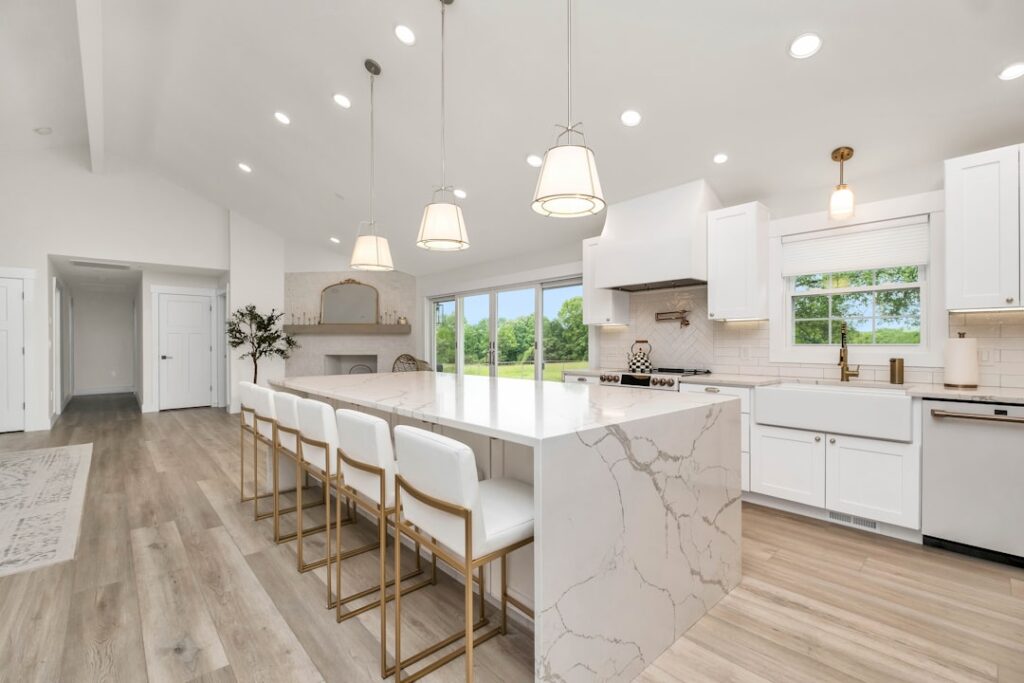
- Use a waterfall edge on an island to showcase the clean white surface.
- Add a bold patterned backsplash, the neutral counter keeps it from feeling busy.
- Choose a matte or leathered finish instead of polished for a softer, more contemporary look.
Care and Maintenance
Keeping Arctic White looking new is easy: wipe daily with mild dish soap and warm water, and dry with a soft cloth to prevent water spots. Avoid abrasive scrubbers and harsh chemicals like bleach or high-alkaline cleaners, which can dull the finish over time. Always use trivets for hot cookware and cutting boards to protect against the rare deep scratch. Do that, and the surface stays bright for decades, no sealing required.
Choosing the Right Edge Profile
The edge profile you pick subtly changes how Arctic White reads, and it affects cost. A simple eased or straight edge keeps the look clean and modern and is usually included in the base price. A beveled or chamfered edge adds a crisp, contemporary line. Traditional profiles like bullnose, ogee, and dupont bring a softer or more ornate feel but add $10 to $25 per linear foot in fabrication. For a bright, minimalist white kitchen, a straight or eased edge, or a dramatic mitered waterfall on the island, tends to suit the clean aesthetic best. Discuss the options with your fabricator and ask to see samples, the profile is easy to overlook until the counter is installed.
Finish Options: Polished, Honed, and Leathered
Arctic White comes most often in a polished finish, which is glossy, reflective, and maximizes the bright, light-enhancing quality that makes the color popular. But two alternatives are worth considering. A honed (matte) finish gives a soft, contemporary, low-sheen look that hides fingerprints and water spots better, ideal if the crisp white showing every smudge concerns you. A leathered finish adds a subtle textured surface that masks marks even more while keeping a modern edge. Availability of honed and leathered varies by fabricator and may cost slightly more, so confirm before you commit. The finish changes the personality of the counter as much as the edge does.
Is It Right for Your Kitchen?
Before you buy, always view a full slab, not just a small sample chip, at your fabricator’s yard. Quartz colors and the density of the speckling can look different across a large surface than on a two-inch sample, and lighting in your kitchen will shift the perceived tone. Bring a cabinet door and a backsplash sample with you to check the pairing in person. Confirm the slab thickness you’re getting, 2 centimeters versus 3 centimeters changes both the look of the edge and the price, and ask how many slabs your kitchen requires so any seams can be planned in the least conspicuous spots.
Arctic White MSI quartz is an excellent choice if you want a bright, clean, timeless countertop that pairs with anything and demands almost no upkeep. It gives you the coveted white-marble aesthetic without the staining and sealing headaches, at a reasonable mid-range price. Just commit to daily wipe-downs to keep the crisp white spotless, and always protect it from direct high heat. For most homeowners chasing a fresh, light kitchen, it’s one of the safest and most versatile picks on the market.