Turf on a balcony looks great until rainwater gets trapped underneath and starts staining the concrete or rotting the deck boards. Choosing artificial grass for balcony floors is mostly about drainage, weight and a clean fit around railings, not just picking the greenest blade. Get those right and a small outdoor space becomes a soft, cool place to sit that never needs mowing.
The short version: buy turf with a fully perforated backing, keep the balcony’s existing slope and drains clear, use a loose-lay or tape-only install that you can remove, and trim carefully around posts. Renters can do the whole job without a drop of glue, and most balconies take an afternoon.
- Is Artificial Grass for Balcony Floors a Good Idea?
- Drainage: The Most Important Part
- Weight and Balcony Load Limits
- Turf on Concrete Versus Astro Turf on Decking
- Tools and Materials
- Step-by-Step Balcony Turf Installation
- Renter-Friendly No-Glue Installs
- Cleaning and Maintenance
- Troubleshooting
- Cost Ranges
- When to Call a Professional
- Frequently Asked Questions
Is Artificial Grass for Balcony Floors a Good Idea?
For most concrete and deck balconies, yes. Turf softens a hard surface, hides stained or patched concrete and stays cooler underfoot than bare tile in afternoon shade. Pets and kids like it, and it does not need watering. The drawbacks are real, though: synthetic blades can get hot in direct sun, it traps leaves and dust, and a poorly drained install holds water against the surface underneath.
Check two things before you buy. First, read your lease, condo rules or HOA covenants; many buildings allow balcony turf as long as it is removable and does not block drains. Second, look at the balcony itself. If it already has cracks, rust stains near railing posts or soft deck boards, fix those first. Covering damage with turf only hides it until it gets worse.
Drainage: The Most Important Part
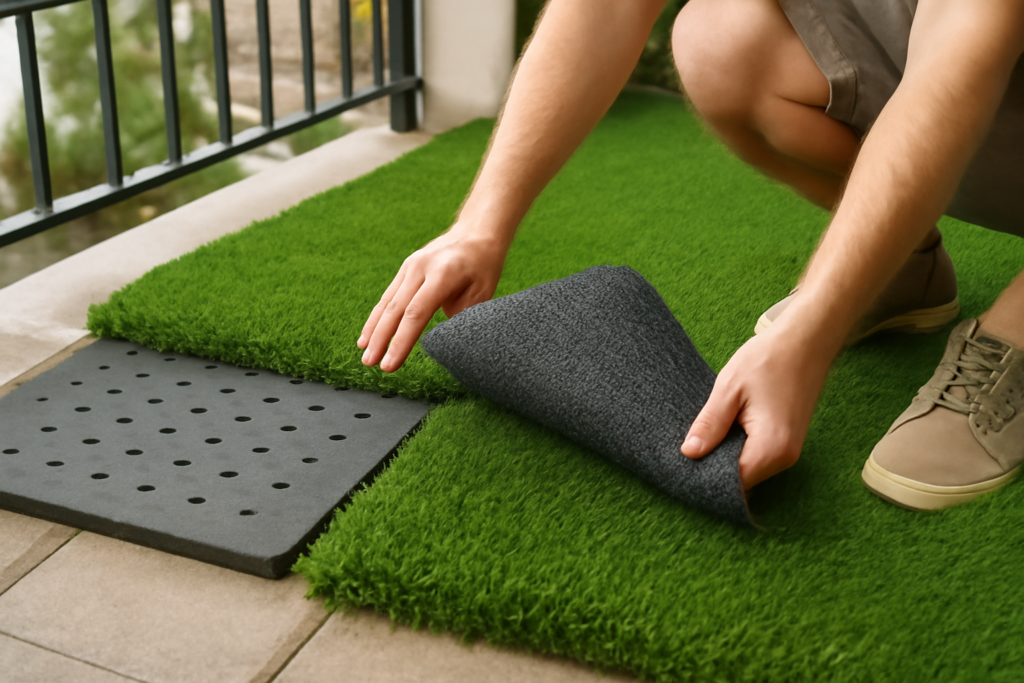
Balconies are built with a slight slope toward a drain, scupper or the open edge. Your turf must let water pass straight through to that sloped surface and then run off. Look for turf with a perforated backing (small holes every few inches) or a fully permeable backing. Solid-backed indoor rugs or cheap green carpet are not the same thing and will trap water.
- Never cover floor drains or scuppers. Cut a neat opening in the turf directly over each drain, or leave a gap of a few inches around it.
- Leave a 1/2 to 1 inch gap along the edge where water exits, so runoff is not blocked by the turf edge.
- On tile or sealed concrete, consider a thin drainage mat or interlocking deck tiles with raised feet underneath the turf. They lift the turf off the surface so water and air move freely.
- After the first heavy rain, lift a corner and check for standing water. If the surface is still wet a day later, you need more airflow underneath.
Weight and Balcony Load Limits
Turf itself is fairly light. A typical roll weighs somewhere between a half pound and a little over a pound per square foot, depending on pile height and backing. A small 6 by 10 foot balcony adds well under 100 pounds of turf, far less than a few people standing on it.
Where weight becomes a concern is infill. Ground-level installs often use silica sand or rubber crumb brushed into the blades, which can add a pound or more per square foot when dry and much more when wet. On a balcony, skip heavy infill or use a light, non-absorbent infill only if the manufacturer requires it. Large planters, water features and hot tubs are the real load risks, so do not let the turf project turn into a heavy rooftop garden without checking with the building manager or a structural engineer.
Turf on Concrete Versus Astro Turf on Decking
Concrete and Tile Balconies
Concrete is the easiest base. Sweep it clean, pressure wash if needed and let it dry fully. Lay the turf directly on the slab if it drains well, or over a thin drainage underlay if water tends to pool. A foam shock pad adds cushioning but must be a perforated, outdoor-rated type.
Wood or Composite Deck Balconies
Astro turf on decking needs more care. Wood needs to breathe and dry out between rains. Laying turf tight against deck boards traps moisture and can cause rot, mildew and stained boards. Use interlocking turf tiles with a raised plastic base, or lay a ventilated grid underneath a turf roll. Never staple or nail turf into the deck boards of a rental or into a waterproof membrane, because the holes let water into the structure.
On composite decking, the bigger issue is heat. Composite and turf both absorb sun, and the combination can get very hot in summer. Lighter-colored turf with a blend of tan thatch fibers stays slightly cooler.
Tools and Materials
- Perforated artificial grass roll sized to your balcony, or interlocking turf tiles
- Utility knife with plenty of fresh blades
- Tape measure, straightedge and chalk or a marker
- Outdoor seaming tape (no-glue or peel-and-stick type) if you need to join two pieces
- Optional drainage underlay or raised deck tiles
- Stiff broom or power brush to lift the pile
- Kneepads and gloves
For most balconies, a single artificial grass roll cut to size avoids seams entirely. Rolls commonly come in widths of about 6.5 or 13 feet, so measure your balcony depth before ordering.
Step-by-Step Balcony Turf Installation
- Measure and sketch the space. Note the location of every railing post, drain, door threshold and air conditioner pad.
- Clean and dry the surface. Remove dirt, moss and debris, and fix any loose tiles or boards.
- Lay the underlay if using one. Butt the pieces tightly and keep drains open.
- Unroll the turf in the sun. Let it relax for an hour or two so creases flatten out.
- Check the grain direction. Point the blades toward the door or main seating area so the grass looks fuller from where you view it.
- Rough cut, then fine cut. Leave a few extra inches on each side, then trim from the back of the turf with a sharp knife, cutting between rows of stitching.
- Cut around railing posts. Make a straight slit from the nearest edge to the post, then cut a small circle or square for the post itself. The slit closes up when the turf lies flat.
- Open the drains. Cut holes over drains and leave runoff edges clear.
- Join pieces without glue. If two pieces are needed, align the grain, butt the edges tight and use peel-and-stick seaming tape underneath.
- Brush the pile. Brush against the grain to stand the blades up.
Renter-Friendly No-Glue Installs
Renters should avoid adhesive, screws and staples entirely. A well-cut turf roll stays in place under its own weight on most balconies, especially once furniture sits on it. Interlocking turf tiles are even easier: they click together, can be lifted in sections to clean underneath and pack into a closet when you move out. If wind is a concern on an upper floor, weight the corners with planters or heavy furniture rather than tape, which can leave residue on concrete or pull up paint.
Cleaning and Maintenance
Brush the turf every couple of weeks to keep blades upright, and rinse it with a hose or a bucket of water monthly in dry weather. Leaves and pollen collect quickly, so a leaf blower on a low setting or a stiff broom helps. For pet use, rinse often and use an enzyme cleaner for odors. Lift the turf a couple of times a year to clean and inspect the surface underneath, especially on wood decks.
Troubleshooting
- Water pooling: the backing is not perforated enough or a drain is blocked. Add a drainage underlay or punch extra drainage holes.
- Edges curling: trim was too tight against a wall or the turf did not relax. Lift, let it sit in the sun and re-lay.
- Musty smell: moisture is trapped underneath. Lift the turf, dry the surface and add airflow.
- Turf too hot: add shade, choose lighter turf or rinse it with cool water before use.
- Visible seam: grain was misaligned. Re-cut so blades point the same way.
Cost Ranges
Balcony turf is one of the cheaper ways to change an outdoor floor. Budget turf with basic perforations sits at the low end of the per-square-foot range, while denser, more realistic grass with cooling or pet-friendly features costs more. Interlocking tiles generally cost more per square foot than rolls but save time and are fully reusable. Professional installation adds labor, though most balcony jobs are small enough that a pro may charge a minimum fee rather than a per-square-foot rate.
When to Call a Professional
Call a pro if your balcony has visible cracks, rust stains around rebar or railing anchors, a soft or sagging deck, or a waterproofing membrane that needs repair. Those signs point to structural or waterproofing issues that turf will only hide. A building manager, deck contractor or structural engineer should look at them first. For a sound, well-drained balcony, artificial grass for balcony spaces is a straightforward DIY upgrade.
Frequently Asked Questions
Can I put artificial grass directly on a concrete balcony?
Yes, as long as the turf has a perforated backing and the balcony drains are kept open. If water pools, add a thin drainage underlay between the concrete and the turf.
Will turf rot my wooden balcony deck?
Turf laid tight against wood can trap moisture and cause rot. Use raised interlocking tiles or a ventilated grid underneath so the boards can dry between rains.
Do I need to glue artificial grass on a balcony?
No. Most balcony turf stays in place under its own weight and furniture. Glue is hard to remove and often against lease or HOA rules.
Is balcony turf too heavy for an apartment balcony?
Turf without infill is light, usually around a pound per square foot or less. Skip heavy sand infill and keep large planters in check.
How do I cut turf around balcony railings?
Cut a straight slit from the nearest edge of the turf to the post, then trim a small opening for the post. The slit closes when the turf lies flat.