
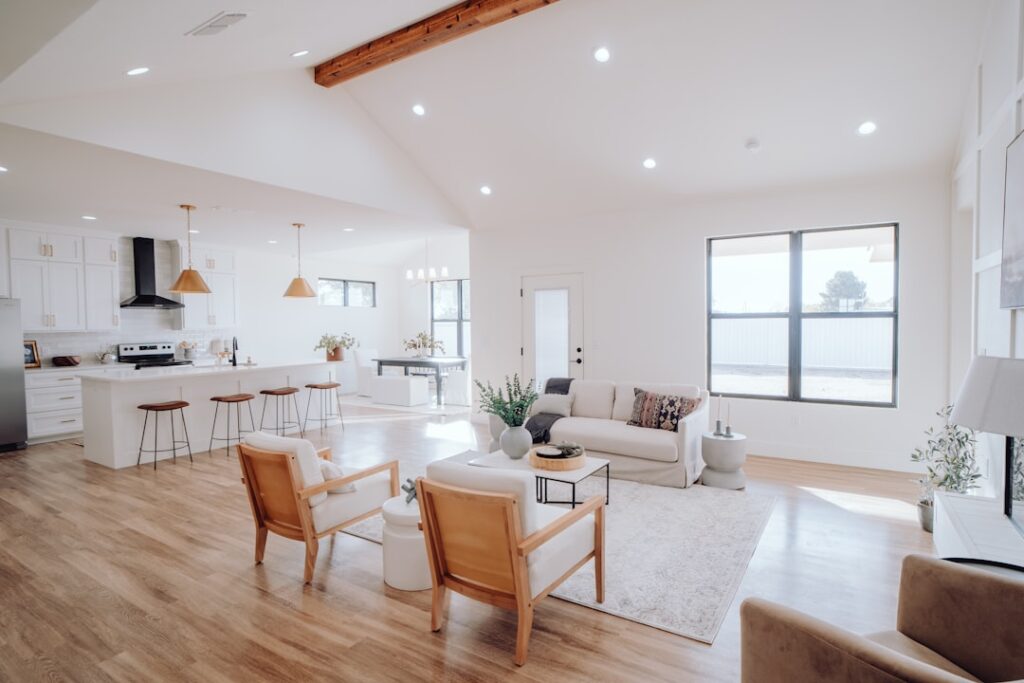
If you love the light, airy look of a pale hardwood but want something with a little more spring and shock resistance underfoot, ash deserves a serious look. Ash solid wood flooring pairs a bright, blond field with bold, flowing grain that lands somewhere between oak’s cathedral pattern and the near-blank cleanliness of maple. It is a favorite of baseball-bat and tool-handle makers precisely because it absorbs impact without shattering, and that same toughness translates well to a floor. Here is a straight look at where ash shines, where it struggles, and what it costs.
What Is Ash Flooring?
North American flooring ash is almost always white ash (Fraxinus americana), a domestic hardwood grown across the eastern US and Canada. The sapwood is creamy white to very pale tan, and the heartwood ranges from light brown to a soft grayish tan. What sets ash apart visually is its grain: long, open, and pronounced, with a wavy cathedral figure that reads as more energetic than oak. It stains and bleaches well, which is why it appears often in Scandinavian-style and gray-washed interiors.
One important note for buyers: the emerald ash borer has devastated North American ash populations over the past two decades, tightening supply and pushing some mills toward European ash or thermally modified stock. That makes availability more regional and pricing more variable than a staple like oak.
The Pros of Ash Solid Wood Flooring
Ash brings a genuinely useful set of strengths to a residential floor.
- Hardness and shock resistance: White ash rates about 1,320 lbf on the Janka scale, essentially tied with white oak (1,335) and harder than red oak. Its elasticity means it resists denting from dropped objects better than its raw number suggests.
- Bright, light look: The pale field visually enlarges rooms and bounces natural light, ideal for north-facing or smaller spaces.
- Takes stain evenly: The open grain accepts stain and reactive finishes with fewer blotches than maple, giving you flexibility from natural blond to deep espresso.
- Sandable for decades: At a full 3/4 inch thick, solid ash can be refinished six to ten times over its life.
- Strong grain character: For homeowners who find maple too plain and oak too expected, ash offers distinctive movement.
The Cons and Trade-Offs
No species is perfect, and ash has real limitations worth weighing before you commit.
- Supply and price volatility: Emerald ash borer losses mean ash is not always in stock, and matching a discontinued lot years later can be difficult.
- Shows scratches on pale finishes: Light natural floors reveal fine scratches and pet claw marks more readily than mid-tone woods, especially in glossy sheens.
- Moisture sensitivity: Like all solid hardwood, ash moves with humidity and is not suited to bathrooms, over concrete slabs, or over most radiant heat.
- Grain can dominate: The bold figure that some buyers love reads as busy to others, particularly in wide planks across a large room.
- Fewer prefinished lines: Compared with oak, far fewer factory-finished ash collections exist, so you may need to finish on site.
What Ash Flooring Costs
Expect ash to price close to, and sometimes slightly above, comparable oak because of tighter supply. Realistic 2026 US material figures:
- Unfinished select-grade solid ash: $6 to $10 per sq ft
- Prefinished solid ash, standard width: $8 to $13 per sq ft
- Wide-plank or specialty finishes: $12 to $18 per sq ft
Nail-down installation of solid tongue-and-groove ash typically adds $4 to $8 per sq ft in labor, plus $1.50 to $3 per sq ft if you finish unfinished boards on site. For a 250 sq ft room in prefinished ash, budget roughly $3,500 to $6,000 all in. Order about 10 percent overage for waste and future board replacement, and note that ash’s supply situation makes stashing a few extra boxes especially smart.
Ash Versus Oak and Maple
The three pale-to-mid domestic hardwoods are often cross-shopped, so a direct comparison helps.
Ash vs. White Oak
Both sit near 1,320 to 1,335 lbf, so durability is comparable. Oak has a slightly tighter, more contained grain and far broader availability and prefinished selection. Ash grain is more open and flowing, and its blond field runs a touch brighter. If you want the look but with reliable supply, white oak is the safer buy.
Ash vs. Hard Maple
Hard maple is harder (1,450 lbf) and far more uniform, almost grainless. Maple resists stain unevenly and blotches, while ash takes color cleanly. Choose maple for a sleek, near-solid look and ash if you want visible, characterful grain in a similarly light tone.
Finishes That Flatter Ash
Because ash is naturally pale, finish choice defines the whole floor. A clear matte hardwax oil or water-based polyurethane preserves the blond color and keeps the room bright; oil-based poly adds a warm amber cast that some buyers like and others avoid. Gray and white-wash reactive stains sit beautifully on ash’s open grain and are a signature Scandinavian look. If scratch-hiding is a priority, lean toward a mid-tone stain and a matte sheen, which together mask fine wear far better than a light glossy finish.
Installation and Care
Solid ash installs like any 3/4 inch hardwood: nailed or stapled over a wood subfloor, never floated. Acclimate the boxes in the room for 7 to 14 days, hold the space at 60 to 80°F and 35 to 55 percent relative humidity, and confirm subfloor moisture is within 4 percent of the flooring before nailing. Leave a 1/2 inch expansion gap at every wall.
For daily care, sweep or vacuum with a hard-floor setting, wipe spills promptly, and clean with a barely damp mop and a pH-neutral hardwood cleaner. Skip steam mops and vinegar, both of which degrade the finish. Felt pads under furniture and a no-shoes-with-heels habit go a long way on a pale floor. Refinish when the wear layer dulls, usually every 10 to 20 years in a home.
Where Ash Works Best in the Home
Because ash is bright and hard but moisture-sensitive, room selection matters. It performs beautifully in living rooms, dining rooms, bedrooms, hallways, and home offices, where its light tone opens up the space and its 1,320 lbf hardness shrugs off daily traffic. It is a strong pick for open-plan main floors where you want continuity and light. Ash is not the right choice for full bathrooms, laundry rooms, mudrooms, or below-grade basements, where standing water and humidity swings will cup and gap any solid hardwood.
Kitchens are a judgment call. Ash can work in a kitchen if you commit to wiping spills immediately and placing runners at the sink and range, but a household that is hard on floors may be happier with an engineered product or luxury vinyl in that one room. For an active family with kids and pets who still want ash’s look throughout, consider a mid-tone stain and a durable matte polyurethane, which together hide the scratches that would show glaringly on a light glossy finish.
Is Ash the Right Choice?
Ash solid wood flooring makes the most sense for homeowners who want a bright, durable, characterful hardwood and can source it reliably in their region. Its toughness suits active households, and its open grain gives designers room to play with stains. The main cautions are supply uncertainty from the ash borer and the way pale finishes reveal wear. If you can find a good lot at a fair price, buy a little extra, choose a matte finish in your preferred tone, and you will have a distinctive, resilient floor that most guests will not be able to name at a glance, which is part of its charm.
Prefer to explore on your own?
See how new flooring looks in your actual room in seconds — free, no signup.
Try the free Floor Studio →

