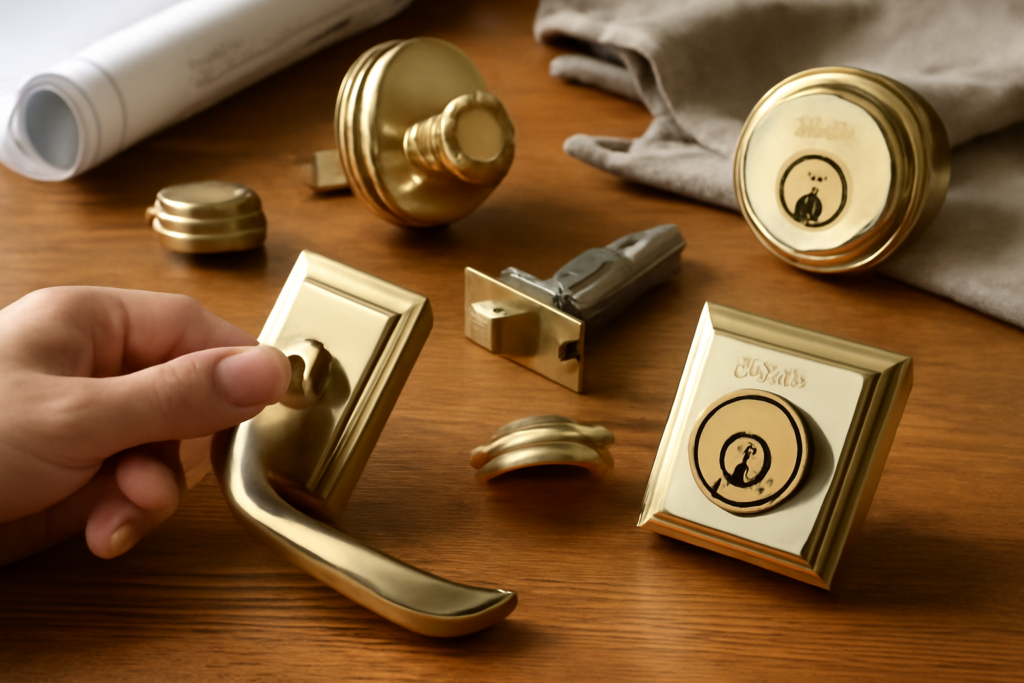
Baldwin door hardware sits at the top of the residential lock market for one reason: it’s forged from solid brass rather than cast from cheaper alloy, and that construction is why a Baldwin handleset can outlast the door it’s mounted on. If you’ve ever wondered why Baldwin door hardware costs three to five times what a builder-grade set does, the answer is in your hand the first time you turn one of their levers.
I’ve installed and serviced a lot of entry hardware, and Baldwin is the brand homeowners rarely have to call back about. Here’s how the lines break down and how to choose.
What Makes Baldwin Different
The headline is forged brass. Baldwin’s higher lines start as a solid brass billet that’s heated and hammered into shape under pressure, producing a denser, heavier part than the zinc die-castings used in budget hardware. That density does two things: it gives the hardware real heft and a solid feel, and it holds a plated or lacquered finish far longer because there’s no porous cast surface to corrode underneath.
The other differentiator is the finish program. Baldwin’s living finishes — unlacquered brass and distressed options — are meant to patina and change with time and touch, while their lifetime finishes like satin nickel and Venetian bronze carry a warranty against tarnish and corrosion. Either way, you’re getting a coating applied over solid brass, not over pot metal.
The Product Lines Explained
Baldwin splits its catalog into tiers, and knowing them keeps you from overspending or underbuying:
- Reserve: The accessible line. Solid-forged and forged-composite construction that mixes and matches knobs, levers, and roses so you can build a set. Strong value for interior doors throughout a house.
- Estate: The flagship. Fully forged solid brass handlesets and knobs, the heaviest and most detailed pieces Baldwin makes, aimed at front entries and statement doors.
- Prestige: The entry-level line sold through home centers. Solid-brass and steel construction at a lower price, a good step up from builder hardware without the Estate premium.
For most homes, Reserve handles the interior doors and an Estate handleset dresses the front entry. Prestige is the budget-conscious whole-house option.
Handlesets, Knobs, and Levers
Baldwin covers every function you’ll need:
- Entry handlesets: A gripping exterior handle paired with an interior knob or lever, usually with a deadbolt above. This is the front-door showpiece.
- Passage sets: Non-locking knobs or levers for hallways and closets that just need to latch.
- Privacy sets: Push-button or turn locks for bedrooms and bathrooms, no key.
- Deadbolts: Single- and double-cylinder, many Grade 1 or Grade 2 rated for real security.
Levers have gained ground over knobs because they’re easier to operate — better for kids, arthritis, and anyone carrying groceries — and they satisfy accessibility guidelines that knobs don’t.
Security Grades That Matter
Look for the ANSI/BHMA grade on any lock protecting an exterior door:
- Grade 1 — the highest residential and light-commercial rating; the deadbolt to want on a front door.
- Grade 2 — solid residential security, fine for side and back entries.
- Grade 3 — minimum residential; acceptable for interior privacy but not a security door.
Many Baldwin deadbolts carry Grade 1 or Grade 2 certification, and some entry sets are available keyed alike so one key runs the front, back, and garage-entry doors. Ask for keyed-alike when you order a whole-house package — retrofitting it later is a locksmith bill.
Finishes and How to Choose
Finish is where Baldwin earns its reputation, and it’s a decision worth slowing down on:
- Satin nickel: The most forgiving, hides fingerprints, works with almost any decor.
- Venetian bronze and oil-rubbed bronze: Warm, dark tones for traditional and craftsman homes.
- Polished chrome and polished nickel: Bright, formal, at home in transitional interiors.
- Unlacquered/living brass: Starts bright and develops a patina over years — for people who want the hardware to age gracefully rather than stay factory-new.
Whatever you pick, match the finish across visible hardware in a sightline — the handleset, the deadbolt, and the door hinges should agree. Mismatched finishes on the same door read as a mistake even when the pieces are individually beautiful.
What It Costs
Baldwin is a premium brand, and the pricing reflects it:
- Prestige knobs/levers: $40 to $90 per interior door.
- Reserve interior sets: $90 to $200 per door depending on style and finish.
- Reserve and Estate entry handlesets: $250 to $700 for the front-door set with deadbolt.
- Estate flagship handlesets: $500 to over $1,200 for the most detailed forged designs.
Outfitting a whole house adds up fast, which is why many homeowners put Estate or Reserve on the front entry where guests touch it and drop to Prestige or Reserve for the interior doors nobody studies.
Installation and Longevity
Baldwin fits standard door prep — a 2-1/8-inch bore for the lock and a 1-inch edge bore — so it drops into most existing doors without special machining. A handleset with a deadbolt is a straightforward hour of work for a handy owner, though heavy Estate sets are worth having installed correctly so the trim sits flush and the bolt throws cleanly.
Once it’s on, maintenance is nearly nothing. Wipe finishes with a soft dry cloth, avoid abrasive cleaners that scratch the coating, and let living finishes patina naturally. Lifetime-finish pieces are warrantied against corrosion, and the internal mechanisms carry mechanical warranties measured in decades. That’s the whole argument for Baldwin door hardware: you buy it once, install it, and it keeps working and looking right long after cheaper hardware would have loosened, tarnished, or failed.
Baldwin vs. the Competition
The natural comparison is to other premium brands like Emtek and Rocky Mountain, and to mid-tier names like Schlage and Kwikset. Against Schlage’s better lines, Baldwin’s edge is the forged-brass feel and the depth of the finish program — Schlage makes a fine Grade 1 lock but doesn’t match Baldwin’s living-finish options or the heft of an Estate handleset. Against Kwikset, it isn’t close; Kwikset is builder-grade value hardware, and Baldwin is a different category entirely.
Emtek, which shares corporate roots with Baldwin, competes closely on solid-brass construction and offers more contemporary and mix-and-match designs. If your home leans modern, Emtek is worth a look alongside Baldwin. For traditional and transitional interiors, Baldwin’s catalog runs deeper and its Estate handlesets remain the reference point.
Matching Hardware Across the House
One planning move saves you money and regret: decide your finish and lever-or-knob style before you buy anything, then order in one pass. Finishes drift slightly between production runs and between a brand’s tiers, so buying a Reserve set today and a matching one next year can leave you with a visible mismatch on adjacent doors. Ordering together keeps the whole house consistent.
Think about function door by door, too. Exterior doors want keyed entry sets with a Grade 1 or Grade 2 deadbolt; bedrooms and baths want privacy sets; hallways and closets only need passage sets. Mapping that out prevents the classic mistake of buying a keyed entry set for an interior closet that never locks.
Handedness catches people as well. Levers are handed — a right-hand door needs a right-hand lever so the return curves toward the jamb — so note which way each door swings before you order. Many Baldwin levers are reversible in the field, but confirming it up front saves a return trip. Measure your backset too, typically 2-3/8 inches or 2-3/4 inches, and match the deadbolt and latch to it so the hardware lines up with the existing bore.
Is Baldwin Worth It?
If you want hardware that feels substantial, holds its finish, and secures the door with a real Grade 1 deadbolt, Baldwin door hardware justifies the price — especially on a front entry where every visitor feels the quality. Budget the Estate or Reserve dollars for the doors that matter most, lean on Prestige where you can, order keyed-alike, and match your finishes. Do that and you’ll have hardware you never think about again, which is the highest compliment you can pay a lock.