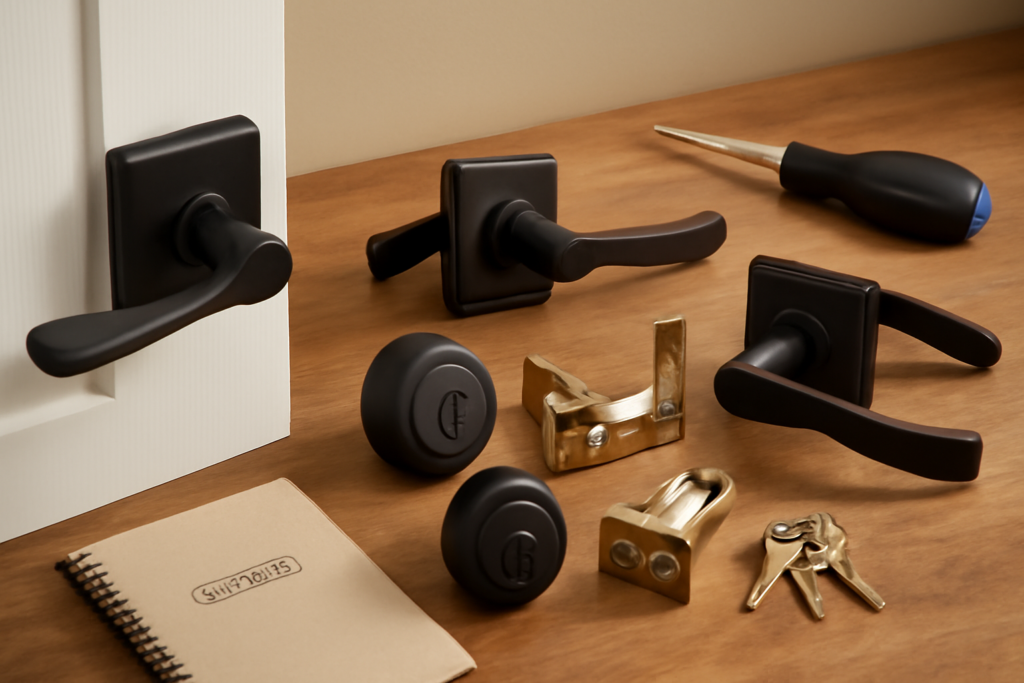
If you are standing in the hardware aisle trying to figure out which lock to trust on your front door, Schlage door hardware is the name that shows up on the top shelf for good reason. The brand has built a reputation on locks that pass the highest residential security grade, and their lineup runs from a $20 interior passage lever all the way to a fingerprint-reading smart deadbolt. This guide sorts out what fits where, so you buy once and install it yourself.
I have fitted a lot of these, and the honest truth is that most Schlage sets go in with a screwdriver in about 20 minutes. The hard part is not the install — it’s picking the right function and getting the sizing right before you leave the store.
Understanding the Grade System
Every lock sold in the US carries an ANSI/BHMA grade, and it is the single most useful number on the box. Grade 1 is commercial-strength, Grade 2 is solid residential, Grade 3 is the bare minimum. Schlage’s claim to fame is that even much of its residential deadbolt line meets Grade 1 — the highest rating, tested for thousands of cycles and serious force resistance. For an exterior door, do not go below a Grade 2 deadbolt, and Grade 1 is worth the extra $15.
Interior doors are a different story. A bedroom or bathroom lever only needs a Grade 3 privacy function, and a closet needs nothing more than a passage set with no lock at all.
The Main Product Families
Schlage’s catalog breaks into a handful of lines that are easy to keep straight once you see them side by side:
- Schlage B60/B62 deadbolts: The workhorse single- and double-cylinder deadbolts, Grade 1, $30 to $60.
- F-Series levers and knobs: The everyday residential handles — F40 privacy, F10 passage, F51 keyed entry. $20 to $50.
- Camelot, Century, and Latitude trim styles: These are design names, not different mechanisms. Camelot is the classic beveled look; Latitude and Century are flat and modern.
- Encode and Encode Plus smart deadbolts: Built-in WiFi, keypad, and app control, $200 to $300. Encode Plus adds Apple Home Key tap-to-unlock.
- Sense and Connect: Bluetooth and Z-Wave smart options for homes with a hub.
Match your finish across the whole door — satin nickel, aged bronze, matte black, and bright brass are the common ones — and check that your handle set and deadbolt use the same finish code so they don’t clash.
Getting the Backset and Bore Right
Before anything else, measure. Two numbers decide whether the lock fits your door:
- Backset: the distance from the door edge to the center of the bore hole. American doors use either 2-3/8″ or 2-3/4″. Nearly every Schlage latch is adjustable to fit both, so you are covered either way.
- Bore diameter: the big face hole is a standard 2-1/8″, and the edge hole for the latch is 1″. If your door is already drilled to those, any Schlage set drops in.
Door thickness matters too — standard sets fit 1-3/8″ to 1-3/4″ doors, which covers almost every interior and entry door in a US home. Thicker doors need an extension kit.
Tools and What’s in the Box
A basic Schlage install needs almost nothing:
- #2 Phillips screwdriver — that is genuinely the main tool
- Tape measure to confirm your backset
- A pencil
- Chisel and hammer only if you are cutting a fresh mortise for the strike or latch faceplate
- Cordless drill with a 2-1/8″ hole saw and 1″ spade bit only if the door is not pre-drilled
The box includes the latch, the exterior and interior trim, the strike plate, and all the mounting screws — usually a pair of long combination screws that thread the two halves together. Keep the included template if your door needs drilling.
Step-by-Step Installation
On a pre-bored door, work through it in order:
- Set the backset on the adjustable latch to match your door, then slide the latch into the edge bore with the beveled face toward the doorstop.
- Screw the latch faceplate to the door edge with the two provided screws.
- Insert the exterior half — the keyed cylinder or outside lever — feeding its tailpiece or torque blade through the latch center.
- Mount the interior half over the tailpiece, aligning the two mounting posts.
- Drive the two connecting screws evenly, alternating a few turns each so the trim seats square.
- Install the strike plate on the jamb, and add the long reinforcing screws — this is the step that actually resists kick-ins, so drive those 3″ screws into the framing.
Test the key, the lever, and the deadbolt throw before you walk away. The bolt should extend a full 1″ into the strike.
Keying Alike and Rekeying
One of the best features of Schlage door hardware is that you can key several locks to a single key. Buy sets marked “keyed alike” together and they ship matched, or use a Schlage rekey kit (about $12) to reset an existing lock to a new key yourself in a few minutes. Their SecureKey and comparable DIY rekey systems let you insert a learn key, then the new key, and the pins reset without pulling the cylinder apart. This is a huge time-saver when you move into a house and want every exterior lock on one key.
For smart models like the Encode, you skip physical keys entirely for daily use and hand out unique keypad codes — a code for the dog walker, another for a guest, deleted from the app when you are done.
Choosing the Right Function for Each Door
Buying the wrong function is the most common mistake, so match the lock to the room. A keyed entry set (like the F51) goes on any exterior door — front, back, garage-to-house. A privacy set (F40) has a push-button or turn lock with no key, meant for bathrooms and bedrooms; it releases with a small emergency tool from outside. A passage set (F10) has no lock at all and belongs on closets, hallways, and pantries. A dummy set is a fixed handle with no latch, used on the inactive leaf of double doors or on a closet you just pull open.
Walk your house and count how many of each you need before shopping. Buying three keyed-entry sets and having them keyed alike, plus a handful of privacy and passage levers in the matching finish, sets your whole house on one look and one key for well under $250.
Maintenance and Troubleshooting
Schlage locks are low-maintenance, but a few habits keep them smooth for decades. Once a year, puff a little dry graphite or PTFE-based lubricant into the keyway and work the key a few times — never use household oil, which gums up and traps grit. If a deadbolt gets stiff to throw, the usual cause is door sag or a strike that has drifted out of alignment; loosen the strike-plate screws and nudge it until the bolt slides in freely. A lever that feels loose is almost always a set screw backed out under the handle or a mounting screw that needs a quarter turn. These are two-minute fixes, not reasons to replace the lock.
Smart Locks and Whether They’re Worth It
The Encode Plus is the model I point most people toward if they want to go smart. It replaces only the interior deadbolt half, runs on four AA batteries for roughly six months, connects straight to home WiFi without a separate hub, and supports Apple Home Key so you tap your phone or watch to unlock. At $250 to $300 it is not cheap, but it is a genuine security upgrade with a Grade 1 bolt underneath the electronics.
If you just want reliable, serviceable locks and no app, the plain B60 deadbolt paired with an F-Series lever is all most homes need — decades of proven hardware for well under $80 a door. Whichever direction you go, Schlage door hardware is one of the few home upgrades that is cheap, DIY-friendly, and genuinely makes your home safer.