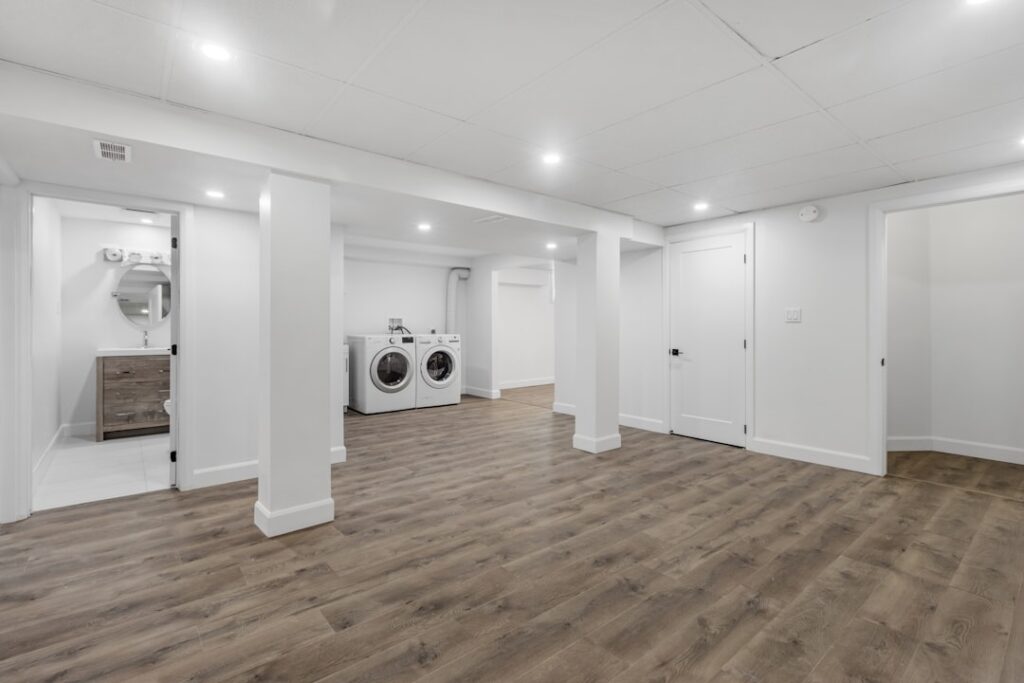
A dry basement isn’t luck; it’s a system quietly moving thousands of gallons of groundwater away from your foundation every wet season. A well-designed basement sump pump system collects water before it reaches your floor and pumps it safely outside, protecting everything from your foundation footings to the boxes of family photos in the corner. Whether you’re installing one for the first time or trying to understand the equipment you inherited, knowing how the pieces fit together makes the difference between a basement that stays dry and one that floods the first time the water table rises.
How the System Works
The concept is simple gravity and pumping. Water in the soil around and under your foundation naturally seeks the lowest point, which the system creates deliberately: a pit, called the sump basin, dug into the lowest part of the basement floor. Drain tile, perforated pipe buried around the foundation’s interior or exterior footing, channels groundwater into that pit before it can seep up through the slab.
When the water in the pit rises to a set level, a float switch triggers the pump, which pushes the water up a discharge pipe and out of the house, ideally 10 or more feet away where it can’t circle back. Once the level drops, the float shuts the pump off. That cycle repeats as often as needed, which during a heavy storm can be every minute or two. Understanding this collect-trigger-discharge loop is the foundation for every decision about the equipment.
Submersible vs. Pedestal Pumps
The pump itself comes in two main forms, and the choice affects noise, lifespan, and cost:
- Submersible pump: sits inside the pit underwater, quieter, handles debris better, and hides out of sight; 7 to 10-year lifespan, $100 to $400
- Pedestal pump: motor sits on a shaft above the pit, easier to service, longer motor life, but louder and more visible; $60 to $200
For finished basements and living space, a submersible pump is almost always the better call because it runs quietly and disappears into the pit. Pedestal pumps make sense in unfinished basements where noise doesn’t matter and easy access to the motor is a plus. Whichever you choose, cast-iron pump housings dissipate heat and outlast plastic bodies, making them worth the modest premium.
Sizing the Pump and Pit
An undersized pump can’t keep up with a serious storm, and an oversized one short-cycles and wears out early. Pump capacity is rated in gallons per hour (GPH) at a given lift height. For most homes, a 1/3 HP pump moving 2,000 to 3,000 GPH handles typical groundwater, while homes with high water tables or heavy inflow benefit from a 1/2 HP unit pushing 3,000 to 5,000 GPH. The higher the water has to be lifted, the less any pump delivers, so account for your discharge height.
The pit matters too. A basin that’s too small forces the pump to cycle constantly, shortening its life, while a properly sized pit, usually 18 inches wide and 22 to 30 inches deep, gives the water room so the pump runs in longer, less frequent cycles. The pit should have a sealed lid to control radon and humidity and to keep debris out of the pump.
The Discharge Line
Where the water goes is as important as how it gets pumped. The discharge pipe, typically 1-1/2 inch PVC, should carry water well away from the foundation, at least 10 feet, and dump it onto a grade that slopes away from the house. Piping it right back next to the foundation just recirculates the same water and never lets the basement dry out.
A check valve on the discharge line is essential; it prevents the column of water in the pipe from draining back into the pit each time the pump shuts off, which would make the pump cycle needlessly. In cold climates, guard against the discharge freezing at its outlet, since a frozen line means the pump runs against a blocked pipe and floods the basement. A freeze-relief fitting or a downward-angled exit that can’t hold ice solves this common winter failure.
Backup Systems for Real Protection
A single pump on household power is a system with an obvious weak point: outages and mechanical failure, both of which love to strike during the very storms that cause flooding. Serious protection means redundancy. A battery-backup pump kicks in when the power fails, running on a deep-cycle battery for many hours, exactly when a downpour has knocked out the grid.
Alternatively, a water-powered backup uses your municipal water pressure to create suction and needs no electricity or battery at all, ideal for areas with frequent, long outages. Add a Wi-Fi high-water alarm that texts your phone the moment the pit rises abnormally, and you’ll know about a problem before the water reaches your floor. Layering a primary pump, a backup, and an alarm turns a fragile setup into a genuinely dependable basement sump pump system.
Maintenance to Keep It Reliable
A sump system rewards a few minutes of attention a couple of times a year. Test it by pouring a bucket of water into the pit and confirming the pump kicks on, moves the water, and shuts off cleanly. Clean debris from the pit and the pump intake screen, make sure the float moves freely and isn’t jammed against the wall, and check that the check valve holds.
Once a year, inspect the discharge line for clogs and confirm it still drains away from the house, and test the battery backup by unplugging the primary pump. Replace the backup battery every 3 to 5 years and the primary pump proactively around its 7-to-10-year lifespan rather than waiting for it to die mid-storm. Consistent, calendar-driven maintenance is what keeps a basement dry decade after decade, and it costs almost nothing compared to a single flood cleanup.
Installation Cost and Whether to DIY
Understanding the numbers helps you decide how far to take a project yourself. Replacing just the pump in an existing pit is a straightforward DIY job costing only the price of the pump, $100 to $400, and an hour of work. Installing a complete system from scratch, jackhammering the slab, digging the pit, running drain tile, and plumbing the discharge, is far more involved and typically runs $1,200 to $4,000 professionally, with high-water-table homes and interior drain-tile systems reaching the top of that range.
The dividing line is usually the pit. If a properly placed sump basin already exists, swapping or upgrading the pump and adding a battery backup is well within a handy homeowner’s reach. Cutting a new pit into a finished basement floor, sizing the drain tile, and ensuring the discharge meets code is a job most people are wise to hand to a waterproofing contractor. Get multiple bids, confirm the discharge routing and any permit requirements, and ask whether the quote includes a backup system, which is worth insisting on.
Signs Your System Needs Attention
A sump system usually warns you before it fails outright, if you know the signals. A pump that runs constantly or cycles every few seconds points to a stuck float, a failed check valve letting water fall back in, or an undersized pump that can’t keep up. Strange grinding or rattling noises suggest debris in the impeller or a worn motor bearing. Visible rust, a pump that vibrates hard, or one that trips its thermal overload and shuts off mid-cycle all flag a unit nearing the end of its life.
Water appearing on the basement floor despite a running pump is the clearest alarm, indicating the pump can’t match the inflow, the discharge is blocked or frozen, or the check valve has failed. Musty smells and efflorescence, the white mineral crust on foundation walls, signal chronic moisture that a healthy system should be preventing. Catch these signs early and you can fix a $40 float switch or a $150 pump on your schedule, rather than mopping up a flood on the system’s.
Final Word
A basement sump pump system is one of the highest-return investments in the house, quietly defending your foundation and everything stored below grade. Choose a properly sized submersible pump, run the discharge well away with a check valve, add a battery backup and an alarm, and keep up the twice-yearly testing. Do that, and you can watch the heaviest storm roll through knowing your basement will still be dry when it clears.