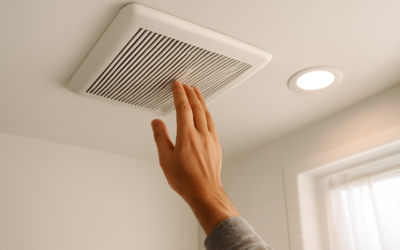
A damp bathroom mirror, peeling paint near the shower, and black specks in the grout are all signs of the same underlying problem — an undersized or missing exhaust fan. Modern bathroom ceiling fans move 50 to 150 cubic feet of moist air per minute, protect drywall and trim from mold, and quietly prevent thousands of dollars in repairs. Building codes require one in any bathroom without an operable window, but even homes with windows benefit from a properly sized fan running on a 20-minute timer after each shower. Here is how to pick, size, and install one that actually works.
Part of our Bathroom Remodeling & Flooring guide — explore the full guide →
Why a Good Exhaust Fan Matters
A single 10-minute shower pushes about 0.5-1 pound of water vapor into the air. Without ventilation, that moisture settles on cold surfaces — mirrors, windows, tile grout, and drywall behind the toilet. Repeated saturation breaks down paint bonds, warps baseboards, and feeds mildew.
The IRC (International Residential Code) section R303.3 requires any bathroom without a window that opens at least 1.5 sq ft to have mechanical ventilation rated at 50 CFM minimum for intermittent use. Most building inspectors will fail a remodel that skips this step.
Sizing Bathroom Ceiling Fans Correctly
For bathrooms 100 sq ft or smaller, use 1 CFM per square foot. For bathrooms larger than 100 sq ft, add CFM based on fixtures:
- Toilet: add 50 CFM
- Shower: add 50 CFM
- Bathtub: add 50 CFM
- Jetted tub: add 100 CFM
A 60 sq ft bathroom with a shower needs at least 60 CFM; a 150 sq ft master bath with separate toilet room, shower, and tub needs about 200 CFM. Undersizing is the most common mistake — a 50 CFM builder-grade fan in a steamy master bath clears the air about as well as a hairdryer blowing sideways.
Sone Ratings and Noise
Sones measure perceived loudness. A rating of 1 sone sounds like a quiet refrigerator; 4 sones sounds like a television at normal volume. Premium bathroom ceiling fans run at 0.3-1.5 sones — quiet enough that you have to look up to confirm they are on.
Panasonic WhisperCeiling fans, for example, rate at 0.3-1.0 sones across their product line. Broan QTX series units are similarly quiet. Builder-grade Nutone 696N fans rate at 4.0 sones — loud enough that many homeowners refuse to turn them on, defeating the purpose.
Top Brands and Models
A few models dominate well-reviewed installer choices:
- Panasonic FV-0511VF1 WhisperFit EZ: 110 CFM, 0.3 sones, built-in damper, $225-$265. Best overall for most bathrooms.
- Broan-NuTone QTXE110S: 110 CFM with humidity sensor, 0.7 sones, $195-$230. Good for families who forget to flip the switch.
- Delta BreezSignature VFB25AEH: 80 CFM with humidity sensor, 0.8 sones, $140-$170. Great budget option.
- Broan Sensonic SPK110: 110 CFM with Bluetooth speaker, 2.0 sones, $280-$320. Novelty option for music in the shower.
- Panasonic FV-1115VQL1 WhisperCeiling DC: Adjustable 110/130/150 CFM, 0.3-0.8 sones, $350-$420. Top of the line.
Installation Requirements
Installing a bathroom fan is a weekend job for an experienced DIYer, or about $250-$450 for an electrician and handyman. Key requirements:
- Dedicated 120V, 15-amp GFCI-protected circuit (or shared with lights if within code)
- 4-inch rigid metal or insulated flex duct — never use flexible plastic duct, which sags and traps water
- Duct must terminate at an exterior wall or roof cap — venting into the attic violates code and causes mold in the sheathing
- Backdraft damper at the fan and the exterior termination
- Duct run kept under 25 feet total equivalent length (subtract 10 feet per 90-degree elbow)
Use 2-inch rigid foil tape (not cloth duct tape) at every joint. Insulate the duct run through unconditioned attic space with R-6 duct wrap to prevent condensation dripping back toward the fan.
Humidity Sensors and Smart Controls
Humidity-sensing fans turn themselves on when relative humidity jumps 10-15% over ambient and run until conditions normalize. Broan SmartSense and Panasonic ECM versions do this seamlessly — worth the extra $30-$60 if your household has teenagers or anyone who forgets to switch the fan on.
Timer switches like the Leviton LTB30-1LZ ($28) or Lutron Maestro MA-T51MN ($45) add manual run-time control. Set it for 20 minutes after each shower and the fan handles itself. Smart switches integrate with Google Home or Alexa for voice control, though that borders on overkill.
Light and Heater Combinations
Combination fan/light/heater units pack a lot into one ceiling housing. The Broan 100HL combines a 100 CFM fan, a 100W incandescent light, a 1,300W heater, and a 4W night light. These work well in bathrooms without a separate heat source but draw heavy current — plan for a dedicated 20-amp circuit.
Panasonic WhisperWarm FV-11VHL2 brings the noise down to 1.6 sones while adding an infrared heater that warms you, not just the room. For master baths in cold climates, this combo is popular with remodelers across the Northeast and Midwest.
Common Installation Mistakes
A few pitfalls kill fan performance fast:
- Using flexible plastic duct (restricts airflow by 40-50% and collects water)
- Terminating in the soffit without a proper exterior cap (air recirculates through attic vents)
- Skipping the backdraft damper (cold air pours in on winter nights)
- Mounting the fan over the shower without a GFCI-protected circuit
- Sharing a single vent duct with a second fan — two fans on one duct effectively cancel each other out
Maintenance and Lifespan
A quality bathroom fan lasts 10-15 years. Pull the grille once a year and vacuum the blower wheel and motor housing. Dust buildup is the number one cause of rising noise levels and reduced CFM output. Replace the housing flapper if you feel cold air blowing back through the fan when it is off.
If the motor starts humming without spinning, it is usually a seized bearing — motors are rarely worth replacing on older units. Budget about $130-$200 for a new fan and 1-2 hours of installation labor. Matching the existing ceiling hole size (usually 8×8 or 10×10 inches) makes drop-in replacement straightforward.
Energy Use and Code Updates
Modern DC-motor fans draw only 5-15 watts compared to 40-70 watts for older AC motors. Running a 10-watt Panasonic WhisperCeiling for 90 minutes a day costs roughly $4 per year at the national average electric rate. Energy Star certified models must deliver at least 1.4 CFM per watt at 0.1 inches of static pressure.
Newer versions of the IECC call for continuous low-speed whole-house ventilation in tight homes. Fans like the Panasonic WhisperGreen Select run 24/7 at a low speed and boost to full CFM when you shower — a one-appliance solution that satisfies both code paths.