
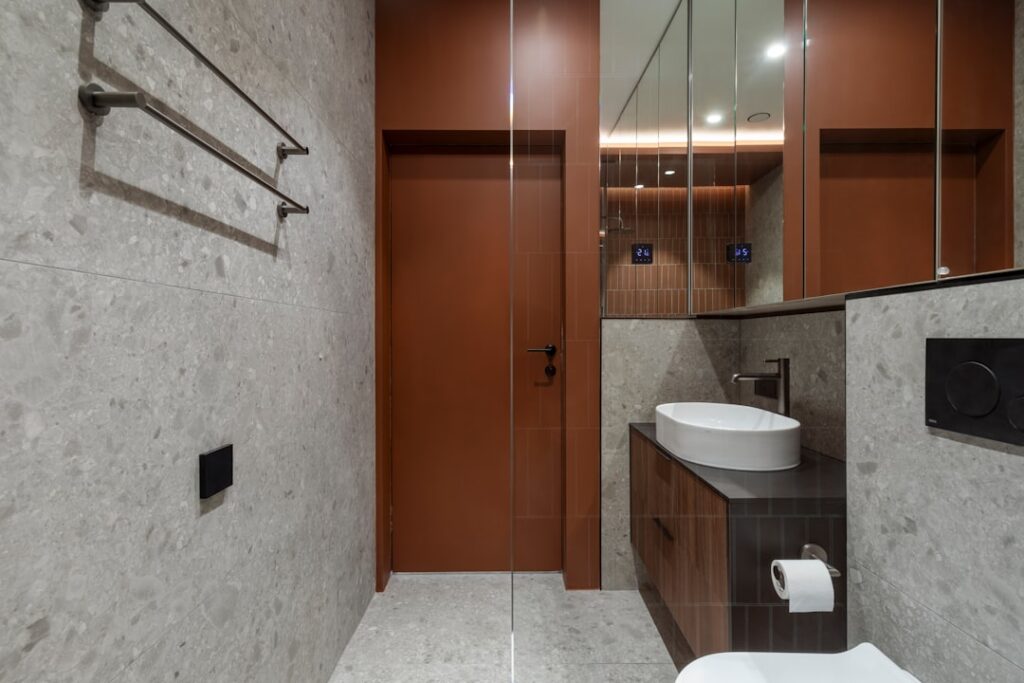
Choosing a bathroom closet door means solving three problems at once: fitting a door into a tight space, handling the humidity of a bathroom, and matching the room’s style. The linen closet or storage cabinet in a bathroom is small, often squeezed beside a vanity or toilet, and the door you pick can either eat up precious floor space or disappear entirely. Add the constant moisture, and material choice becomes a durability question, not just an aesthetic one.
Part of our Bathroom Remodeling & Flooring guide — explore the full guide →
Whether you are finishing a remodel or replacing a warped, swollen door that has seen too many steamy showers, understanding your options will help you pick one that fits, functions, and lasts. Here is a rundown of the styles, materials, and sizing that matter.
Space-Saving Door Styles
Bathrooms rarely have room for a door that swings out into the walking path, so space-efficient styles dominate. The main contenders each solve the clearance problem differently.
- Pocket doors: Slide into a cavity inside the wall, disappearing completely. The ultimate space-saver, but they require opening the wall to install a track and frame.
- Bifold doors: Fold in half on a track, projecting only a few inches into the room. Common on linen closets and easy to retrofit.
- Barn (sliding) doors: Slide across the wall face on an exposed track. Trendy and easy to install, but they need clear wall space beside the opening and do not seal tightly.
- Hinged doors: The traditional swing door. Simplest and cheapest, but only where there is clearance for the swing arc.
For a cramped bathroom, a pocket or bifold usually wins. Barn doors look great over a linen closet on an open wall but seal poorly, which matters less for storage than for a bathroom entry.
Moisture Is the Real Enemy
Bathrooms swing between dry and steamy multiple times a day, and that cycle is brutal on doors. A solid wood door absorbs moisture, swells, and sticks; over years it can warp permanently. This is why material choice deserves as much thought as style.
The best-performing options resist moisture: solid-core doors with a moisture-resistant skin, MDF doors with a quality primed and painted finish, PVC or vinyl-clad doors, and fiberglass. Avoid hollow-core doors with untreated edges in a heavily used bathroom, since water wicks into the exposed core at the bottom and delaminates the skin. Running an exhaust fan during and after showers dramatically extends any door’s life.
Louvered Doors for Ventilation
A louvered bathroom closet door deserves special mention because it solves a hidden problem: airflow. A sealed closet in a humid bathroom traps damp air, and stored towels and linens can develop a musty smell or even mildew. Louvers let air circulate while keeping the contents hidden.
Full-louver and half-louver doors are widely available in both bifold and hinged styles. They pair naturally with traditional and coastal bathroom designs. The tradeoff is dusting, since the slats collect dust, and they offer no privacy for the contents. For a linen closet holding towels, though, the ventilation benefit usually outweighs the extra cleaning.
Getting the Size Right
Closet openings are less standardized than room doors, so measure carefully. Common linen and storage closet door widths are 24, 30, and 36 inches, with standard heights of 80 inches. Bifold sets cover wider openings by pairing panels.
Measure the rough opening width, height, and the wall depth (jamb thickness). For a pocket door, confirm you have enough clear wall cavity beside the opening, roughly equal to the door width, with no plumbing or wiring in the way. For a barn door, you need flat wall space at least as wide as the door on the slide side. Order the door to the opening, or plan to trim a slab to fit.
Style and Finish Options
The door is a visible design element, so coordinate it with the room. A few directions:
- Shaker panel: Clean recessed panels that suit almost any style, from farmhouse to transitional.
- Flat/flush slab: Minimalist and modern, easy to paint any color.
- Glass or frosted-glass panel: Brightens a windowless bathroom; frosted or reeded glass keeps contents private.
- Painted vs stained: Paint hides MDF and matches trim; stain shows off real wood grain but needs a moisture-sealed finish.
Matching the closet door to the main bathroom door and trim creates a cohesive look. A contrasting color or a natural wood barn door, by contrast, makes it a deliberate accent.
Cost of Each Option
Budget varies widely by style and material. A basic hollow-core bifold runs $40 to $90, a solid or louvered bifold $80 to $200, and a quality hinged slab door $50 to $250. Barn door kits with hardware cost $150 to $500. Pocket doors are the priciest to install because of the in-wall frame, running $300 to $1,000 including labor if you are opening a wall.
DIY installation of a bifold or barn door is straightforward for a couple of hours of work. Pocket doors and cutting into a wall are better left to a carpenter unless you are experienced, since a mistake in the framing is costly to fix.
Barn Doors: Pros and Real Drawbacks
Barn doors have become the default choice for many bathroom remodels, and for good reason, but they carry tradeoffs people discover too late. On the plus side, they slide flat against the wall on an exposed track, taking up zero swing space and adding an instant style statement. They install without opening the wall, unlike a pocket door, which makes them the easiest space-saver to retrofit.
The drawbacks matter in a bathroom. A barn door does not seal the opening; there is always a gap around the edges, so it offers limited privacy and lets sound and light pass. It also needs a clear stretch of wall beside the opening at least as wide as the door, with no light switches, towel bars, or outlets in the slide path. For a linen closet those gaps are a non-issue, but for a door where privacy matters, a pocket or hinged door seals better. Choose soft-close hardware to prevent the door from slamming into its stops, and make sure the track is anchored into studs or solid blocking, since a loaded barn door is heavy.
Ventilation and Preventing Mustiness
A closed closet in a humid bathroom can trap moisture and leave towels and linens smelling musty over time. The door plays a role in whether that happens. Louvered doors solve it directly by letting air circulate, which is why they remain popular for linen closets despite the extra dusting.
If you prefer a solid door for looks, build ventilation in another way. Leave a small gap at the bottom of the door for airflow, or add a discreet vent grille to a lower panel. Running the bathroom exhaust fan during and after every shower is the single biggest factor, since it removes the humidity before it can migrate into the closet. Inside the closet, a small container of moisture absorber or a few cedar blocks helps keep stored linens fresh. Address airflow at the design stage and you avoid the damp, musty closet that plagues so many older bathrooms.
Hardware and Finishing Touches
Do not overlook the hardware, which sees daily use in a humid room. Choose corrosion-resistant finishes like brushed nickel, matte black, or stainless over cheap plated hardware that pits and tarnishes in bathroom air. Soft-close hardware on barn and pocket doors prevents slamming and adds a premium feel.
For the finish coat, use a bathroom-rated paint in satin or semi-gloss that resists moisture and wipes clean. Seal the bottom and top edges of any wood or MDF door before installation, since those raw edges are where water intrusion starts. Get the material, style, and sealing right, and your bathroom closet door will fit the space, resist the steam, and look sharp for many years.


