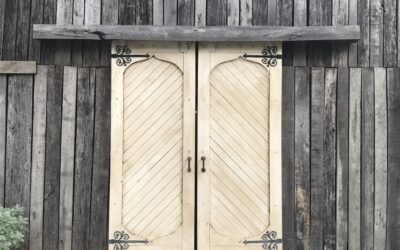
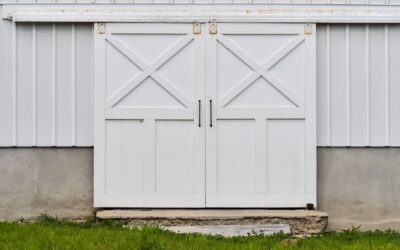
Standard bifold closet doors have a way of jamming off their tracks and swinging into the room at the worst moment, which is exactly why so many homeowners are replacing them. A double barn door closet answers both problems at once, gliding two doors along a wall-mounted track to cover a wide opening with rustic or modern flair and zero swing into the room. For closets too wide for a single sliding door, the biparting two-door setup is often the best-looking and most practical solution. But it takes the right measurements, the right hardware, and enough wall space on each side to work properly. Here’s what to know before you buy.
Part of our Windows & Doors guide — explore the full guide →
Why Choose a Double Barn Door for a Closet
The appeal is part function, part looks. Barn doors slide flat against the wall, so unlike swinging or bifold doors they never intrude into the room or block furniture. On a wide closet, splitting the coverage between two doors that part in the middle means each door only has to travel half the distance, so you need less blank wall on either side than a single large slider would demand. And visually, a pair of matched barn doors makes a bold architectural statement that a plain closet almost never does.
Understanding a Biparting Setup
A double barn door closet uses what’s called a biparting configuration: two doors hang on a single long track (or two separate tracks) and slide apart from the center to open, meeting in the middle when closed. This differs from a bypass setup, where two doors overlap on parallel tracks and slide past each other. Biparting is cleaner-looking because the doors sit in the same plane and meet flush, but it requires open wall space on both sides of the opening for the doors to slide onto. Know which style you’re buying, since the hardware and clearances differ.
Sizing the Doors to the Opening
Correct sizing is where most projects go right or wrong. The core rule for barn doors: each door should overlap the opening it covers.
- For a biparting pair, the two doors together should be about 2 to 4 inches wider than the opening so they overlap the edges and close light gaps.
- Divide that total by two to get each door’s width. For a 60-inch opening, two doors around 32 inches each work well.
- Door height should exceed the opening by an inch or so at the top for proper coverage, with the track mounted above.
Measure the rough opening width and height carefully, then plan the doors and track around it. Ordering doors that just barely match the opening leaves gaps at the sides and a poor seal in the middle.
The Critical Wall Clearance Check
Here’s the make-or-break requirement people overlook. When the doors open, each one slides sideways onto the wall beside the opening, so you need clear, flat wall space at least as wide as one door on each side. For that 60-inch opening with 32-inch doors, you need roughly 32 inches of unobstructed wall to the left and 32 inches to the right. Check for obstacles in that zone:
- Light switches and outlets the door would cover
- Adjacent walls or corners that are too close
- Trim, windows, or wall sconces in the door’s path
- Furniture that must sit against those walls
If you don’t have the clearance on both sides, a biparting setup won’t fully open, and you may need a bypass configuration or a different door solution instead.
Choosing the Hardware
The track and rollers carry the entire weight and determine how smoothly the doors glide, so don’t cheap out here. Look for a track kit specifically rated for double or biparting doors, with hardware sized to your door weight, typically rated for solid doors up to 200 pounds per pair. Key components include:
- The track, long enough to span the opening plus a door’s width on each side.
- Rollers or hangers, two per door, bolted through the door top.
- Floor guides, essential to keep the door bottoms from swinging out and to align the doors as they meet in the center.
- A soft-close mechanism and anti-jump discs, worth adding for smooth, quiet operation.
- A center or edge pull on each door.
Mounting the Track Securely
Barn door hardware hangs heavy loads from the wall, so it must anchor into solid framing, not just drywall. The best practice is to mount a wood backer board, often called a mounting board or header, across the wall above the opening, screwed into the wall studs. This board spans the studs and gives you a continuous solid surface to attach the track anywhere along its length. Paint or stain the board to match the wall or the doors so it reads as intentional trim. Then lag the track to the backer board at the marked heights, checking the track is dead level so the doors don’t drift open or closed on their own.
Installation Overview
- Confirm your wall clearance on both sides and locate the studs.
- Mount and finish the backer board level above the opening, into the studs.
- Attach the track to the backer board, leveled precisely.
- Bolt the roller hangers onto each door at the specified spacing.
- Lift the doors onto the track (get a helper, since barn doors are heavy).
- Install anti-jump hardware and end stops so doors can’t roll off the track.
- Set the floor guides at the bottom to control sway and center alignment.
- Test the glide, adjust the rollers for even height, and add pulls.
Getting It Right
A double barn door closet delivers wide-opening access, saves the room from swinging doors, and turns a plain closet into a design feature, but only if the sizing and clearances line up. Measure the opening, size the doors to overlap it, and above all confirm you have flat wall space on both sides for the doors to slide onto. Invest in properly rated hardware, anchor the track into a solid backer board, and don’t skip the floor guides. Handle those details and you’ll have a pair of doors that glide open with a satisfying, quiet ease every single day.