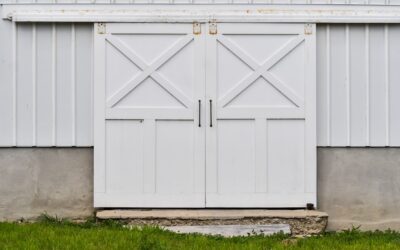
Standard sliding barn doors run into a wall problem: a single panel needs wall space equal to the opening to slide out of the way, and most homes do not have it. A double bypass barn door solves this by stacking two panels on parallel tracks so they slide past each other, covering a wide opening while only ever needing space equal to one panel. That makes bypass hardware the go-to choice for closets, laundry rooms, pantries, and any opening flanked by walls, windows, or corners. Here is everything to know before you install one.
Part of our Windows & Doors guide — explore the full guide →
- How a Bypass Barn Door Works
- Where Double Bypass Doors Work Best
- Understanding Bypass Hardware
- Sizing Your Doors Correctly
- Step-by-Step Installation Overview
- Choosing the Door Panels
- Cost Breakdown
- Common Pitfalls to Avoid
- Double Bypass vs. Other Door Styles
- Maintaining Smooth Operation
- Style and Finish Ideas
- The Verdict
How a Bypass Barn Door Works
In a bypass system, two or more door panels hang from separate but adjacent tracks mounted at slightly different depths from the wall. Because each panel rides its own track, they can slide independently and pass one another without colliding. To open the left half of a closet, you slide the left panel behind the right; to reach the right half, you slide the right panel behind the left.
The genius is the footprint. A single sliding door needs the wall beside the opening to be clear for the full door width. Bypass doors never leave the opening zone, which is why they shine in tight hallways, bedrooms with corner closets, and any wall crowded with switches, outlets, or trim.
Where Double Bypass Doors Work Best
- Reach-in closets: the classic use, replacing dated bifold or mirrored sliders with something with character.
- Laundry and utility rooms: hiding a washer-dryer or a stacked unit behind wide panels.
- Pantries: covering a broad kitchen storage opening without swinging into the room.
- Home offices and media nooks: concealing shelving or equipment behind a clean sliding face.
They are less ideal where you need the entire opening clear at once, since one panel always overlaps the other. For a full-width clear opening, a single slider or pocket door serves better. But for everyday closet and storage access, the bypass trade-off is barely noticeable.
Understanding Bypass Hardware
The hardware is what separates a smooth bypass door from a rattling one. A double bypass kit includes two tracks, or a single track with a two-tier bracket that offsets the panels, plus rollers, floor guides, stops, and mounting hardware. The offset is critical: the front panel hangs closer to the room and the rear panel sits behind it, with enough gap that they never scrape.
Quality kits use sealed steel ball-bearing rollers rated for the panel weight, soft-close dampers to stop the slam, and an anti-jump feature that keeps rollers from hopping the track. Budget for a solid floor guide too, since bypass panels can swing at the bottom without one. Expect a good double bypass hardware kit to run $150 to $400 depending on finish and weight rating.
Sizing Your Doors Correctly
Proper sizing prevents gaps that let you see into the closet. As a rule, each panel should be at least half the opening width plus 1 to 2 inches of overlap where the panels meet in the middle. For a 60-inch opening, two 32-inch panels give you coverage plus overlap. The panels should also be tall enough to overlap the opening top and bottom by an inch or so for a finished look.
Track length matters as much as panel size. The mounting board or track needs to span the full opening plus enough extra on each side for the panels to slide clear. Measure your opening width, double it in your head for how far panels travel, and confirm you have wall or header space above for the track. A structural mounting board, typically a 1×6 anchored into studs, gives the lag bolts something solid to grip.
Step-by-Step Installation Overview
- Mount the header board. Locate wall studs, then lag-bolt a level 1×6 mounting board above the opening. This carries all the weight.
- Attach the tracks. Fasten the front and rear tracks (or the two-tier bracket) to the mounting board, checking level carefully. Even a slight tilt makes doors drift open.
- Install the rollers. Bolt roller hangers to the top of each door panel at the spacing your kit specifies.
- Hang the panels. Lift the rear panel onto its track first, then the front panel onto its track. This is a two-person job for anything over 40 pounds.
- Add stops and guides. Install end stops so panels cannot roll off, and fasten floor guides that keep the bottoms aligned as they pass.
- Adjust and test. Fine-tune roller height so panels hang plumb and slide smoothly past each other without rubbing.
Plan on 3 to 5 hours for a first-timer. A stud finder, level, impact driver, and a helper are the essentials.
Choosing the Door Panels
Bypass panels can be solid wood, MDF with a painted finish, glass-paneled, or even mirrored on one face. Weight drives your hardware choice, so confirm your kit’s rating before falling for heavy solid-wood doors. For a farmhouse look, Z-brace or plank-style doors suit; for modern spaces, flat slab panels with a matte finish read clean. Mirrored bypass panels do double duty in bedrooms, adding a full-length mirror without sacrificing wall space.
Cost Breakdown
- Two door panels: $150 to $600 depending on material
- Double bypass hardware kit: $150 to $400
- Mounting board and fasteners: $20 to $50
- Professional installation: $200 to $500 if you hire out
A DIY double bypass barn door project typically lands between $350 and $900 all in, well under the cost of custom closet systems and far more distinctive.
Common Pitfalls to Avoid
The most frequent mistake is skimping on the mounting board and bolting the track into drywall anchors, which will eventually pull loose under repeated sliding. Always hit studs or a structural header. The second is an out-of-level track that makes panels slide open on their own. The third is forgetting floor guides, which lets the panels sway and clack together. Address all three and your bypass doors will glide quietly for years.
Double Bypass vs. Other Door Styles
It helps to see where bypass doors fit among the alternatives. A single sliding barn door needs wall space equal to its width beside the opening, which most rooms lack, but it clears the entire opening at once. Bifold doors fold back on hinges and clear most of the opening but intrude into the room and have flimsy hardware prone to jumping the track. Pocket doors slide into the wall and disappear entirely, giving a full clear opening, but they require opening up the wall to install, a major job.
Double bypass doors trade a fully clear opening for the smallest footprint and easiest installation of any wide-opening slider. You always have one panel overlapping the other, so you can only access half the opening at a time, but you never sacrifice wall space or open up drywall. For closets, laundry rooms, and pantries where you reach one side at a time anyway, that trade-off barely registers and the space savings are substantial.
Maintaining Smooth Operation
Bypass doors glide effortlessly when maintained and turn balky when neglected. A few times a year, wipe the tracks clean of dust and pet hair, which is the most common cause of gritty, sticking rollers. Avoid greasy lubricants that attract more debris; a dry silicone spray on the track keeps things moving without the mess. Check that the roller bolts and the mounting board lag bolts remain snug, since the repeated back-and-forth slowly works fasteners loose.
Inspect the floor guides too, as a loose or worn guide lets the panels sway and clack together at the bottom. If a door starts to drift open on its own, the track has likely gone slightly out of level, often from the mounting board settling, and a small shim behind one end restores it. Sealed ball-bearing rollers should last many years, but if one develops a flat spot or grinds, replace it before it damages the track. A five-minute seasonal check keeps a bypass system whisper-quiet.
Style and Finish Ideas
Because bypass doors present two panels side by side, their combined look reads as a feature wall, so coordinate the panels and hardware finish deliberately. Matte black hardware against white or natural-wood panels gives a clean, modern farmhouse feel that suits most homes. For a warmer look, oil-rubbed bronze rollers pair beautifully with stained wood doors. In a tight hallway, painting the doors the same color as the wall makes the closet recede visually, while a bold contrasting color turns the doors into a focal point. Glass-paneled bypass doors brighten a dark hallway by borrowing light, though they trade away the concealment of solid panels.
The Verdict
For wide closets and storage openings where wall space is scarce, a double bypass barn door delivers the sliding-door look without the impossible clearance a single panel demands. With the right hardware rating, careful sizing, and a solid mounting board, it is a satisfying weekend upgrade that adds both function and character to a room. Measure twice, buy hardware rated above your panel weight, and enjoy a smooth-gliding closet that finally makes sense of a tight wall.