
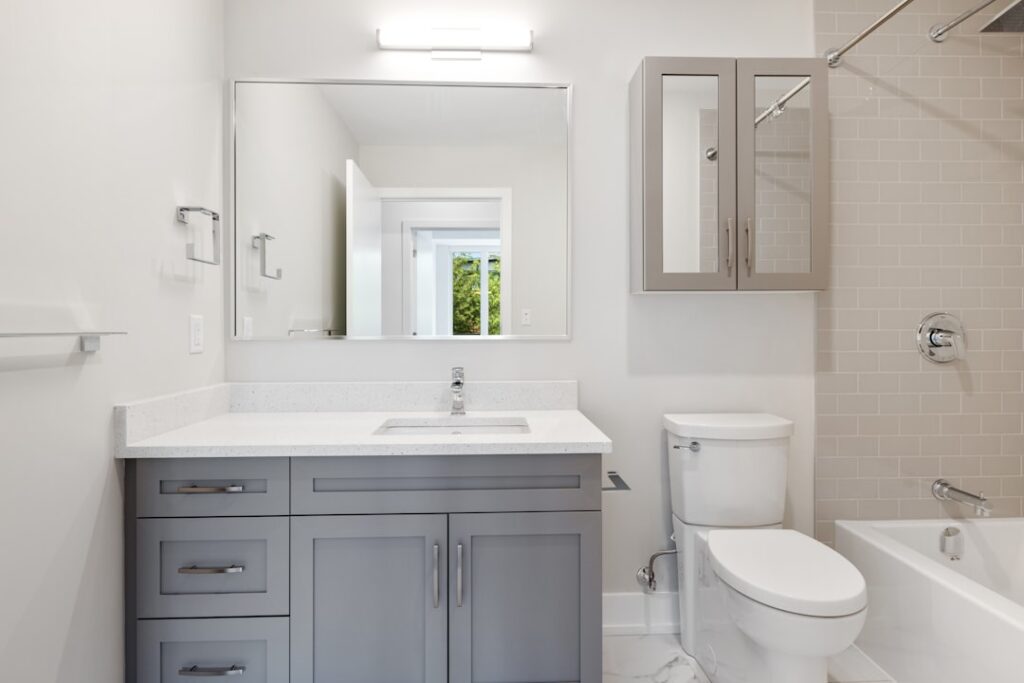
Walk any home center and most vanities come as a package with a top and sink already chosen for you, which is convenient until you want a stone counter, an undermount basin, or a specific faucet setup. That is when you buy a bathroom vanity cabinet only and pair it with a top of your choosing. Buying the cabinet alone gives you control over the countertop material, the sink type, and the number of faucet holes, and it often saves money because you skip the builder-grade cultured-marble top bundled into ready-to-go units. The tradeoff is that you become the general contractor for the assembly, matching the top, sink, and plumbing yourself.
Part of our Bathroom Remodeling & Flooring guide — explore the full guide →
Here is everything you need to line up so the pieces fit together the first time.
- Why Buy the Cabinet Alone
- Match the Cabinet Width to a Standard Top
- Depth and Height Still Matter
- Choosing the Countertop
- Sink and Faucet Coordination
- Plumbing Rough-In Check
- Assembly and Installation Steps
- Cost Breakdown and Bottom Line
- Judging Cabinet Construction Quality
- Coordinating the Whole Look
- When to Skip the Cabinet-Only Route
Why Buy the Cabinet Alone
There are three good reasons to go cabinet-only. First, material choice: you can top a $250 cabinet with a quartz or granite remnant for a look the bundled cultured-marble top cannot touch. Second, sink freedom: you can run an undermount basin for a seamless counter, a vessel for a modern look, or a specific brand you already own. Third, replacement: if your old counter is fine but the cabinet is water-damaged, you buy just the box. In each case, decoupling the parts gives you flexibility a sealed package cannot.
Match the Cabinet Width to a Standard Top
The single most important number is width, because pre-made vanity tops are sold in standard sizes and you want the cabinet to match one. Common widths are 24, 30, 31, 36, 48, and 60 inches. If you buy a 30-inch cabinet, a stock 31-inch top with a small overhang drops right on. Go with an oddball cabinet width and you are forced into a custom-cut top, which costs more. When possible, size the cabinet to a top that already exists off the shelf.
- 24-inch cabinet: pairs with a 25-inch top
- 30-inch cabinet: pairs with a 31-inch top
- 36-inch cabinet: pairs with a 37-inch top
- 48- and 60-inch cabinets: single or double-bowl tops available off the shelf
Depth and Height Still Matter
Width gets the attention, but confirm depth and height too. Standard vanity cabinets are about 21 inches deep and 32 to 36 inches tall before the top. If you are matching a top, the top’s depth needs to cover the cabinet with a slight overhang, usually landing around 22 inches. Buy a narrow-depth 18-inch cabinet and you must find an 18-inch-depth top to match, which narrows your options, so verify both parts before ordering either one.
Choosing the Countertop
With a cabinet-only purchase, the counter is your call. Your realistic options span a wide price range:
- Cultured marble or solid surface: integrated bowl, $100 to $300, the budget default
- Quartz: durable and non-porous, $200 to $600 for a vanity-sized piece, often available as a remnant
- Granite: similar price to quartz, great for remnant deals
- Butcher block or wood: warm look, needs sealing, $100 to $300
For a vanity-sized run of 30 to 48 inches, ask a local fabricator about remnants. A leftover slab from a kitchen job often covers a vanity for 30 to 50 percent less than a full slab, and quartz remnants are common.
Sink and Faucet Coordination
The sink and counter decisions are linked. If you want an undermount sink, the top must be a solid material like quartz or granite that can be drilled and polished for it, not a laminate. Drop-in sinks work on almost any top with a cutout. Decide your faucet configuration too, because the top needs the right hole layout: single-hole for a one-piece faucet, or a widespread with holes at 8 inches on center. Order the top with the correct holes pre-drilled, or have the fabricator drill them, since drilling stone yourself risks cracking it.
Plumbing Rough-In Check
Before anything ships, verify your plumbing lines up with the cabinet you chose. Measure the height of the drain stub and the supply valves off the floor and their distance from the wall, then confirm the cabinet back is open or notched where those lines enter. Many cabinet-only units ship with no back panel or a knock-out, which actually makes plumbing easier. If you switch from a pedestal sink to a cabinet, the old plumbing may sit too high and need lowering to clear the cabinet floor.
Assembly and Installation Steps
Putting the pieces together follows a clear order:
- Set and level the cabinet, shimming the base and anchoring the back rail to a wall stud.
- Attach the sink to the top if it is an undermount or drop-in, per the sink’s instructions.
- Set the top on the cabinet, checking the overhang is even, and secure it with silicone or clips.
- Install the faucet and drain assembly before or after setting the top, whichever gives better access.
- Connect the supply lines and P-trap, then run water and check every joint for leaks.
- Caulk the back edge of the top to the wall.
Cost Breakdown and Bottom Line
A cabinet-only vanity runs $150 to $600 depending on size and quality, and you add the top and sink separately. All in, a 30-inch cabinet with a quartz remnant top and an undermount sink might land around $500 to $900, often less than a comparable-quality pre-bundled unit and with far better materials. The real value of buying a bathroom vanity cabinet only is control: you decide the counter, the sink, and the faucet instead of accepting whatever the manufacturer bundled. Just size the cabinet to a standard top, confirm your plumbing, and the assembly comes together like a package deal you designed yourself.
Judging Cabinet Construction Quality
Since the cabinet is the one part you are committing to, know how to judge it. Open a drawer and check the glides; soft-close undermount glides on metal runners signal a quality build, while stapled bottom-mount plastic glides signal a cheap one. Look at the box material: plywood sides resist water far better than particleboard, which swells permanently if a supply line ever weeps. Check the drawer boxes themselves, where dovetail or dowel joints outlast stapled butt joints. Solid-wood or plywood face frames hold hinge screws for decades. In a bathroom, moisture resistance is the whole game, so if you can only upgrade one thing, choose a cabinet with a plywood or moisture-resistant box over the cheapest particleboard option, because that box has to survive years of humidity and the occasional drip.
Coordinating the Whole Look
Buying the pieces separately means you are the designer, so plan the finishes to work together before you order. Decide the metal finish first and carry it through the faucet, drawer pulls, and any exposed drain and trap, because mixed metals read as a mistake. Match the counter to the room’s palette; a white quartz brightens a small bath, while a bold granite becomes a focal point in a larger one. Consider the sink shape against the counter, since a rectangular undermount suits a modern look and an oval softens a traditional one. When you control every piece, the reward is a vanity that feels custom, but only if you make the finishes talk to each other rather than choosing each part in isolation.
When to Skip the Cabinet-Only Route
Buying separately is not always the smart move. If you want a basic builder-grade look and do not care about the counter material, a pre-bundled vanity with an included cultured-marble top is often cheaper and simpler, because you skip sourcing and coordinating parts. If you are not comfortable measuring for a matching top or drilling faucet holes, the bundled route removes those decisions. And if your timeline is tight, a complete vanity ships as one unit rather than three separate purchases that must all arrive and fit. Reserve the cabinet-only approach for when you genuinely want a specific counter, sink, or faucet configuration that no bundled unit offers, because that flexibility is the whole reason to take on the extra coordination.


