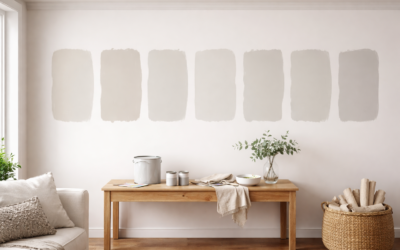
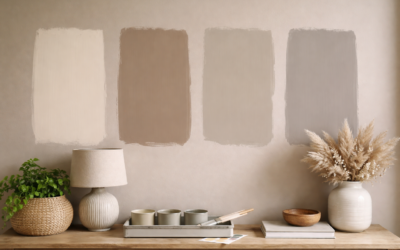
Greige is supposed to be the safe choice, yet it is one of the easiest colors to get wrong, because two greiges with nearly the same name can differ by 20 points of lightness. The Benjamin Moore greige paint colors worth shortlisting range from barely-there Classic Gray (LRV 73.67) to the deeper Thunder (LRV 47.58), with Revere Pewter, Edgecomb Gray, Pale Oak, Balboa Mist and Collingwood in between. Pick by lightness first, then by how warm you want the room to feel.
Part of our Paint & Walls guide — explore the full guide →
For a bright, airy room, start in the 60s and 70s: Classic Gray, Pale Oak or Balboa Mist. For a balanced, all-purpose neutral, look at Edgecomb Gray or Collingwood. For more depth and contrast with white trim, Revere Pewter and Thunder do the job. Every code and LRV here comes from the color’s page on the manufacturer’s website.
- Benjamin Moore Greige Paint Colors Compared
- Light Greiges: Classic Gray, Pale Oak and Balboa Mist
- Mid-Light Greiges: Edgecomb Gray and Collingwood
- Deeper Greiges: Revere Pewter and Thunder
- How to Choose the Right Greige for Your Room
- Greige Pairings for Floors, Cabinets and Exteriors
- Troubleshooting Greige Problems
- Sheen, Coverage and Cost
- When to Call a Pro
- Frequently Asked Questions
Benjamin Moore Greige Paint Colors Compared
LRV (light reflectance value) runs from 0 for black to 100 for pure white. Most people perceive a difference once two colors are a few points apart, and a gap of 10 or more is obvious on the wall.
| Color and code | LRV | Collection | How it reads | Best rooms |
|---|---|---|---|---|
| Classic Gray OC-23 | 73.67 | Off White | Ultra-light gray that can act as an off-white | Small rooms, dim spaces, whole-house color |
| Pale Oak OC-20 | 68.64 | Off White | Light neutral with warm gray undertones | Living rooms, bedrooms, open plans |
| Balboa Mist OC-27 | 65.53 | Off White | Pale gray with a slightly warm cast | Hallways, kitchens, family rooms |
| Edgecomb Gray HC-173 | 63.09 | Historical | Warm, welcoming go-to neutral | Whole-house color, traditional homes |
| Collingwood OC-28 | 61.52 | Off White | Widely appealing warm gray | Bright rooms, exteriors, cabinets |
| Revere Pewter HC-172 | 55.05 | Historical | Iconic neutral bridging warm and cool | Sunny rooms, accent walls, exteriors |
| Thunder AF-685 | 47.58 | Affinity | Mid-tone neutral blending warm and cool | Offices, dining rooms, cabinets, doors |
Descriptions follow the language Benjamin Moore uses on each color page. Screens distort color, so view a physical sample before you buy.
Light Greiges: Classic Gray, Pale Oak and Balboa Mist
Classic Gray OC-23
With an LRV of 73.67, Classic Gray is the lightest color here and is often mistaken for an off-white once it is on the walls. It suits rooms with limited daylight, where a deeper greige would turn murky. Benjamin Moore lists Simply White OC-117 as a coordinating color, which makes an easy trim match.
Pale Oak OC-20
Benjamin Moore describes Pale Oak as a versatile neutral with warm gray undertones. At 68.64 LRV it gives a touch more color than Classic Gray while still reading light. It looks especially good with white oak floors and natural wood furniture. Chantilly Lace OC-65 is one of the listed coordinating colors for trim.
Balboa Mist OC-27
At 65.53, Balboa Mist is described as a pale gray with a slightly warm cast. It sits close to Pale Oak in lightness, so test the two side by side; one will look warmer in your particular light.
Mid-Light Greiges: Edgecomb Gray and Collingwood
Edgecomb Gray HC-173
Part of the Historical Colors collection, Edgecomb Gray (LRV 63.09) is a classic whole-house greige. It leans warm enough to feel welcoming and light enough to flow from room to room. Coordinating colors on its page include White Heron OC-57 and Boothbay Gray HC-165, the latter a useful option for a contrasting room or exterior.
Collingwood OC-28
Collingwood (LRV 61.52) is described as a widely appealing warm gray. It has a little more depth than Edgecomb Gray, which helps in sun-filled rooms where lighter greiges can wash out. It also coordinates with White Heron OC-57.
Deeper Greiges: Revere Pewter and Thunder
Revere Pewter HC-172
Revere Pewter is the best-known of the group, and many searches for Benjamin Moore greige land on it. At 55.05 LRV it is noticeably deeper than Edgecomb Gray, by about 8 points. Benjamin Moore calls it a neutral that bridges warm and cool tones. In a bright south-facing room it looks soft and balanced; in a dim north room it can feel heavy, so test before you commit. Listed coordinating colors include White Dove OC-17 for trim and Chelsea Gray HC-168 for a darker accent.
Thunder AF-685
From the Affinity collection, Thunder (LRV 47.58) is a true mid-tone. It works on a single accent wall, on a home office, on kitchen islands and on interior doors. Paired with a bright white trim, it gives a tailored, modern contrast.
How to Choose the Right Greige for Your Room
- Check the light direction. North light is cool and flat, so choose a lighter, warmer greige (Classic Gray, Pale Oak). South light is warm and strong, so deeper options (Revere Pewter, Collingwood) stay balanced.
- Look at fixed finishes. Floors, counters, tile and brick influence the walls. Warm oak floors favor warm greiges; gray tile or cool vinyl plank favors the grayer end.
- Decide on contrast. If you want walls and trim to blend, stay above 60 LRV. If you want clear separation from white trim, go into the 50s or below.
- Sample large. Peel-and-stick paint sample sheets let you move a big swatch from wall to wall without painting test patches. Otherwise paint two coats on a 2 by 2 foot board.
- Watch it for two days. Check morning, midday, evening and lamp light before deciding.
- Repeat the color on purpose. In an open plan, use one greige for connected spaces and shift only one step lighter or darker in separate rooms.
Greige Pairings for Floors, Cabinets and Exteriors
Greige walls shine when the surrounding finishes share their warmth. Medium and light oak floors suit Pale Oak, Edgecomb Gray and Revere Pewter. Gray-washed wood or cool gray vinyl plank pairs more naturally with Classic Gray or Balboa Mist. Dark walnut and espresso floors give strong contrast with any of the lighter shades.
In kitchens, greige walls work with white, wood or deep-colored cabinets. A Thunder island under Edgecomb Gray walls is an easy two-tone scheme. On exteriors, sunlight lightens colors considerably, so Revere Pewter or Collingwood often read lighter outside than inside; Thunder can serve as a body color with white trim and a black door. Always test an exterior sample on the actual siding in full sun and shade.
Troubleshooting Greige Problems
- Walls look green: Some greiges pick up green from outdoor foliage or certain floors. Step to a warmer neighbor or change bulbs to a warmer color temperature.
- Walls look purple or pink: Cooler greiges in strong warm light can show a violet hint. Compare against a warmer greige in the same room.
- Too dark: Move up roughly 8 to 10 LRV points, for example from Revere Pewter to Edgecomb Gray.
- Looks like plain beige: The room light is very warm. Try a grayer option or add cooler accents such as black metal, gray textiles and greenery.
- Uneven finish: Spot-prime patches and apply a full second coat to remove flashing.
Sheen, Coverage and Cost
Matte or eggshell finishes flatter greige on walls because they reduce glare and hide minor surface flaws. Use satin in kitchens, baths and kids’ rooms where walls get wiped, and semi-gloss on trim and doors. A gallon of interior paint typically covers about 350 to 400 square feet per coat on smooth, primed walls, so a 12 by 14 foot bedroom with 8-foot ceilings (about 416 square feet of wall) usually needs around 2 to 3 gallons for two coats, depending on openings and surface texture.
Premium interior paint lines cost noticeably more per gallon than budget lines, though they often cover better and touch up more cleanly. Professional painting usually costs a few dollars per square foot of wall area, rising with tall ceilings, heavy patching and color changes.
When to Call a Pro
Hire a painter for stairwells, two-story foyers and cathedral ceilings that need scaffolding, for exterior work above the first floor, and for cabinet refinishing where a sprayed finish matters. In homes built before 1978, test old paint for lead before sanding or scraping, and use lead-safe practices if it is present. A color consultant can also visit and hold samples against your floors and counters if you are torn between two neighboring greiges.
Benjamin Moore greige paint colors cover a wide range of depth, so the right choice is mostly a question of light. Start with LRV, narrow by warmth, and test at full size before you buy gallons.
Frequently Asked Questions
What is the most popular Benjamin Moore greige?
Revere Pewter HC-172 is the best-known. Edgecomb Gray HC-173 is the usual pick for people who want something similar but lighter.
Is Revere Pewter lighter or darker than Edgecomb Gray?
Darker. Revere Pewter has an LRV of 55.05 and Edgecomb Gray has an LRV of 63.09, a difference of about 8 points.
What is the lightest Benjamin Moore greige?
Of the shades compared here, Classic Gray OC-23 is the lightest at 73.67 LRV, light enough to act as an off-white.
What white trim goes with Benjamin Moore greige colors?
White Dove OC-17, Chantilly Lace OC-65, Simply White OC-117 and White Heron OC-57 are listed as coordinating colors for several of these greiges.
Which Benjamin Moore greige works best in a north-facing room?
Lighter, warmer greiges such as Classic Gray, Pale Oak or Edgecomb Gray hold up best in cool north light. Deeper shades can look flat or gray there.