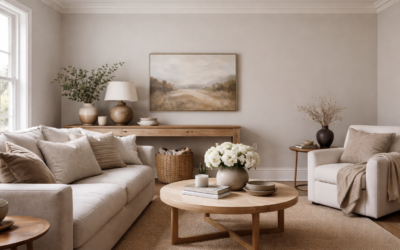
Benjamin Moore Pale Smoke is color 1584, a light, cool blue-gray with an LRV of 63.6 on the manufacturer’s color page. Benjamin Moore describes it as blue meeting gray to create a smoky, light and cool neutral, and that is exactly how it reads: a soft gray with a clear but gentle blue cast. It sits in the Benjamin Moore Classics collection and is listed in the neutral family.
For most homes, Pale Smoke works best in bedrooms, bathrooms and living spaces with decent daylight, paired with clean or softly warm whites. It is light enough to keep a room airy but has enough color to look intentional rather than washed out. North-facing rooms will push it bluer, so test it there before committing.
- Benjamin Moore Pale Smoke at a Glance
- What the LRV and Undertones Mean in a Room
- Rooms Where Pale Smoke Shines
- Trim, Ceiling and Accent Pairings
- Pale Smoke Compared With Boothbay Gray and Wedgewood Gray
- How to Paint With a Light Blue-Gray
- Troubleshooting
- Cost and When to Hire a Painter
- Frequently Asked Questions
Confirm specs on the current manufacturer page or a physical chip before you buy, since listed values can be updated and screens rarely show blue-grays accurately.
Benjamin Moore Pale Smoke at a Glance
This spec table collects the confirmed details for 1584 along with what each means for your room.
| Spec | Value | What it means |
|---|---|---|
| Color number | 1584 | Order by this code to avoid mix-ups with similar names |
| LRV | 63.6 | Light; reflects more light than it absorbs |
| Collection | Benjamin Moore Classics | Part of the large classic color system |
| Color family | Neutral | Behaves like a neutral with a blue cast |
| Undertone | Blue | Reads as a smoky blue-gray, bluer in cool light |
| Listed coordinating colors | White Diamond OC-61, White Dove OC-17, Sebring White 1492, Mount Saint Anne CC-710 | Whites and soft companions for trim and adjoining rooms |
What the LRV and Undertones Mean in a Room
On a scale where 0 is black and 100 is white, an LRV of 63.6 puts this color in the light range. It bounces back plenty of daylight, so rooms stay bright, but it still has enough depth that white trim stands out clearly against it. That balance is part of why light blue-grays are so popular in older homes and new builds alike.
The blue undertone is gentle, not loud. In south- and west-facing rooms with warm afternoon light, the color tends to look like a soft gray with a cool whisper of blue. In north-facing rooms, the cooler light brings the blue forward, and it can read as a pale, misty blue. Warm white bulbs (2700K to 3000K) soften it at night; very cool daylight bulbs make it look crisper and bluer.
Your surroundings change it too. Warm honey-toned floors and beige stone make the blue look stronger by contrast. White oak, gray-washed wood and white tile keep it reading as a calm gray. Hold samples next to your floor and countertop rather than judging the color on its own.
Testing tips
Light blue-grays shift more than almost any other color family, so sampling is worth the effort. Paint a large sample board or use peel-and-stick samples, and check them on at least two walls at different times of day. Look at the color next to your trim white, too, since the two always read as a pair.
Rooms Where Pale Smoke Shines
- Bedrooms: The soft, cool tone feels restful, especially with white or linen bedding.
- Bathrooms: Pairs naturally with white tile, marble-look surfaces and chrome or nickel fixtures.
- Living rooms: A good all-over wall color for rooms with solid daylight.
- Kitchens: Works on walls with white cabinets, or on cabinets themselves for a gentle color.
- Nurseries and kids’ rooms: Light and calm without being overtly blue.
- Exteriors: On siding, light colors look even lighter in full sun; expect Pale Smoke to read as a pale, airy gray outside.
Be cautious in small, dim rooms with only north light, where the blue may feel chilly. In those spaces, balance it with warm lighting and textiles or consider a gray with a warmer undertone.
Trim, Ceiling and Accent Pairings
White trim
The manufacturer lists White Diamond OC-61 and White Dove OC-17 among the coordinating colors. White Diamond is a cleaner, cooler white that keeps the look crisp. White Dove is a softer, slightly warm white that takes the edge off the blue and feels cozier. Very yellow creams can clash with a cool blue-gray, so test any creamy white beside the wall color first.
Companion colors
Sebring White 1492, a cool white with green undertones (LRV 78.5), is also listed as a coordinate and works as a ceiling or trim alternative. Mount Saint Anne CC-710, the other listed coordinate, is a deeper blue-gray (LRV 41.9) for an adjoining room or accent. For deeper accents, navy, charcoal and deeper blue-grays on doors, an island or built-ins create a tonal, layered look. Warm accents such as rust, terracotta or camel leather balance the coolness.
Materials
Polished nickel, chrome and matte black hardware suit this color. White oak, light maple and gray-washed floors keep things light. For a coastal feel, add natural fibers like jute and linen.
Pairing it with flooring
Floors change how any light color reads. With white oak and other pale, natural wood, Benjamin Moore Pale Smoke reads as a soft, calm gray. With warm red oak, cherry or golden pine, the contrast makes the walls look noticeably bluer, which some people love and others find too cool. Gray luxury vinyl plank or gray tile can make a room feel flat and monochrome, so add warmth through a rug, wood furniture or brass accents. Dark floors give a crisp, high-contrast look and keep the light walls feeling bright.
Carpet matters too. A warm beige carpet will pull the walls toward blue; a gray or oatmeal carpet keeps the whole room in the same cool, quiet range. Bring a carpet or floor sample home when you test paint swatches so you see them together.
Pale Smoke Compared With Boothbay Gray and Wedgewood Gray
These two historical colors come up in the same searches because they share a cool blue-gray character. Here is how they compare using LRVs from the manufacturer’s color pages.
| Color | LRV | How it compares |
|---|---|---|
| Pale Smoke 1584 | 63.6 | The lightest of the three; airy, smoky blue-gray |
| Wedgewood Gray HC-146 | 49.59 | A noticeable step deeper with more visible color |
| Boothbay Gray HC-165 | 43.26 | The deepest of the three; a medium blue-gray often used on exteriors |
If you want color you can clearly see on the wall, Wedgewood Gray and Boothbay Gray deliver more depth. If you want a light background that keeps rooms bright, Pale Smoke is the softer option. Many people use these together: Pale Smoke in a bedroom or upstairs, with a deeper blue-gray on a front door, an island or exterior siding.
How to Paint With a Light Blue-Gray
A good paint roller and tray kit makes a big difference to an even finish. Here is a reliable process:
- Prep the walls. Clean, fill holes and sand patches smooth. Wipe away dust.
- Prime where needed. Use primer on bare drywall, patches, stains or when covering a dark color.
- Pick a sheen. Matte or eggshell for walls, satin for bathrooms and busy areas, semi-gloss for trim and doors.
- Cut in first. Brush along ceilings, corners and trim before rolling.
- Roll in sections. Load the roller well, roll in a W pattern, then fill in, keeping a wet edge.
- Apply two coats. Light colors usually cover in two coats over a primed or similar-color surface.
- Box your paint. Mix all cans for one room together so the color is uniform.
Troubleshooting
The room looks too blue: Switch to warmer bulbs, add warm wood and textiles, or use a softer warm white on the trim. If it is still too blue, try a gray with a green or warm undertone.
The color looks washed out: In very bright, south-facing rooms, light colors can lose depth. Wales Gray 1585, the next step deeper on the same strip (LRV 53.54), may work better.
Patchy finish: Usually caused by thin coats or painting over unprimed patches. Spot-prime the patches and apply a full second coat.
Cost and When to Hire a Painter
A gallon covers roughly 350 to 400 sq ft per coat on smooth walls, so a typical bedroom needs about 2 gallons for two coats. Premium lines cost more per gallon but often cover and wear better. Hiring a painter for one room typically costs from a few hundred dollars to over a thousand, depending on size, prep, trim and region.
Consider a pro for high ceilings, stairwells, cabinets and exterior work above one story. In homes built before 1978, test existing paint for lead before sanding or scraping and follow lead-safe practices.
Frequently Asked Questions
What is the LRV of Benjamin Moore Pale Smoke?
The manufacturer’s color page lists Pale Smoke 1584 with an LRV of 63.6, which makes it a light color. Check the current page, since values can be updated.
Is Pale Smoke blue or gray?
It is a blue-gray. The manufacturer describes it as blue meeting gray in a smoky, light and cool neutral. It looks grayer in warm light and bluer in north light.
What white goes with Pale Smoke?
White Diamond OC-61 gives a crisp look and White Dove OC-17 a softer one; both are listed as coordinating colors by the manufacturer.
Is Pale Smoke lighter than Boothbay Gray?
Yes. Pale Smoke has an LRV of 63.6 compared with 43.26 for Boothbay Gray, so it is clearly lighter.
Does Pale Smoke work in a north-facing room?
It can, but expect it to look bluer and cooler. Warm lighting, warm textiles and a softer white trim help balance it.