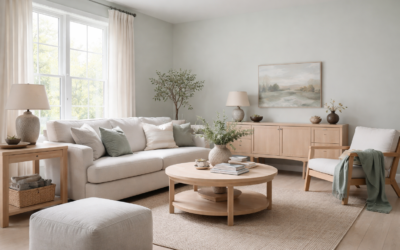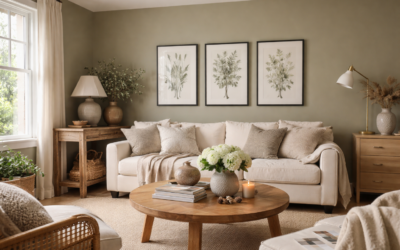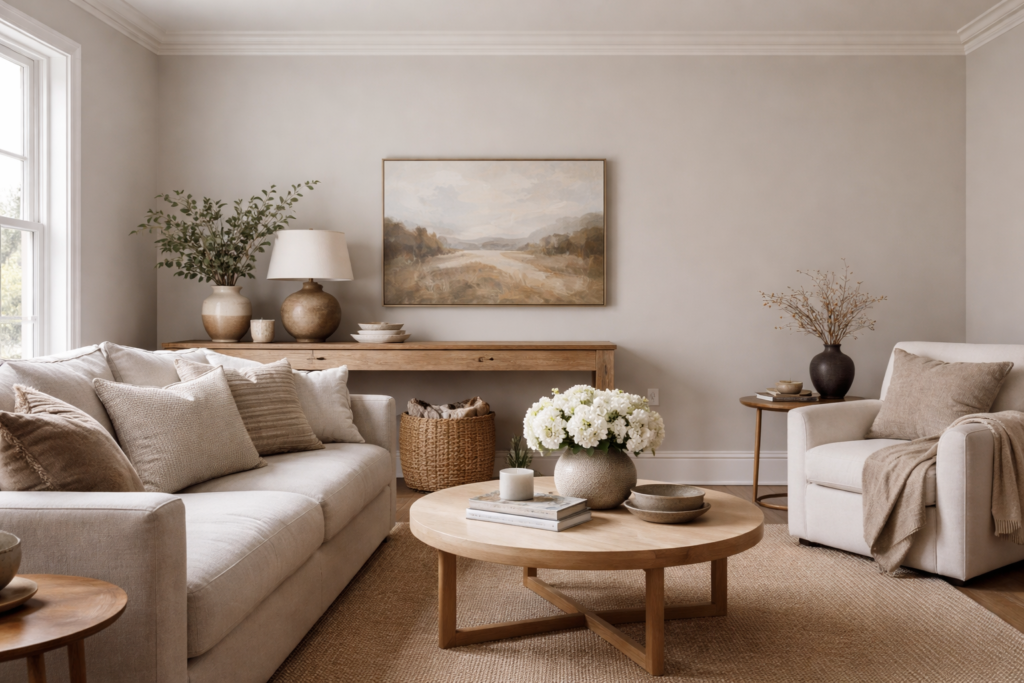
The name sounds dark and smoky, so plenty of people expect a charcoal. In reality, Benjamin Moore Smoke Embers is a soft, mid-light gray that sits right in the comfortable middle of the brightness scale. It is color number 1466 in the Benjamin Moore Classics collection, and the maker lists its light reflectance value (LRV) at 51.44.
Benjamin Moore describes it as falling ever so slightly cooler than traditional warm grays. Put simply, Smoke Embers is a balanced gray with a quiet hint of warmth that leans just a touch cool next to beige-based greiges. It reads calm and neutral in most rooms, without the stark, icy feel of a blue-gray or the yellowish cast of an old-school beige.
If you want a gray that works on large wall areas, plays well with white trim, and does not swing wildly between morning and evening light, Smoke Embers is a strong candidate. It is not a moody accent color, so if you were looking for a deep charcoal, you will want a much darker chip from the same family.
Benjamin Moore Smoke Embers at a Glance
These are the core facts from the manufacturer’s color page, plus what each one means in a real room. Paint formulas and color pages are updated over time, so confirm the current listing before you buy.
| Spec | Value | What it means |
|---|---|---|
| Color number | 1466 | Use this code at the paint counter to avoid mix-ups |
| Collection | Benjamin Moore Classics | A large, long-running palette, widely available to tint |
| Color family | Neutral | Works as a whole-house wall color |
| LRV | 51.44 | Mid-light: reflects about half the light hitting it |
| Temperature | Slightly cooler than warm grays | Reads balanced, not beige and not icy |
| Coordinating whites | Cloud White 967, White Dove OC-17 | Soft, warm-leaning whites for trim and ceilings |
| Coordinating colors | Westchester Tan 246, Newburyport Blue HC-155 | A soft yellow-cream (LRV 77.95) and a deep blue (LRV 10.31) for accents |
An LRV in the low 50s is the sweet spot for many homeowners. It stays light enough for rooms with average windows, yet it has enough depth that white trim and cabinetry stand out clearly against it.
Undertones in Different Light
Every gray has an undertone, and Smoke Embers keeps its hidden color unusually quiet. In most light it reads as a true soft gray. The subtle shifts show up mainly when you compare it directly with other neutrals or when the light is extreme.
North-facing rooms
Cool, indirect northern light emphasizes the cooler side of this color. Expect a slightly deeper, more silvery gray. It stays pleasant rather than cold, but if your north room already feels dim, consider a lighter color with a higher LRV.
South-facing rooms
Warm southern sun softens it into a gentle, light gray with a faint warm glow. Midday light can make it look a step lighter than the chip, so do not panic if it seems paler on the wall than in the store.
East and west exposures
East rooms get warm morning light and cooler afternoons, so the color looks warmer early and grayer later. West rooms reverse that pattern, with a warm, almost greige look at sunset.
Artificial light
Bulb color temperature matters. Warm bulbs around 2700K make Smoke Embers look cozier and slightly warmer. Cool bulbs around 4000K and above pull out the gray and can make it feel more modern. Keep the bulbs consistent within one open space so walls do not look like two colors.
Rooms Where Smoke Embers Works Best
Living rooms and family rooms. A soft, balanced gray suits large walls and pairs well with wood floors, slipcovered sofas and mixed metals. It gives the room structure without dominating it.
Bedrooms. Its calm character makes it a good choice for restful spaces. Combine it with white bedding and warm wood furniture so the room does not feel flat.
Open-plan main floors. Because it does not swing hard warm or cool, it can run through a hallway, living area and dining space as one connecting color.
Bathrooms and kitchens. It sits nicely beside white tile, marble-look quartz and chrome or nickel fixtures. In a small windowless bath, use bright, neutral lighting so it does not read too dim.
Where to be careful. In a very small, dark room with one small north window, a 51 LRV may feel heavier than you want. Test there before committing.
Trim, Ceiling and Accent Pairings
The manufacturer lists Cloud White and White Dove as coordinates, and both are soft whites that keep the overall scheme warm and welcoming. Use either in a semi-gloss or satin sheen for trim and doors, and a flat finish for ceilings. A bright, stark white also works if you want a crisper, more contemporary contrast.
For accents, Newburyport Blue gives a deep, classic navy contrast on a kitchen island, built-ins or an interior door. Westchester Tan, the other listed coordinate, is a soft yellow-cream that works in an adjoining room if you want a softer transition between spaces.
Charcoal and black accents, such as window frames, light fixtures or cabinet hardware, also look sharp against this gray. Natural oak, walnut and warm brass add the warmth that keeps a gray room from feeling sterile.
Side by Side With Near Shades
Smoke Embers is often compared with greige colors, especially Revere Pewter (HC-172), which Benjamin Moore lists at an LRV of 55.05. That makes Revere Pewter slightly lighter. It also carries more visible warmth and reads more clearly as greige, while Smoke Embers looks more like a straightforward soft gray.
Compared with blue-gray colors, Smoke Embers is far less cool. It will not read as blue on the wall. Compared with lighter grays in the 60 to 70 LRV range, it has more depth and gives trim stronger definition, but it will make a room feel slightly more enclosed.
If you like its character but want it lighter, ask the paint counter about a lighter strength formula, or look one or two steps up the same color strip. For a darker version, move down the strip rather than jumping to an unrelated charcoal, so the undertone stays consistent.
How to Sample and Paint It
- Use large samples. Peel-and-stick sample sheets or painted boards of at least 12 by 12 inches give a far better read than a small chip.
- Test on two or three walls. Place samples on the brightest and darkest walls, and near trim, flooring and cabinets.
- Look at several times of day. Check morning, afternoon and evening under your normal lamps for two to three days.
- Prep the walls. Fill holes, sand patches smooth, clean greasy areas and spot-prime repairs.
- Prime if needed. When covering a very dark or very bright color, a tinted primer helps you reach true color in two coats.
- Cut in and roll. Cut in along trim and ceilings, then roll in sections while keeping a wet edge.
- Apply two coats. A second coat evens out the color and sheen.
For walls, eggshell or matte finishes are popular. Matte hides wall flaws, while eggshell is a bit easier to wipe clean in busy areas.
Troubleshooting
It looks darker than expected. Common in north rooms or with few windows. Add brighter bulbs, switch to a lighter strength formula, or choose a lighter step on the strip.
It looks slightly purple or blue at night. Cool LED bulbs or strong blue decor can exaggerate the cool side of a gray. Swap to warmer bulbs around 2700K to 3000K.
The trim looks dingy. A very creamy white can look yellow beside a cool-leaning gray. Choose a cleaner soft white instead.
Patchy finish. Usually from missing a coat or uneven primer. Apply a full second coat across the whole wall, corner to corner.
Cost Ranges and When to Hire a Painter
Expect general prices of about $40 to $90 per gallon for quality interior paint depending on product line, and roughly 350 to 400 square feet of coverage per gallon on smooth, primed walls. A typical 12 by 12 foot bedroom needs around 2 gallons for two coats. Professional interior painting generally runs a few hundred dollars for a single small room up to several thousand for a whole floor.
Call a painter for high stairwell walls, rooms with extensive drywall damage or homes built before 1978, where existing paint should be tested for lead before sanding.
Frequently Asked Questions
What is the LRV of Benjamin Moore Smoke Embers?
Benjamin Moore lists Smoke Embers at an LRV of 51.44. That places it in the mid-light range, so it reflects roughly half the light hitting it.
Is Smoke Embers a warm or cool gray?
It is a balanced gray that the maker describes as slightly cooler than traditional warm grays. In most rooms it reads as a neutral soft gray with only a faint warm or cool shift depending on the light.
Is Smoke Embers a charcoal gray?
No. Despite its name, it is a mid-light gray, not a dark charcoal. For a charcoal look, move several steps down a gray strip or choose a dedicated dark gray.
What white trim goes with Smoke Embers?
The maker lists Cloud White and White Dove as coordinating whites. Both are soft whites that keep the room warm and look clean against this gray.
What is the color number for Smoke Embers?
Smoke Embers is color 1466 in the Benjamin Moore Classics collection. Give the number at the paint counter so the correct formula gets mixed.
How does Smoke Embers compare with Revere Pewter?
Revere Pewter has a slightly higher LRV of 55.05 and more visible warmth, so it reads as a greige. Smoke Embers looks more like a straightforward soft gray.