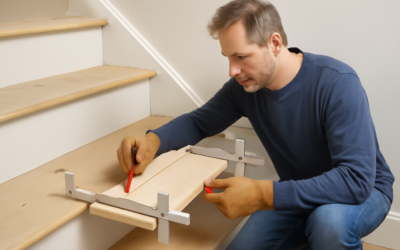
Drilling knob holes freehand is how a beautiful kitchen ends up with crooked, mismatched pulls that catch your eye every time you walk past. The best cabinet hardware jig removes that risk entirely by guiding your drill bit to the exact same spot on every door and drawer. For a project where a fraction of an inch is the difference between professional and amateur, this $30 to $60 tool pays for itself on the very first cabinet.
Part of our Kitchen Remodeling guide — explore the full guide →
Why a Jig Beats Measuring by Hand
Consider what’s actually at stake. A typical kitchen has 20 to 40 doors and drawers, each needing one or two precisely placed holes. Marking each one with a tape measure and square invites tiny errors that compound across the room, and a hole drilled a sixteenth of an inch off is permanent.
A hardware jig sets your spacing once, then reproduces it on every piece. That consistency is what separates a kitchen that looks custom-built from one that looks like a rushed weekend job.
What to Look For in a Quality Jig
Not all jigs are built the same. These features matter most:
- Adjustable centering — an edge guide that self-centers on rails and stiles so pulls sit dead center without math.
- Hardened steel drill bushings — replaceable metal sleeves that keep the bit from wandering and won’t wear out like plastic guides.
- Wide spacing range — support for pull centers from 2 to 10 inches or more, covering everything from cabinet knobs to appliance pulls.
- A fence for doors and drawers — flip-down stops that reference the corner of the piece for repeatable placement.
Steel bushings are the single most important feature. Cheaper jigs with bare drilled holes let the bit chew out the guide over time, and accuracy drifts after a dozen uses.
Top Cabinet Hardware Jigs Compared
Kreg KHI-Pull Cabinet Hardware Jig
At around $40, the Kreg KHI-Pull is the crowd favorite for good reason. It handles knobs and pulls, self-centers on any rail width, and includes edge guides for both doors and drawer fronts. The adjustable stops make repeat drilling foolproof, and the hardened bushings hold up to a full kitchen and then some.
True Position Tools TP-1934
This is the professional’s choice at roughly $130. It’s heavier, all-aluminum, and dead accurate, with independent fences and a range that covers oversized appliance pulls. If you’re outfitting cabinets for a living, the TP-1934 earns its price. For a one-time kitchen, it’s overkill.
Milescraft 1361 JointMate
Around $30, the Milescraft is the budget pick that still gets the job done. It lacks the refinement of the Kreg but offers solid centering and adjustable spacing for occasional DIYers who won’t drill hundreds of holes.
How to Use a Cabinet Hardware Jig
Even the best jig needs correct technique. Follow this sequence:
- Set your desired pull spacing on the jig using its scale, then lock it.
- Position the jig on the door or drawer, referencing the corner with the fence.
- Clamp or hold the jig firmly so it can’t shift mid-drill.
- Drill through the bushing with a sharp bit sized for your screws, usually 3/16 inch.
- Back the bit out slowly to avoid splintering the finished face.
Always drill a test hole in scrap or an inside cabinet panel first to confirm your spacing. And place a piece of tape on the back of the door where the bit exits to prevent tear-out on that hidden but visible edge.
Common Mistakes to Avoid
The biggest error is referencing off the wrong edge. Doors typically get hardware referenced from the corner nearest the counter or floor, while drawers get pulls centered both horizontally and vertically. Decide your placement convention before you drill a single hole and stick to it across the entire room.
Rushing is the other trap. Take an extra thirty seconds to seat the jig and verify the reference on each piece. A mispositioned jig produces a perfectly consistent set of holes in the wrong place, which is arguably worse than random errors.
Is a Jig Worth It for One Kitchen?
Absolutely. A cabinet installer charges $5 to $10 per hole to hang hardware, so a kitchen with 30 pieces could run $200 to $400 in labor alone. A $40 jig and an afternoon of your time deliver identical results and leave you with a reusable tool for the next project.
Even if you only ever do one kitchen, the peace of mind of knowing every pull will line up is worth far more than the modest cost.
Placement Conventions for a Polished Look
A jig guarantees consistency, but you still decide where the hardware lands, and there are conventions that read as professional. On upper cabinet doors, knobs typically go 2.5 to 3 inches down from the bottom corner of the door. On lower cabinet doors, they mount 2.5 to 3 inches up from the top corner, keeping them within easy reach.
Drawer pulls are usually centered horizontally on the drawer face, and on wide drawers you can mount two pulls or a single long appliance pull for balance. For tall pantry or appliance doors, align the hardware with the adjacent cabinet knobs so everything sits on a consistent horizontal line. Sketch your plan on paper before drilling, and use the jig’s fence to reproduce whichever convention you choose across every matching piece in the room.
Final Recommendation
For nearly every homeowner, the Kreg KHI-Pull is the best cabinet hardware jig on the market: accurate, affordable, and genuinely easy to use. Serious pros should step up to the True Position TP-1934, while tight budgets can lean on the Milescraft. Whichever you choose, a jig transforms cabinet hardware from a nerve-wracking gamble into a satisfying, repeatable task that leaves your kitchen looking factory-finished.