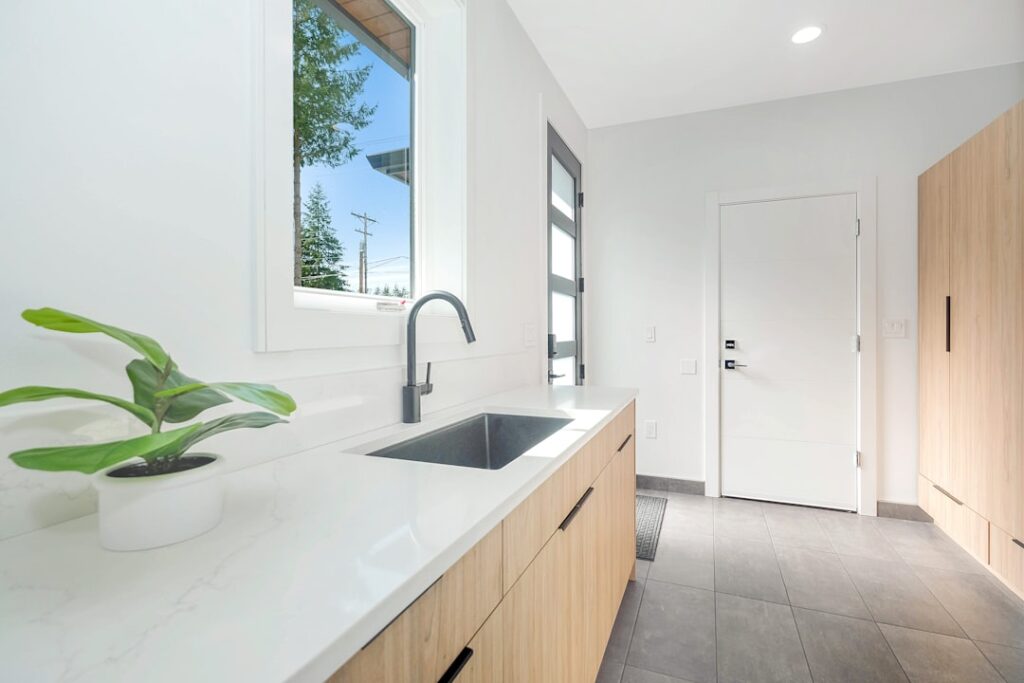
The laundry room ranks alongside the bathroom and kitchen as one of the wettest rooms in a home — but it gets far less attention when it comes to flooring selection. Between washer leaks, hose failures, detergent spills, and tracked-in moisture from wet clothes, best flooring for laundry room choices need to prioritize waterproofing above all else. A burst washing machine supply hose can release 500 or more gallons of water per hour — and if your floor cannot handle it, you are looking at thousands of dollars in damage.
This guide covers the top laundry room flooring options with specific product recommendations, explains what to avoid, and addresses practical considerations like washer leak protection, floor drain compatibility, standing comfort, and cost.
Laundry Room Flooring Requirements
Before comparing options, understand the specific demands a laundry room places on flooring.
- Waterproof (not just water-resistant): The floor must survive standing water from a washer leak, not just occasional splashes
- Slip-resistant when wet: Wet laundry drips, detergent spills, and standing water create slip hazards
- Durable under heavy appliances: Washers and dryers weigh 150 to 300 pounds each and vibrate during operation
- Easy to clean: Detergent residue, bleach splashes, and lint accumulation require regular cleaning
- Chemical-resistant: Bleach, fabric softener, and stain remover can damage sensitive flooring
- Comfortable to stand on: Folding laundry means extended standing time
Top Pick: Luxury Vinyl Plank (LVP)
LVP is the best all-around choice for most laundry rooms. It is 100 percent waterproof, comfortable underfoot, easy to install, affordable, and available in realistic wood and stone looks that elevate a utilitarian space.
Why LVP Works in Laundry Rooms
- 100% waterproof core: SPC and WPC cores are made from PVC — they cannot absorb water regardless of exposure duration
- Comfortable: WPC options have a foam core that reduces foot fatigue during long folding sessions
- Dent-resistant: Quality SPC LVP handles heavy appliance weight without indentation (use appliance pads for extra protection)
- DIY-friendly: Click-lock floating installation requires no special tools — install in an afternoon
- Chemical-resistant: PVC surface handles bleach, detergent, and stain remover without damage
Top LVP Products for Laundry Rooms
| Product | Core | Wear Layer | Price (per sq ft) | Why We Recommend It |
|---|---|---|---|---|
| Lifeproof Sterling Oak | SPC | 22 mil | $2.50 – $3.50 | Best value; attached pad; Home Depot availability |
| COREtec Pro Plus Enhanced | SPC | 20 mil | $3.50 – $5.00 | Premium quality; excellent dent resistance |
| SmartCore Ultra | SPC | 12 mil | $2.00 – $3.00 | Budget-friendly; Lowe’s exclusive; good for laundry |
| Flooret Modin Rigid | SPC | 20 mil | $3.00 – $4.50 | Direct-to-consumer; free samples; thick wear layer |
Lifeproof is our top laundry room recommendation because it offers the best balance of price, durability, and availability. The attached IXPE pad provides comfort and sound reduction, the 22-mil wear layer handles appliance feet, and the SPC core is completely impervious to water.
Runner-Up: Ceramic/Porcelain Tile
Ceramic and porcelain tile are the most durable and waterproof laundry room flooring options. If your laundry room has a floor drain (common in basements and utility rooms), tile is the ideal choice because it can be sloped to the drain for complete water management.
Why Tile Works
- Completely waterproof: Porcelain has a water absorption rate below 0.5% — it is essentially impermeable
- Handles any chemical: Tile is unaffected by bleach, solvents, and cleaning chemicals
- Floor drain compatible: Tile can be installed with a slight pitch (1/4 inch per foot) toward a floor drain
- Extremely durable: Tile lasts 50+ years and handles any appliance weight
Why Tile Is Not the Top Pick
- Hard and cold underfoot: Standing on tile while folding laundry for 30 minutes is uncomfortable without an anti-fatigue mat
- Higher cost: $6 to $15 per square foot installed vs $4 to $8 for LVP
- Professional installation recommended: Tile installation requires thinset, grout, and specialized tools — it is not a quick DIY project
- Grout maintenance: Grout between tiles can stain and requires periodic sealing (unless epoxy grout is used)
Budget Pick: Sheet Vinyl
Sheet vinyl is a continuous roll of vinyl flooring — no seams, no joints, no place for water to penetrate. This makes it one of the most waterproof flooring options available, and at the lowest cost.
Why Sheet Vinyl Works
- Seamless (in small rooms): A standard 12-foot-wide roll covers most laundry rooms without a single seam — zero water entry points
- Very affordable: $1 to $3 per square foot installed
- Soft and warm underfoot: The cushioned backing provides comfort for standing
- Easy to clean: Smooth surface with no grout lines
Drawbacks
- Less durable: Thinner than LVP, can puncture or tear under heavy appliances without protection pads
- Less attractive: While modern sheet vinyl has improved dramatically, it still does not match LVP’s visual realism
- Difficult to replace partially: If one area is damaged, the entire sheet may need to be replaced
Utility Pick: Concrete / Epoxy
If your laundry room is in a basement or utility area with an existing concrete slab, an epoxy coating or polished concrete finish is a practical, durable, and waterproof solution.
- Cost: $2 to $6 per square foot for a DIY epoxy kit; $4 to $10 per square foot for professional epoxy application
- Durability: Handles any weight, chemical, or moisture exposure
- Maintenance: Sweep and mop — virtually no upkeep
- Drawback: Hard and cold underfoot; use anti-fatigue mats at the folding station
For more on concrete and epoxy options, see our LVP flooring and tile flooring guides for alternative comparisons.
Full Comparison Table
| Feature | LVP (SPC) | Ceramic/Porcelain Tile | Sheet Vinyl | Concrete/Epoxy |
|---|---|---|---|---|
| Waterproof | Yes | Yes | Yes (seamless) | Yes |
| Flood survival | Excellent (dry and reinstall) | Excellent | Excellent | Excellent |
| Standing comfort | Good (WPC best) | Poor (cold, hard) | Good (cushioned) | Poor (hard) |
| Dent resistance | Very good (SPC) | Excellent | Fair | Excellent |
| Chemical resistance | Very good | Excellent | Good | Excellent (epoxy) |
| DIY difficulty | Easy | Moderate to hard | Moderate | Moderate (epoxy kit) |
| Cost installed (per sq ft) | $4 – $8 | $6 – $15 | $2 – $5 | $2 – $10 |
| Appearance | Excellent (realistic wood/stone) | Excellent | Good | Industrial/modern |
| Lifespan | 15 – 25 years | 25 – 50+ years | 10 – 20 years | 15 – 25 years (epoxy) |
| Laundry room rating | Best overall | Most durable | Best budget | Best utility |
What to Avoid in a Laundry Room
- Standard laminate: HDF core swells and warps from moisture — it will fail in a laundry room
- Solid hardwood: Expands, cups, and warps from humidity and splashes
- Engineered hardwood: Better than solid but still susceptible to water damage from leaks
- Carpet: Absorbs water, breeds mold, and is nearly impossible to dry after a washer leak
- Cork: Absorbs moisture despite sealing and warps over time in wet environments
Practical Tips for Laundry Room Flooring
Washer Leak Protection
- Install a washer pan: A $20 to $40 plastic or metal pan under the washer catches slow leaks and minor overflows before they reach the floor
- Use braided stainless steel supply hoses: Replace rubber hoses every 5 years — rubber hoses are the number one cause of catastrophic laundry room floods
- Install an automatic shut-off valve: Devices like FloodStop detect leaks and shut off water supply instantly ($100 to $200 installed)
Floor Drain Considerations
If your laundry room has a floor drain, keep it clear and functional. Do not cover it with floating flooring — cut the flooring around the drain and use a drain cover that sits flush. If installing tile, slope the floor toward the drain (1/4 inch per foot). For LVP installations over drains, leave a 1/4-inch gap around the drain perimeter.
Standing Comfort
If you spend significant time in the laundry room (folding, ironing, sorting), consider adding an anti-fatigue mat at your primary work station regardless of flooring type. Even soft LVP becomes uncomfortable after 30+ minutes of standing.
Cost Comparison
For a typical laundry room of 40 to 60 square feet:
| Flooring Option | Material Cost | Installed Cost | 50 sq ft Total |
|---|---|---|---|
| Sheet vinyl | $1 – $3/sq ft | $2 – $5/sq ft | $100 – $250 |
| LVP (SPC) | $2 – $4/sq ft | $4 – $8/sq ft | $200 – $400 |
| Epoxy coating (DIY kit) | $2 – $4/sq ft | $2 – $6/sq ft | $100 – $300 |
| Ceramic tile | $2 – $8/sq ft | $6 – $15/sq ft | $300 – $750 |
| Porcelain tile | $3 – $10/sq ft | $8 – $18/sq ft | $400 – $900 |
Given the small size of most laundry rooms, even premium options like porcelain tile are relatively affordable. The difference between the cheapest (sheet vinyl at $100) and most expensive (porcelain at $900) option is only $800 — a small investment for a floor that needs to handle water reliably for 15 to 25 years.
Frequently Asked Questions
What is the best flooring for a laundry room?
LVP (luxury vinyl plank) with an SPC core is the best overall choice for most laundry rooms. It is 100 percent waterproof, affordable ($2 to $4 per square foot), comfortable to stand on, easy to install as a DIY project, and available in attractive wood and stone looks. Lifeproof and COREtec are our top brand recommendations for laundry room use.
Should I tile my laundry room?
Tile is an excellent laundry room choice if you prioritize maximum durability and waterproofing, especially if you have a floor drain that the tile can be sloped toward. The downsides are higher cost ($6 to $15 per square foot installed), cold and hard feel underfoot, and the need for professional installation. For a basement laundry room with a drain, tile is the top choice. For an upstairs laundry closet, LVP is usually more practical.
Can I put laminate flooring in a laundry room?
Standard laminate is not recommended for laundry rooms. Even water-resistant laminate poses a significant risk because a washer leak can deposit large amounts of water quickly — far beyond what water-resistant laminate can handle. LVP offers the same look at a similar price with true waterproof performance. See our guide on laminate flooring for more details on its moisture limitations.
How do I protect my laundry room floor from washer leaks?
Three layers of protection: (1) choose a waterproof floor (LVP, tile, or sheet vinyl), (2) install a washer drain pan under the machine ($20 to $40), and (3) use braided stainless steel supply hoses instead of rubber. For additional security, install an automatic leak-detection shut-off valve on the water supply lines.
Is vinyl plank or tile better for a laundry room?
Both are excellent waterproof options. LVP is better for comfort, DIY installation, and budget. Tile is better for maximum durability, floor drain integration, and longevity. If your laundry room is small (under 60 square feet), the cost difference is minimal — choose based on comfort preference and whether you have a floor drain to accommodate.
Can I install flooring over existing laundry room tile?
Yes. Click-lock LVP can be installed directly over existing tile as long as the tile is firmly attached, flat, and free of large grout lines that could telegraph through. If grout lines are deep, apply a thin self-leveling compound first. This is one of the fastest ways to update a laundry room without the cost and mess of tile removal.
Prefer to explore on your own?
See how new flooring looks in your actual room in seconds — free, no signup.
Try the free Floor Studio →