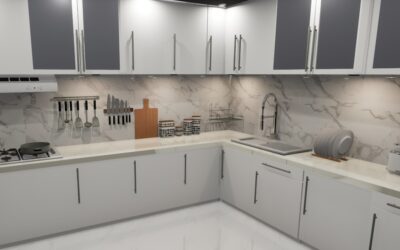
Your countertops do more daily work than almost any surface in the house, taking the brunt of hot pans, sharp knives, spills, and constant wiping. Choosing the best kitchen counter top means balancing how a material looks against how it holds up, how much upkeep it demands, and what it costs per square foot installed. The right choice can anchor your kitchen’s style for decades, while the wrong one leads to etching, staining, and regret.
Part of our Kitchen Remodeling guide — explore the full guide →
This guide compares the most popular countertop materials by durability, maintenance, and rough cost ranges so you can match a surface to how you actually cook and live. Prices below are general installed estimates and will vary by region, slab quality, and edge detail.
- Quartz: The Low-Maintenance Favorite
- Granite: Natural Durability with Character
- Marble: Timeless Elegance, Higher Upkeep
- Butcher Block: Warmth and Workability
- Laminate: Budget-Friendly and Versatile
- Solid Surface, Concrete, and Quartzite
- What to Look For When Choosing
- Care and Maintenance by Material
- Comparing Lifespan and Resale Value
- Final Thoughts
Quartz: The Low-Maintenance Favorite
Engineered quartz blends roughly 90 percent ground natural quartz with resins and pigments, producing a non-porous slab that never needs sealing. It resists stains, scratches, and bacteria better than most natural stone, and it comes in a vast range of colors and patterns, including convincing marble look-alikes.
Expect to pay roughly $50 to $120 per square foot installed. The main drawbacks are heat sensitivity, since the resin can scorch under a hot pan, and a slightly less natural depth than real stone. For busy families who want beauty without babysitting, quartz is hard to beat.
Granite: Natural Durability with Character
Granite remains a top choice for homeowners who want a genuine stone surface with one-of-a-kind veining. It is extremely hard, handles heat well, and resists scratches from everyday use. Each slab is unique, so no two granite kitchens look exactly alike.
Costs typically run $40 to $100 per square foot installed. The tradeoff is maintenance: granite is porous and needs sealing once or twice a year to prevent staining from oils and acidic spills. A simple water-bead test tells you when resealing is due. For many, that modest upkeep is a fair price for natural beauty and toughness.
Marble: Timeless Elegance, Higher Upkeep
Few surfaces match marble’s luminous, classic appeal, which is why it endures in luxury kitchens. Its soft veining and cool surface make it a favorite for baking stations, since it stays naturally cool for working dough.
Marble runs roughly $60 to $150 per square foot installed, sometimes far more for premium varieties. Be realistic about maintenance, though: marble is soft and porous, etches from acids like lemon and vinegar, and scratches more easily than granite or quartz. If you love a lived-in patina and will seal it diligently, marble rewards you; if you want a worry-free surface, look elsewhere.
Butcher Block: Warmth and Workability
Butcher block brings warmth and a natural, inviting texture that hard stone cannot match. Made from glued strips of hardwood like maple, walnut, or oak, it is comfortable to work on and can be sanded smooth if it gets scratched or stained.
Prices generally fall between $40 and $100 per square foot installed. Wood requires regular oiling, every few weeks at first, to stay sealed against moisture, and you should avoid leaving standing water or cutting directly on certain finishes. With care, butcher block ages beautifully and is one of the most repairable surfaces available.
Laminate: Budget-Friendly and Versatile
Laminate has come a long way, with modern versions mimicking stone, wood, and concrete convincingly. Built from layers of paper and resin bonded to particleboard, it is lightweight, easy to clean, and the most affordable option on this list.
At roughly $15 to $40 per square foot installed, laminate fits tight budgets and rental properties. The limits are durability: it can scratch, scorch, and chip at the edges, and damage is generally not repairable. Seams and exposed particleboard are also vulnerable to water. For a low-cost refresh or a starter kitchen, though, laminate delivers strong value.
Solid Surface, Concrete, and Quartzite
Three more materials round out the field, each with a distinct personality.
- Solid surface: A blend of acrylic and minerals, seamless and non-porous, with integrated sinks possible. It runs about $35 to $80 per square foot but scratches and scorches more easily than stone.
- Concrete: Fully customizable in shape and color with an industrial look, typically $65 to $135 per square foot. It must be sealed and can develop hairline cracks over time.
- Quartzite: A natural stone often confused with marble but far harder, prized for elegant veining and heat resistance. Expect $60 to $150 per square foot, with periodic sealing required.
What to Look For When Choosing
The best kitchen counter top for your home depends on your habits, not just the showroom photo. Run through these questions before you commit:
- How do you cook? Heavy cooks who set down hot pans should favor heat-tolerant granite or quartzite over quartz or laminate.
- How much maintenance will you do? Be honest. If you will skip resealing, choose non-porous quartz or solid surface.
- What is your budget? Factor in edge profiles, cutouts, and removal of old counters, which add to the base square-foot price.
- What is your style? Match the surface to your cabinetry and overall design so it still looks right in ten years.
Care and Maintenance by Material
Day-to-day upkeep separates a counter that ages gracefully from one that looks tired in a few years. Quartz and solid surface need only mild soap and water; skip abrasive pads that can dull the finish. Granite, marble, quartzite, and concrete are porous and benefit from resealing on a schedule, anywhere from once a year for granite to every few months for marble in heavy use.
For all stone, wipe acidic spills like wine, citrus, and tomato sauce promptly to prevent etching and staining. Always use a cutting board, since even hard stone can dull knives and laminate scratches easily, and set hot pans on a trivet rather than directly on quartz, laminate, or solid surface. Butcher block asks for the most attention, with regular mineral-oil treatments, but it also forgives the most, since a light sanding erases scratches and stains that would be permanent on other surfaces.
Comparing Lifespan and Resale Value
Durability translates into long-term value. Granite and quartzite can last 50 years or more with proper care, and quartz commonly carries a manufacturer warranty of 10 to 25 years. Marble endures for decades but shows its age through patina that some buyers love and others do not. Butcher block lasts 20 years or longer when oiled, while laminate typically needs replacing within 10 to 20 years.
From a resale standpoint, quartz and granite are the surfaces most home buyers expect in mid-range and upper-tier kitchens, so they tend to protect your investment. Marble and quartzite signal luxury, while laminate, though practical, can read as dated to some buyers. If you plan to sell within a few years, choosing a widely desired material can pay off at closing.
Final Thoughts
There is no single best kitchen counter top, only the right match for how you cook, clean, and spend. Quartz wins on low maintenance, granite and quartzite on natural durability, marble on timeless looks, butcher block on warmth, and laminate on price. Weigh the cost ranges against your daily routine, request samples in your own kitchen lighting, and you will land on a surface that earns its keep for decades.