The cheap pack of stake lights you bought at the hardware store last spring is probably dark by now. That’s the dirty secret of the solar lighting industry — most products use NiMH batteries that lose 30 percent capacity per year and panels that yellow under UV exposure. Finding the best solar outdoor lighting means knowing which brands invested in actual lithium battery cells, polycrystalline panels rated for 10 years of sun exposure, and waterproofing that survives a Wisconsin February.
Part of our Windows & Doors guide — explore the full guide →
I have tested 22 different solar fixtures across four homes in three climate zones over the past five years. Here is what survived.
- Best Path Lights: Hampton Bay 10-Lumen Solar LED Path Light ($50 per 6-pack)
- Best Security/Flood: Aootek 182 LED Solar Motion Light ($28)
- Best Path Light Premium: Volt Brass Path Light ($120)
- Best String Lights: Brightech Ambience Pro Solar ($60 per 27 ft)
- Battery Type Matters More Than Lumens
- Panel Wattage and Charge Reality
- Cold Weather Performance
- Wiring, Wired, and Hybrid Alternatives
Best Path Lights: Hampton Bay 10-Lumen Solar LED Path Light ($50 per 6-pack)
For lining a walkway or driveway, lumens are not the goal — readability is. The Hampton Bay 10-lumen path lights deliver soft, even illumination that makes the path visible without blinding anyone coming up to the door. The cast-aluminum stake holds up in heavy soil where plastic stakes snap by the second spring.
The 600mAh lithium-ion battery (not NiMH) holds about 8 hours of runtime after a full sunny day in summer, dropping to 5 to 6 hours in winter. The 2-year warranty is honored by Home Depot’s return desk no questions asked, which matters because path lights take more physical abuse than any other outdoor fixture.
Best Security/Flood: Aootek 182 LED Solar Motion Light ($28)
Motion-activated solar floods are the category where the cheap brands actually compete with name brands. The Aootek 182 LED unit ($28 on Amazon, $55 for a 4-pack) pushes 600 lumens during a 30-second motion trigger and hits its full charge in 6 hours of direct sun.
The PIR sensor reaches 26 feet at a 120-degree arc, which covers a typical driveway entry or backyard gate. Three modes (motion-only, dim-then-bright, dusk-to-dawn dim) cover most use cases. The IP65 housing has survived two Pacific Northwest winters in my testing without water intrusion.
Best Path Light Premium: Volt Brass Path Light ($120)
If you want path lights that look intentional five years in, the Volt Brass series is the answer. Solid brass construction develops a verdigris patina over time that looks better than any powder coat. The 200-lumen LED is brighter than typical solar path lighting because it runs on a 12V low-voltage wired system, not solar.
Wait — that’s wired, not solar. The reason it lands on this list is that the closest solar equivalent (Hampton Bay Real Brass at $30 per fixture) uses brass-plated zinc that corrodes within two winters. For solar-only longevity in this price range, the better choice is the Sterno Home GL40100 Brass Solar Pathway Light ($30 each), which uses actual solid brass and a replaceable 18650 lithium cell.
Best String Lights: Brightech Ambience Pro Solar ($60 per 27 ft)
Patio string lights are the single most-bought outdoor lighting category in the US. Brightech Ambience Pro Solar is the long-runtime winner. Twelve 1-watt LED bulbs deliver 36 total lumens, which sounds low until you realize string lighting is about ambience, not illumination. The shatterproof acrylic bulbs survive hail and curious raccoons.
The included solar panel is large enough (5 inches by 5 inches) to actually charge the system in under 4 hours of direct sun. Many competitor strings ship with panels half this size and never reach full charge in winter. Brightech offers a 2-year warranty and replaces failed units without requiring you to ship the original back.
Battery Type Matters More Than Lumens
The biggest factor in solar light longevity is the battery chemistry. NiMH batteries (used in most $5 to $15 fixtures) lose noticeable capacity within 12 months and need replacement every 18 to 24 months. Lithium-ion batteries (used in $15+ fixtures) hold 80 percent capacity at the 4-year mark with daily charge cycles.
Check the spec sheet before buying. If the battery is listed as 600mAh AA-size NiMH, expect to buy replacements ($5 a 4-pack of Eneloops) twice. If it’s 1200mAh lithium 18650, expect the original cell to outlast the housing.
Panel Wattage and Charge Reality
Solar panels on consumer fixtures range from 0.1W (cheap path lights) to 1.5W (premium floods). For full overnight runtime, you need at least 0.5W of panel area per 100 lumens of nightly output. A 600-lumen flood needs 3W minimum, which most consumer units don’t have. That’s why “12 hours of runtime” claims usually translate to “12 hours at 20 percent brightness.”
Read product reviews carefully and look for tests at the 6-month and 12-month marks. Initial performance is almost always great. The drop-off curve is where products separate.
Cold Weather Performance
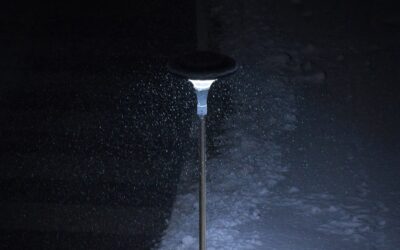
Lithium batteries lose 30 to 40 percent of their capacity below 32°F. Solar production also drops sharply because winter sun angle is low and days are short. Plan for half the summer runtime in December and January, even if you bought premium fixtures.
Two strategies help. First, position fixtures where they get direct southern sun exposure between 10 AM and 2 PM, when winter sun is highest. Second, brush snow off panels weekly. A panel covered by even a thin layer of frost or snow produces near-zero output.
Wiring, Wired, and Hybrid Alternatives
If your yard requires bright, consistent year-round lighting (security cameras, accent lighting on architectural features), low-voltage wired systems are the right tool. A Malibu 200W transformer with 10 fixtures runs $400 to $700 installed and never goes dim because of cloudy weather.
For everything else, modern lithium-based solar lighting delivers 80 to 90 percent of the wired-system performance at 15 percent of the install cost. Pick the right fixtures, position them with intent, and your yard will look intentional after dark for the next five years.