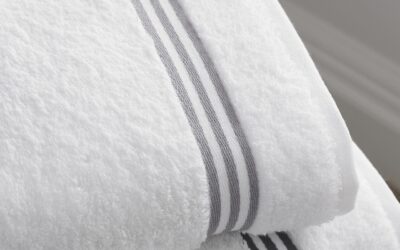
Standard terry cloth towels weigh nearly a pound each, hog half a laundry basket, and take two full drying cycles before the lint stops sticking to the inside of the dryer. A good Turkish towel does the same job at a third the weight, dries in under 20 minutes, and actually gets more absorbent after every wash. The best Turkish towels have been the not-so-secret weapon of frequent travelers, compact-bathroom dwellers, and beachgoers for years. Here is how to pick one that lives up to the hype, plus the specific picks worth the money.
What Makes a Towel Turkish
A peshtemal, or hammam towel, is a flat-woven cotton textile originally used in Turkish bathhouses. The weave is what separates it from terry cloth. Instead of looped pile, a Turkish towel uses a tight horizontal weave that packs thin, dries fast, and absorbs water through capillary action rather than volume.
The fiber matters as much as the weave. Authentic Turkish towels are woven from Aegean cotton, an extra-long-staple variety grown in southwestern Turkey and prized for softness and absorbency. Cheap knockoffs substitute shorter-staple cotton, which feels scratchier and pills within 10 wash cycles. Check the label for GOTS-certified organic cotton or specific mention of Aegean cotton. Anything vague is usually a red flag.
Top Brands Worth the Money
Several brands consistently deliver authentic Turkish quality at reasonable prices. Quality runs from about $28 for entry-level to $95 for handwoven heirloom pieces.
- Olive and Linen Ruby at $38 — 100 percent Aegean cotton, OEKO-TEX certified, 40×70 inches
- Riviera Towel Company classic at $48 — handwoven in Turkey, tasseled, 6 colorways
- Turkish-T Basic at $45 — lightweight 340 GSM, sand-resistant weave
- Loomia Hammam at $32 — budget-friendly, good for gym and travel use
- Hilana Upcycled Cotton at $28 — made from textile scraps, OEKO-TEX certified
- Jennifer’s Homemade at $85 — hand-loomed, heirloom quality, 50×70 inches
If you are only buying one, the Olive and Linen Ruby is the most versatile pick. Large enough for bath or beach, soft enough for daily use, and the price point makes it reasonable to buy two and rotate.
GSM and What It Means for You
GSM (grams per square meter) measures fabric density. Standard bath terry runs 500 to 700 GSM. Turkish towels range from 280 to 500 GSM. Lower GSM means faster drying and easier packing. Higher GSM means more plush feel and slightly better absorbency at the cost of bulk.
For travel and gym use, 280 to 340 GSM is the sweet spot. You can roll it into a tight 6-inch bundle, it dries on a hotel towel bar overnight, and it still dries a full-sized adult. For daily bath use where you want a more terry-like feel, 400 to 500 GSM is the right weight. For beach and picnic towels, 340 to 400 GSM is the standard, thick enough to sit on comfortably and thin enough to shake sand out easily.
First Wash and Break-In
Turkish towels feel a little stiff and less absorbent out of the package because manufacturers often use starch or sizing to keep them looking crisp on shelves. Wash once in warm water with a small amount of detergent before first use. Skip fabric softener entirely. Softener coats fibers and kills absorbency permanently.
After 3 to 5 wash cycles, the weave relaxes, the towel gets noticeably softer, and absorbency roughly doubles. This break-in is why a well-used Turkish towel is usually softer than a new one. Tumble dry on low heat or hang to dry. High heat shrinks cotton and tightens the weave prematurely.
Common Use Cases Where They Shine
Turkish towels truly outperform terry in specific situations. They are unbeatable for the beach because sand shakes loose rather than embedding in the pile. They dry overnight in a humid bathroom where terry stays damp for 36 hours. They fold flat, which matters in a small linen closet or a carry-on bag. And they double as a picnic blanket, beach cover-up, sarong, or scarf when needed.
They are also the right choice for a guest bathroom. Hotels have been switching to Turkish-style towels because they look cleaner on the rack, dry faster between guests, and last 3 to 5 times as many wash cycles as mid-grade terry. Industrial laundries love them for the same reasons.
Where They Fall Short
A Turkish towel will not give you the plush, hug-yourself feeling of a 600 GSM bath sheet. If that sensory experience is what “towel” means to you, you will be disappointed. They also do not hold as much water volume, so if you have very long or very thick hair, a standard terry bath towel will pull more water in one pass.
The fringe at the ends of most peshtemals can fray in the wash. Tie the fringe into loose knots before washing, or buy a machine-hemmed version like the Turkish-T Basic that has no tassels. Knots untie easily after drying and the fringe lasts 3 to 4 times longer.
Care and Longevity
With correct care, a quality Turkish towel lasts 8 to 10 years. Wash in warm water with regular detergent, skip softener, avoid bleach (it breaks down cotton fibers within 20 cycles), and tumble dry low or line dry. Stains lift with a paste of baking soda and water rubbed in before washing. A well-kept Turkish towel will outlast three sets of terry bath towels and still look beautiful at year 10, which is ultimately why most buyers never go back.