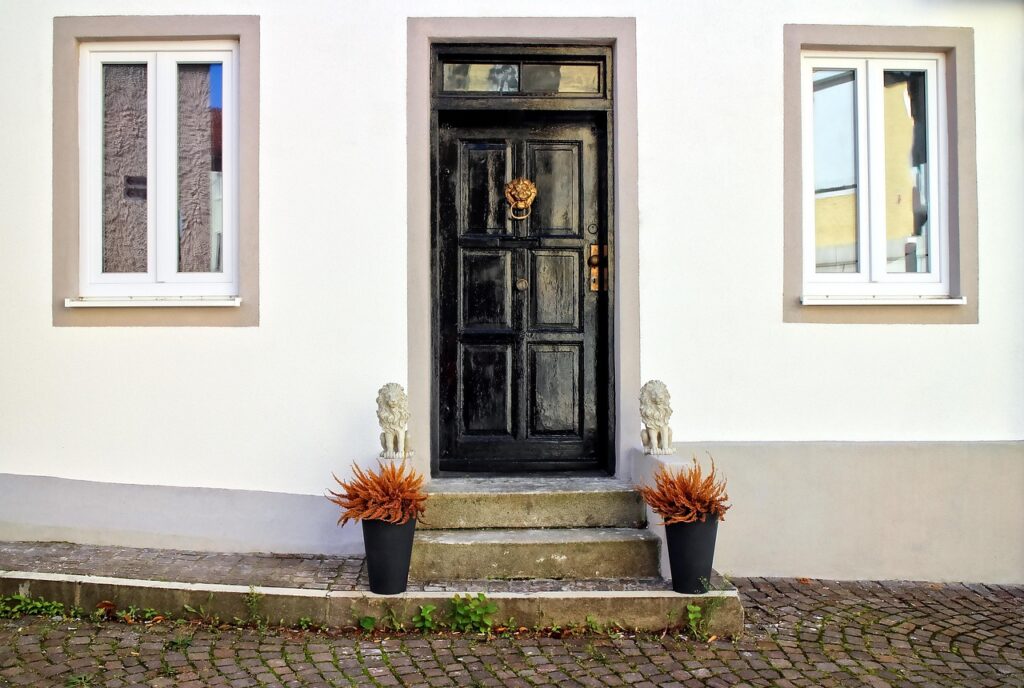
A Zillow study a few years back tracked sale prices against exterior paint choices and found that homes with a true black front door sold for an average of $6,271 more than expected. That single data point turned what was once a bold choice into one of the safest curb-appeal upgrades a homeowner can make. The right black front door ideas elevate everything around them — siding, brick, landscaping, even a tired roof — and the project costs less than $200 in materials for a confident DIYer.
Part of our Windows & Doors guide — explore the full guide →
- Why Black Works on Almost Any House
- Choose the Right Shade of Black
- Hardware Pairings That Make or Break the Look
- Eight Black Front Door Ideas Worth Stealing
- Surrounding Colors That Make Black Pop
- Painting Tips That Avoid Common Mistakes
- Lighting and Accessories
- Styling a Black Front Door With Oval Glass
Why Black Works on Almost Any House
Black acts as a visual anchor. It draws the eye, frames the entry, and contrasts cleanly with almost every exterior color. Designers reach for it the same way they reach for a black sofa in a busy room — it grounds the composition and lets the other colors breathe.
It also reads consistently across architectural styles. A black door is right at home on a colonial revival, a craftsman bungalow, a mid-century ranch, a modern farmhouse, and a contemporary cube. Few other colors carry that range. The character of the look shifts based on the paint sheen, the door style, and the hardware finish — which is where the real design decisions live.
Choose the Right Shade of Black
Pure jet black is rarely the right call outdoors. Sunlight blows it out and it photographs flat. Designer-favorite blacks all have a slight undertone that gives the color depth:
- Benjamin Moore Black Beauty 2128-10 — neutral with a faint blue cast, photographs sharp on white siding
- Sherwin-Williams Tricorn Black SW 6258 — close to true black, very clean against any color
- Benjamin Moore Onyx 2133-10 — slight charcoal warmth, perfect on red brick
- Farrow & Ball Off-Black 57 — deep gray-black, softer and more sophisticated
- Sherwin-Williams Iron Ore SW 7069 — technically a deep gray, behaves like a forgiving black
For exterior front doors, an exterior-rated alkyd or urethane enamel in satin or semi-gloss sheen delivers the longest service life. Flat black on a south-facing door fades to chalky gray within two years.
Hardware Pairings That Make or Break the Look
Hardware is the jewelry on a black door. The wrong finish can drag the whole composition down. Three combinations consistently work:
- Polished or satin brass — the strongest contrast, very on-trend for modern traditional homes
- Matte black — monochrome and intentional, ideal for contemporary and modern farmhouse styles
- Oil-rubbed bronze — warmer than black, blends rather than contrasts, classic on craftsman and tudor
Avoid bright chrome or polished nickel — both feel out of place on an exterior door. Whatever you choose, match every piece: lockset, deadbolt, kickplate, knocker, and the screws on the address numbers. Mixed metals work indoors but rarely outdoors where one door reads from the curb as a single object.
Eight Black Front Door Ideas Worth Stealing
These configurations show up again and again in award-winning curb appeal photos:
- Black six-panel door with polished brass knocker on white clapboard colonial
- Black craftsman door with three top lights, oil-rubbed bronze hardware on tan stucco
- Black flush slab door with full-height vertical sidelights on a modern white stucco facade
- Black Dutch door with antique brass thumb latch on a cedar shingle cottage
- Black door painted on a fiberglass smooth slab, paired with sage green shutters on a brick ranch
- Black arched-top door with iron speakeasy grille on Mediterranean stucco
- Black double doors with brushed brass long-pull handles on a contemporary home
- Black door with brass clavos (decorative nail heads) on a Spanish revival
The thread connecting all eight is restraint. Each black front door idea uses the door as the focal point and lets the surrounding architecture support it rather than compete with it.
Surrounding Colors That Make Black Pop
Black plays well with most exteriors but really sings against specific palettes. White siding with black trim around the door creates the highest contrast and looks cinematic in photos. Soft warm whites like Benjamin Moore White Dove or Simply White read more inviting than a stark cool white. Red brick with cream trim and a black door is a classic East Coast colonial combination that has not aged a day in 40 years.
Avoid black on dark gray or charcoal siding unless you add bright trim around the door. The door disappears into the wall and the curb appeal benefit is lost. A 4 inch white casing solves the problem at a cost of one weekend and a quart of trim paint.
Painting Tips That Avoid Common Mistakes
Most failed black-door paint jobs share the same three errors: poor prep, wrong product, and skipped primer. Do this instead:
- Remove the door if at all possible — painting horizontally on sawhorses gives a far better finish than painting vertically on hinges
- Sand the existing finish with 180 grit, then 220, and wipe with a tack cloth
- Spot-prime any bare wood or fiberglass with an exterior-rated bonding primer like Sherwin-Williams Extreme Bond
- Apply two thin coats of exterior alkyd or urethane enamel with a high-density foam roller and a quality brush for cut-ins
- Wait the full 4 hours between coats and 24 hours before rehanging
For fiberglass doors with a faux wood grain, use a brush in the direction of the grain rather than rolling. The brush marks enhance the grain illusion. Smooth fiberglass and steel doors look best rolled with a 4 inch high-density foam roller and tipped off lightly with a brush.
Lighting and Accessories
A black door is dramatic in daylight but disappears at night without proper lighting. Pair it with two outdoor sconces flanking the door at a centerline 66 to 72 inches off the porch floor, each sized about one-quarter the height of the door. Choose warm 2700K LED bulbs and dimmable fixtures if you can. A clean welcome mat in a complementary color and a single seasonal planter complete the picture without crowding the entry.
Black front doors are one of the rare design moves where the cost-to-impact ratio favors the homeowner heavily. Pick the right black, match your hardware, prep the surface, and the door will pay you back every time someone pulls into your driveway.
Styling a Black Front Door With Oval Glass
A black front door with oval glass suits traditional, Victorian and classic suburban homes, where the curved glass softens the door’s strong color and lets light into the entry. The look works best when the glass caming matches the hardware finish and the glass pattern gives the privacy the entry needs. On a modern facade, a flush slab or vertical lites usually fits better than an oval.
Choosing the Glass Pattern
Oval glass inserts come in clear beveled, frosted, textured and decorative leaded designs. Clear bevels show off the black frame but give little privacy, while heavily textured or leaded glass blurs the view from the street and still passes daylight. Glass in an entry door must be tempered or laminated safety glass, so buy factory inserts rather than cutting ordinary glass.
| Glass style | Privacy | Best match |
|---|---|---|
| Clear beveled | Low | Porches set back from the street, formal colonial homes |
| Frosted or satin etched | High | Entries facing a sidewalk or a neighbor’s door |
| Leaded decorative with brass caming | Medium to high | Victorian and traditional homes with brass hardware |
| Leaded with black or patina caming | Medium to high | Craftsman and farmhouse homes with matte black or bronze hardware |
| Rain or reeded texture | High | Transitional homes wanting a quieter look |
Make the Caming and Hardware Agree
The metal strips between leaded glass pieces read as part of the hardware set from the curb. Brass caming pairs with polished or satin brass handlesets and kick plates, while black or patina caming pairs with matte black or oil-rubbed bronze. Mixing brass caming with black hardware tends to look accidental on a black door.
Painting a Door That Already Has Oval Glass
Most oval inserts sit in a molded frame screwed through the door. Mask the glass with painter’s tape and paper, and check whether the insert frame is plastic, since some plastic frames need a bonding primer or a paint the door maker approves. Keep paint off the glazing seal so it can still shed water. If the existing glass is fogged, cracked or the wrong style, many fiberglass and steel doors accept a replacement insert of the same size, which is cheaper than a new door.
Heat on Dark Doors
A black door behind a full-glass storm door in strong sun can trap enough heat to warp vinyl trim or stress the insert seals. Check both the door and storm door makers’ guidance on dark colors before adding one.