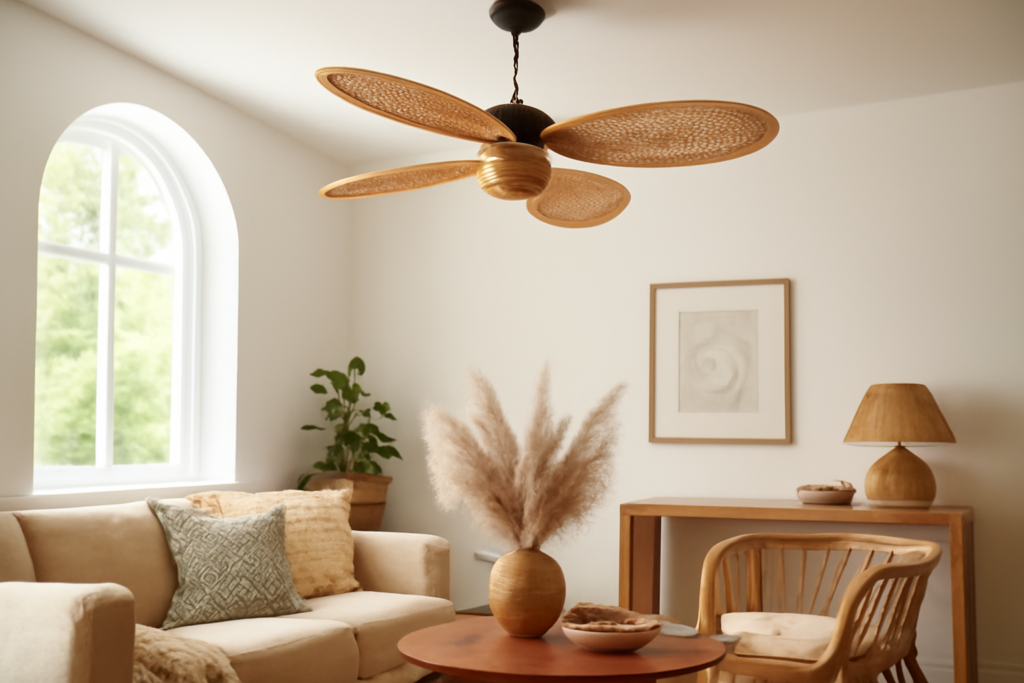
Natural-material fans went from a niche Etsy find to a stocked category at Home Depot in about three years, and the demand is easy to understand — a woven fan reads as decor first and appliance second. A good boho ceiling fan brings rattan, seagrass, bamboo, or carved wood into the room’s fifth wall and softens the hard-edged look that standard brushed-nickel fans impose. The trap is that plenty of boho fans are furniture that happens to spin: gorgeous blades, gutless motors. This guide covers the materials, the models that balance both jobs, and the specs that keep style from costing you airflow.
- What Makes a Fan "Boho"
- The Four Blade Materials, Ranked for Real Use
- Picks That Balance Looks and CFM
- Damp Ratings for Porches and Sunrooms
- Keep the Airflow: Three Specs That Save the Look
- Lighting on a Boho Fan: Warm or Nothing
- Room-by-Room: Where the Style Lands Best
- Where to Buy and What Shipping Does to Woven Blades
- Styling It Into the Room
- Care for Natural-Fiber Blades
What Makes a Fan “Boho”
Bohemian style leans on organic texture, handcraft, and warm neutrals, and fan designers translate that through four signatures: woven blade material (rattan cane, wicker, seagrass, abaca rope), visible natural grain (light oak, weathered teak, bamboo), softened silhouettes (paddle and palm-leaf blade shapes, drum-style woven shades), and earthy hardware finishes — aged brass, matte black, or oil-rubbed bronze rather than chrome. The look pairs naturally with coastal, japandi, and organic-modern rooms, which is why retailers increasingly file these under “natural” or “coastal” rather than boho alone.
The Four Blade Materials, Ranked for Real Use
- Rattan and cane webbing: The signature boho look — open hexagonal weave over a wood or metal frame. Light weight is easy on motors, but open weave slightly reduces air displacement, so favor models with aggressive 12-degree-plus blade pitch. Indoor use only unless specifically rated.
- Woven seagrass and abaca: Denser, ropier texture with more visual weight. Heavier than cane, so check that the motor is DC or a robust AC unit; underspecced motors wobble with these blades.
- Solid and carved wood: Palm-leaf and paddle blades in oak, walnut, or distressed finishes. Best airflow of the group because the blade face is solid, and the easiest to find in damp-rated versions for covered patios.
- Bamboo: Light, sustainable, and cheap, but thin bamboo blades on budget fans warp within a couple of humid summers. Look for laminated (multi-ply) bamboo rather than single-layer.
Picks That Balance Looks and CFM
Under $200: Hampton Bay’s Vailen and similar big-box woven-blade 52-inch models run $150 to $180 with integrated LEDs — honest starter fans around 4,000 to 4,500 CFM, fine for bedrooms up to about 15 by 15 feet. $200 to $400: The strongest value tier. Fanimation’s Windpointe with natural palm blades, Kichler’s rattan-blade 52- and 60-inch models, and Hunter’s woven-cane offerings pair the look with 5,000-plus CFM and quieter motors. $400 to $800: Minka-Aire and Matthews Fan Company deliver designer pieces — oversized palm and rope-wrapped models with DC motors, 6-speed remotes, and the build quality to run 12 hours a day. Sizing rules are unchanged by style: 52 inches for rooms up to about 225 square feet, 56 to 60 inches beyond that.
Damp Ratings for Porches and Sunrooms
Boho fans beg to hang over a porch daybed, but natural fibers and humidity are enemies. For covered patios and sunrooms, buy a UL Damp-rated model with synthetic “faux rattan” (ABS blades molded and colored to mimic weave) or sealed hardwood blades — genuine cane in outdoor humidity slackens and sags inside two seasons. Several manufacturers make damp-rated versions of their woven designs that are nearly indistinguishable from a ladder’s distance. Salt-air coastal installs should step up to Wet-rated with stainless hardware regardless of blade material.
Keep the Airflow: Three Specs That Save the Look
Natural-blade fans fail buyers on performance more than style, so screen every candidate against three numbers. First, CFM on high: 4,500 minimum for bedrooms, 5,500-plus for living spaces — if the listing omits CFM, assume it is poor. Second, blade pitch of at least 12 degrees; woven blades with flat pitch push almost no air and exist purely as decor. Third, motor type: a DC motor costs $80 to $120 more and matters doubly here because heavier organic blades load small AC motors into audible hum. A reversible motor also earns its keep, since these fans often hang in four-season rooms where winter destratification mode is useful.
Lighting on a Boho Fan: Warm or Nothing
Lighting makes or breaks the natural look. The strongest boho fans either skip the light kit entirely — letting the woven blades read as pure sculpture — or lean into warm, decorative light: an exposed Edison-style bulb under a simple fitter, a rattan or seagrass drum shade that doubles as a pendant, or a frosted bowl in aged brass. What kills the aesthetic is a bright, cool-white LED disk bolted under hand-woven blades; if the fan includes an integrated LED, confirm it runs at 2700K to 3000K and dims low, because natural materials photograph and live best under warm light. Drum-shade models carry a practical caveat: the shade blocks downward airflow slightly and collects dust on its top face, so plan on a step-stool wipe-down a few times a year. In rooms with good lamps, the light-free version is almost always the better-looking and better-performing choice.
Room-by-Room: Where the Style Lands Best
Bedrooms are the natural habitat — a 52-inch rattan fan over a bed with linen and a jute rug completes the scheme, and DC-motor quiet matters most here. Sunrooms and covered porches are the second home, with the damp-rating caveat above. Living rooms can absolutely carry a 56-to-60-inch woven fan, but scale the texture: a densely woven seagrass fan above a room already full of pattern tips into busy, while an open cane weave keeps things airy. Nurseries love the softness of palm-blade designs, and the low speeds of a 6-speed DC motor earn their keep over a crib. The one place to hesitate is a kitchen — open weave over a cooktop collects airborne grease that is genuinely difficult to clean out of cane, so choose sealed wood blades within 10 feet of a range.
Where to Buy and What Shipping Does to Woven Blades
Stock at Home Depot, Lowe’s, and Wayfair covers the budget and mid tiers, while lighting showrooms and brand sites (Fanimation, Kichler, Minka-Aire, Matthews) carry the designer pieces. Order online with eyes open: woven blades ship in molded cradles, but crushed corners still happen, so unbox and inspect within the return window and photograph any damage on arrival — reputable brands replace individual blade sets without returning the whole fan. Check that replacement blades exist as a stocked part before committing to a boutique import, because a fan whose blades cannot be replaced individually becomes disposable the first time a mover’s ladder clips one.
Styling It Into the Room
Let the fan repeat a material that already exists in the space — a rattan headboard, jute rug, or cane-front console — so it reads as intentional rather than themed. Aged-brass hardware warms rooms heavy in whites and creams; matte black grounds rooms with lots of pale wood. If your ceiling is wood-clad or painted a deep color, a light woven blade pops; against plain white drywall, mid-tone teak and walnut blades carry more presence. Boho sits comfortably adjacent to other warm styles, and if your room leans more shiplap-and-galvanized than rattan-and-jute, our farmhouse ceiling fan guide covers that neighboring lane.
Care for Natural-Fiber Blades
Woven blades are dust magnets with texture that defeats a quick wipe. Every month or two, run a vacuum’s soft brush attachment along the weave, then follow with a barely damp microfiber cloth — never a wet one, since standing moisture swells cane and raises fibers. Twice a year, check blade screws; organic materials expand and contract with seasonal humidity more than plastic or metal blades do, and loose screws are the source of most new wobbles. A fan balancing kit (usually included, otherwise $5) fixes residual wobble in ten minutes. Treated this way, a quality rattan or hardwood-blade fan holds its finish 10 to 15 years — long enough to outlast the trend cycle and settle in as simply a good-looking fan.