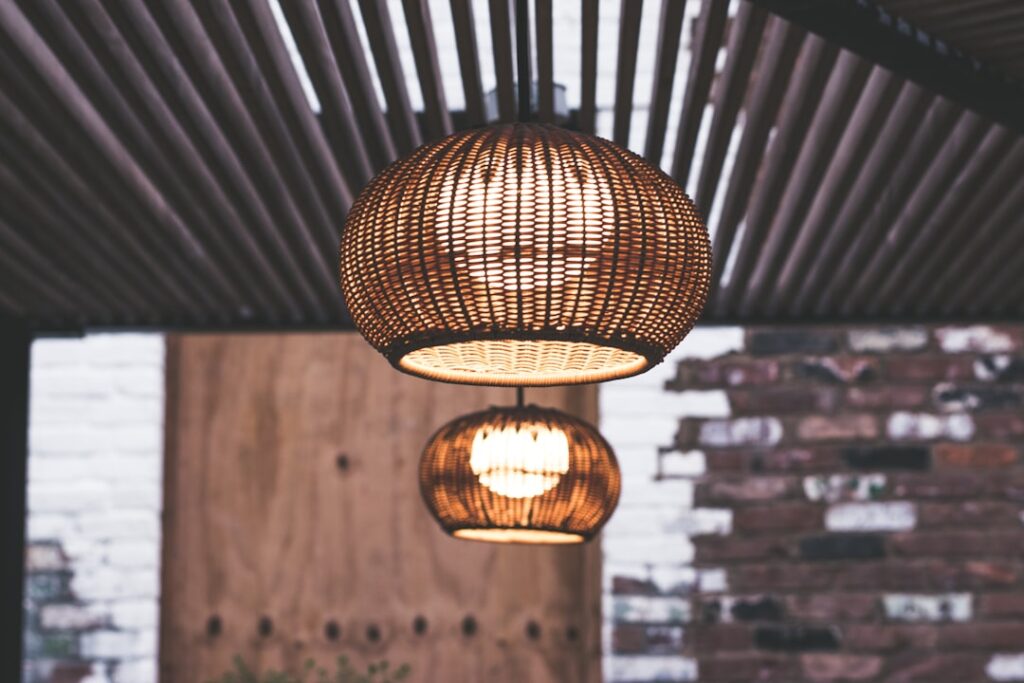
Few fixtures change a room’s temperature — the felt kind, not the thermostat kind — like woven natural fiber overhead. A rattan ceiling light filters its bulb through an organic weave, throwing soft, patterned light and warm shadows instead of the flat glare of a glass shade. That’s why the category has moved from beach houses into mainstream American interiors: it delivers texture in rooms that have plenty of paint and drywall and not much else with a handmade feel. This guide sorts the styles (drum, dome, bell, cluster, semi-flush), decodes the materials (rattan vs cane vs wicker vs bamboo — sellers scramble these constantly), matches shapes to rooms, covers fan pairing, and lays out honest price ranges from big-box to designer.
Rattan, Cane, Wicker, Bamboo: What You’re Actually Buying
- Rattan is a climbing palm — a solid-core vine that bends under steam and holds its shape. The poles and their peeled skin are the raw material.
- Cane is the glossy outer bark of rattan, sliced into strips — the tight hexagonal “cane webbing” on chair backs and on many popular drum shades.
- Wicker is a technique, not a material — any woven construction (of rattan, cane, seagrass, or synthetic) is wicker.
- Bamboo is hollow grass, used in slat or spoke forms rather than tight weaves.
- Synthetic “rattan” (resin/PE weave) matters for one reason: it’s the only version rated for damp and outdoor locations — covered porches want it.
Buying signal: “rattan pendant” listings at suspiciously low prices are often paper-cord or synthetic weave. Check the material line, not the title.
The Styles
Drum
A straight-sided cylinder — usually cane webbing on a frame. The most furniture-like and tailored of the weaves, it suits transitional and modern rooms that want texture without a tropical accent. Drums put light out horizontally through the weave and down through an open or diffused bottom; over dining tables and kitchen islands they’re the easy win.
Dome and Bell
The classic open-weave basket shapes — wide domes (often 20–36 inches) that read boho, coastal, or organic-modern depending on how loose the weave is. Domes concentrate light downward and paint the ceiling with radial shadow patterns at night, which is half their charm. Wide-and-shallow domes are the statement pick over beds, reading corners, and round tables.
Globe and Lantern
Spherical or urn-shaped weaves that glow in all directions like a woven moon. Because light exits everywhere, they work as ambient sources in entries, stairwells, and hallways where you want warmth rather than task light.
Scalloped, Fluted, and Tiered
Layered or wavy-edged shades — the designer end of the category, edging toward coastal-grandmother and Parisian-boho looks. Tiered pagoda shapes suit taller drops in two-story entries.
Semi-Flush and Flush Rattan
The fastest-growing slice: woven drums and domes mounted tight to the ceiling for standard-height rooms. All the sizing and clearance math for the mounting style lives in our semi flush ceiling lights guide — the short version is that 8-foot ceilings want total fixture height under about 12 inches, which woven drums handle gracefully because they’re wide, shallow, and nearly weightless.
Clusters and Multi-Pendant Rows
Three or five small woven pendants staggered over an island or run down a hallway. Mixing shapes within one material family (a bell, a globe, a drum, all natural rattan) is the current designer move and is hard to get wrong.
Which Rooms They Suit
| Room | Best styles | Notes |
|---|---|---|
| Dining room | Drum, wide dome | Diameter ≈ half to two-thirds table width; bottom 30–36 in above the table |
| Kitchen island | Cluster of small bells/globes, or one long drum | Open weaves shed less usable task light — keep under-cabinet lighting in the plan |
| Bedroom | Semi-flush drum, shallow dome | The soft shadow play is made for bedrooms; dimmer mandatory |
| Living room | Large dome or tiered statement | Size by room length + width in feet = diameter in inches |
| Entry/hall | Globe, lantern, small flush drum | All-direction glow flatters tight spaces |
| Nursery/kids | Flush or semi-flush weave | Warm, dimmable, and no glass to break |
| Covered porch/sunroom | Synthetic weave, damp-rated | Natural rattan mildews and sags in humidity — check the rating |
| Bathrooms | Only damp-rated synthetics | Natural fiber and shower steam are a short marriage |
Style-pairing guidance: rattan is a texture, not a commitment to a theme. Against white walls and linen it reads coastal; against black metal and walnut, organic-modern; with brass and color, eclectic. The one real rule is contrast — a woven shade disappears against beige everything and sings against deep paint or crisp white.
Light Quality: What Weaves Do to Lumens
Open weaves are decorative diffusers, not efficient ones — expect a meaningful share of output to become pattern and glow rather than task light. Plan accordingly:
- Bulb it warm: 2700K LED, 800–1,100 lumens for single pendants; the weave’s shadows look best warm and dim.
- Layer the room: treat rattan fixtures as the ambient/mood layer and let lamps, sconces, or recessed cans carry task lighting.
- Mind the bare bulb: open-bottom domes show the bulb from below — buy a good-looking bulb (spiral-filament LED) or choose fixtures with a diffuser cup.
- Dimmers on everything. The whole point of woven light is range.
Pairing with Ceiling Fans
Rattan fixtures live in the same rooms that want fans, and the pairing works when you follow two rules. First, match the material family, not the exact weave: a natural-finish or woven-blade fan (many coastal fan lines offer rattan-look blades) alongside a rattan pendant reads intentional; two different tight weaves compete. Second, keep hierarchy: let the light fixture be the statement and the fan quiet (or vice versa) — a caged-rattan fan light plus a big dome pendant in one ordinary room is one texture too many. In great rooms, a woven-blade fan at the seating zone and a rattan drum over the dining zone at matching warmth is the classic resolution. Cohesion extends to hardware: pick one metal accent — matte black, antique brass — and repeat it in the fan, fixture canopy, and even plumbing (finish-matching logic covered in our Kohler faucet guide).
Price Ranges: What You Get at Each Tier
| Tier | Price | What it looks like |
|---|---|---|
| Budget (big-box, Amazon) | $40–$120 | Machine-woven or synthetic; smaller diameters (12–18 in); visible glue and thin frames up close |
| Mid (West Elm, Serena & Lily outlet-adjacent, better Amazon) | $120–$350 | Hand-woven natural rattan/cane, 18–30 in, cleaner frames, better canopies and cord hardware |
| Designer (Serena & Lily, Palecek, boutique makers) | $350–$1,200+ | Sculptural hand-weaving, oversized 30–48 in statements, refined color/finish |
| Vintage/secondhand | $30–$300 | 1970s wicker swags rewired ($20 kit or $75–$150 electrician) — often the best weave-per-dollar available |
Where to spend: diameter and weave quality show from across the room; brand names don’t. A $150 hand-woven 24-inch dome beats a $400 machine-made 18-inch drum in every room it enters.
Care and Longevity
- Dust monthly — a vacuum brush attachment or microfiber glove; weaves are dust shelves.
- Keep natural fiber dry: below ~60% humidity; mildew spots clean with diluted white vinegar, but sagging weave doesn’t recover.
- LED only: stay within the fixture’s wattage rating and skip hot incandescents in tight weaves — LEDs run cool and eliminate the scorch risk.
- Sun-fade is real but slow: natural rattan mellows from blonde to honey over years; most owners count that as a feature.
- Weight is a gift: nearly all rattan fixtures weigh under 15 lb — any properly mounted ceiling box handles them, making them ideal DIY swaps.
FAQ
Are rattan ceiling lights still in style?
Yes — the natural-materials wave (rattan, cane, seagrass, travertine, linen) has held for years because it solves a real problem: warmth and texture in builder-basic rooms. Tight cane drums and organic-modern domes are the most future-proof shapes; hyper-themed tiki looks date fastest.
Do rattan pendants give enough light?
As a solo source in a task room, usually not — plan them as the ambient layer with 800+ lumen warm bulbs and support from lamps or cans. In bedrooms, halls, and dining rooms, one well-sized fixture on a dimmer is genuinely sufficient.
Can I hang a rattan light in a bathroom or porch?
Only if the fixture is damp-rated — which in practice means synthetic weave. Natural rattan in steam or coastal porch humidity mildews and slackens within a couple of seasons.
How do I clean a woven light fixture?
Monthly vacuuming with a brush head, a barely damp cloth for grime, and vinegar solution for mildew spots — never soak natural fiber, and let it dry fully before relighting.