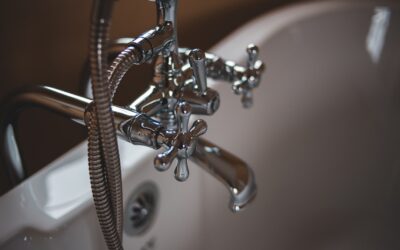
A bridge faucet connects two separate hot and cold valves with an exposed horizontal pipe — the “bridge” — that carries mixed water up to the spout. It is the signature faucet of farmhouse, Victorian, and classic English kitchens, and it is deliberately old-fashioned: the plumbing that every other faucet hides under the deck is put on display as architecture. This guide explains how bridge faucets mount, what they cost (spoiler: more than you expect), and which brands do them well.
How a Bridge Faucet Works
On a conventional kitchen faucet, hot and cold water mix inside a cartridge hidden in the body below the deck. On a bridge faucet, each supply rises through its own deck-mounted valve column, and the two streams meet in the exposed crossbar before traveling up the gooseneck spout. Functionally, the result is identical — one spout, mixed water — but visually you get a piece of exposed plumbing sculpture with real presence, typically standing 9 to 17 inches tall.
Because the mixing happens above deck, the under-sink side is simple: two supply connections, nothing else, unless you add a side sprayer. Modern bridge faucets use ceramic disc cartridges in each valve, so despite the antique look, drip resistance and handle feel match any contemporary faucet.
Mounting Requirements
This is where bridge faucets trip people up. Check your sink before falling in love with one:
- Two holes on 8″ centers is the standard requirement — one hole for each valve column. Most American bridge faucets are built for 8-inch spread; a few adjustable models flex from 7-3/4″ to 8-1/4″.
- Three or four existing holes? You will need hole covers for the extras, or a model with a matching side spray to occupy one hole. Escutcheon plates for bridge faucets are less common than for standard faucets, so plan this before ordering.
- One hole? A true deck-mount bridge faucet will not work. Your options are drilling a second hole (possible in stainless and some composite sinks, risky in porcelain) or choosing a different style, like a single hole kitchen faucet styled with traditional cross handles.
- Wall-mount versions exist and skip deck holes entirely, but require supply stubs at the correct height and spread inside the wall — a remodel-level change, not a swap.
Weight matters too. Bridge faucets are solid brass and heavy — 7 to 12 pounds is common. On a thin stainless sink deck, that mass can flex the deck; mounting through a granite or butcher-block countertop is more stable.
What Bridge Faucets Cost
Expect a real premium over standard pull-down faucets. There is more brass, more machining, and lower production volume:
| Tier | Price range | Examples |
|---|---|---|
| Entry | $250–$450 | Kingston Brass Heritage, Delta Broderick |
| Mid-range | $450–$800 | Kohler Artifacts bridge, Moen Weymouth, Signature Hardware |
| Premium | $800–$2,500+ | Perrin & Rowe (House of Rohl), Waterworks, deVOL, Newport Brass |
By comparison, an excellent conventional pull-down faucet runs $150 to $400. You are paying for the look. The good news: because bridge faucets are nearly all-brass with simple ceramic cartridges, even entry-tier models tend to age well, and the premium brands are effectively lifetime fixtures.
Style and Handle Choices
- Cross handles (X-shaped) read the most Victorian and pair with apron-front fireclay sinks and unlacquered brass hardware.
- Lever handles look slightly more transitional and are easier to operate with wet or full hands — the practical pick for a working kitchen.
- Porcelain lever inserts marked HOT and COLD lean full farmhouse.
Finishes follow the traditional palette: polished nickel, unlacquered brass (which develops a living patina), aged brass, polished chrome, and matte black for modern-farmhouse schemes. Unlacquered brass is the connoisseur’s choice but requires accepting tarnish as character — if you want warm metal that stays uniform, a PVD brushed-gold or satin-brass finish is lower maintenance. Our gold faucet guide covers how those finishes hold up.
The Sprayer Question
Traditional bridge faucets predate pull-down sprayers, and purist models have none — a real functional sacrifice if you rinse the sink and wash produce constantly. You have three options:
- Side spray: A separate deck-mounted sprayer in its own hole, matched to the faucet. Classic-correct and effective, but it occupies a fourth hole and adds $100 to $250.
- Pull-down bridge: Several modern designs (Kohler Artifacts, Moen Weymouth pull-down, Delta Broderick) hide a pull-down wand in the gooseneck. You get the bridge silhouette with modern function. These are the best-selling compromise.
- No sprayer: Fine for prep sinks and pot-filler-equipped kitchens; frustrating as the sole faucet on a busy main sink.
Practical Considerations Before You Buy
- Spout clearance: Gooseneck bridge spouts arc 9 to 17 inches high. Confirm clearance under shelving or a window sill, and check that the spout reach (8 to 10 inches is typical) lands water over your sink’s drain, especially on deep 30-inch farmhouse sinks.
- Flow rate: Most ship at 1.8 GPM (2.2 GPM max federally; 1.8 in California). Adequate for filling pots, if slower than the 2.2 GPM faucets of the past.
- Cleaning: All that exposed pipe collects grease film near a cooktop. Smooth polished finishes wipe easier than aged, textured ones.
- Supply lines: Bridge valves usually accept standard 3/8″ compression connections, but the rigid vertical columns leave less slack for misaligned shutoffs — measure and buy the right length faucet supply line rather than forcing a stretch.
- Two-handle reality: You give up single-lever temperature memory. Every use means adjusting two handles — charming to some, mildly annoying to others. Decide honestly which camp you are in.
Best Bridge Faucets by Use Case
- Best overall value: Kohler Artifacts bridge with pull-down spray, around $600 to $700 street price. Authentic profile, modern sprayer, Kohler’s ceramic valves and lifetime warranty — our Kohler faucet overview covers the brand’s warranty terms.
- Best budget entry: Kingston Brass Heritage, often $250 to $350. All-brass construction that outperforms its price; finish quality is a step below the majors.
- Best showpiece: Perrin & Rowe Edwardian, $1,200 to $2,000. The faucet you see in every high-end English kitchen photo shoot. Heirloom build.
- Best modern-traditional blend: Delta Broderick, $400 to $550, with Delta’s Diamond Seal cartridge and MagnaTite docking on the pull-down version.
Caring for a Bridge Faucet
All that exposed brass rewards a simple routine. Wipe the bridge and columns with a damp microfiber after cooking sessions — grease film is the main enemy, and it bonds harder the longer it sits. For polished nickel and chrome, a monthly wipe with diluted dish soap keeps the shine; never use abrasive pads, which put permanent swirl marks in the finish that the faucet’s prominence makes impossible to ignore. Unlacquered brass owners face a choice: polish monthly with Bar Keepers Friend or a brass polish to keep the bright gold look, or let it darken naturally to a mottled antique patina — most designers recommend committing to the patina, since half-polished brass looks neglected rather than aged. Cartridge maintenance is the same as any two-handle faucet: if a handle drips, shut off that side’s supply, pull the handle and bonnet, and swap the ceramic cartridge — a 15-minute job, and premium brands like Perrin & Rowe sell every internal part separately, which is a genuine long-term ownership advantage over disposable budget faucets.
FAQ
Are bridge faucets practical or just decorative?
Fully practical. Ceramic cartridges, standard flow rates, and optional pull-down sprayers mean a modern bridge faucet functions like any two-handle faucet. The compromises are two-handle operation and a higher price — not reliability.
Do bridge faucets fit a 33-inch farmhouse sink?
Yes, they are the classic pairing. Mount through the countertop behind the sink (fireclay apron sinks rarely have faucet decks) and verify 8-inch hole spread plus adequate spout reach into the deep basin.
Can I install a bridge faucet myself?
If you can install a standard two-handle faucet, yes — it is two valve columns and two supply connections. The weight makes a second set of hands useful when aligning both columns through the deck. Budget 1 to 2 hours.
Why are bridge faucets so expensive?
Solid-brass exposed construction (no cheap hidden components possible), low production volumes, and premium finishes. The visible bridge must be flawless because it is the point of the design.
If your kitchen leans farmhouse, classic, or English-country, nothing anchors the sink wall like a bridge faucet. Verify your two holes on 8-inch centers, decide on the sprayer strategy up front, and buy the best finish quality your budget allows — this is the one fixture everyone will notice.