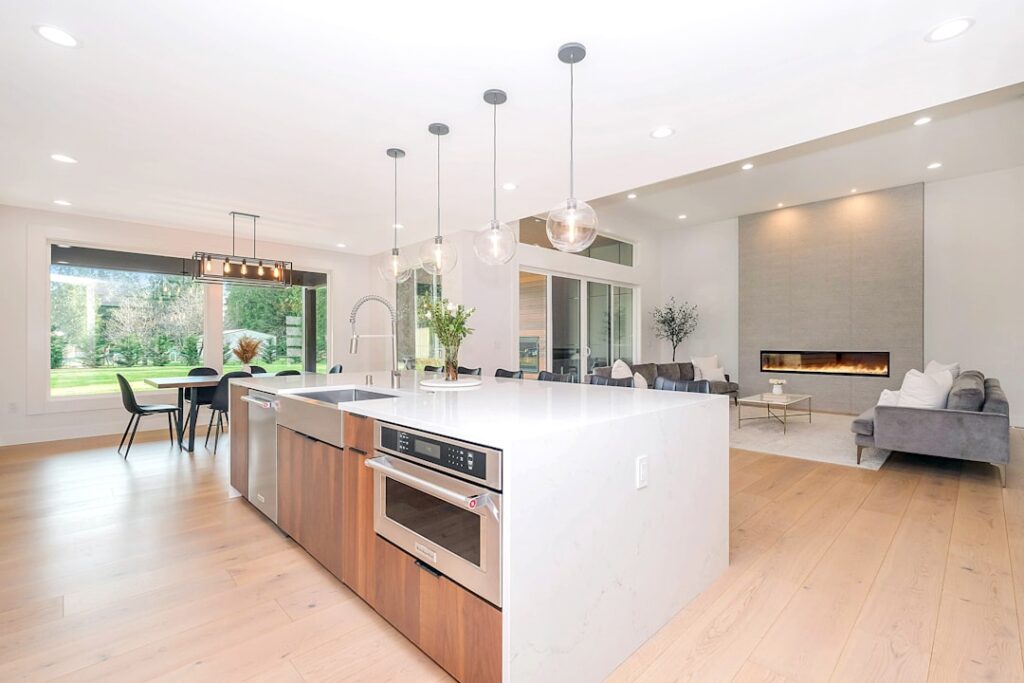
Search for Cambria granite countertops and you will find thousands of homeowners doing the same thing, but there is an important twist worth clearing up right away: Cambria does not actually make granite. Cambria is one of the largest quartz brands in the world, and what most people mean when they type that phrase is either “Cambria quartz that looks like granite” or “how does Cambria compare to real granite.” This guide answers both.
Part of our Countertops guide — explore the full guide →
- Clearing Up the Confusion: Cambria Is Quartz
- Cambria Quartz vs. Real Granite
- Cambria Patterns and Designs
- Cost of Cambria Countertops
- The Cambria Warranty
- Caring for Cambria Countertops
- Why People Search for Cambria Granite Countertops
- Installation and What to Expect
- Which Should You Choose?
- Final Thoughts
Clearing Up the Confusion: Cambria Is Quartz
Cambria is an American-made engineered quartz brand based in Minnesota. Its slabs are roughly 90 percent natural quartz combined with resins and pigments, which makes them non-porous and maintenance-friendly. Granite, by contrast, is 100 percent natural stone quarried in slabs and cut to shape. So the two are genuinely different materials, even though a Cambria design can convincingly imitate the look of granite or marble.
Why the mix-up? Because “granite” became shorthand for “stone countertop” over the last two decades. When shoppers say Cambria granite countertops, they are usually picturing a durable stone-look surface, and Cambria’s veined and speckled patterns fit that mental image perfectly. Understanding the distinction matters, because quartz and granite behave differently once installed.
Cambria Quartz vs. Real Granite
If you are deciding between Cambria quartz and natural granite, here is the honest side-by-side from someone who installs both.
- Porosity: Cambria is non-porous and never needs sealing. Granite is porous and needs sealing every 1 to 3 years.
- Stain resistance: Cambria resists wine, oil, and citrus completely. Granite can stain if a spill sits on under-sealed stone.
- Heat resistance: Granite tolerates hot pans better. Cambria’s resin can scorch above about 300°F, so trivets are required.
- Consistency: Cambria offers predictable, uniform patterns. Granite gives one-of-a-kind natural variation.
- Warranty: Cambria carries a transferable lifetime limited warranty; granite typically has none.
Neither is objectively better. If you want zero maintenance and a consistent look, Cambria wins. If you want genuine natural stone and superior heat tolerance, granite wins.
Cambria Patterns and Designs
Cambria offers more than 180 designs, many named after British locales, and they span the full range of countertop looks. A few of the most popular:
- Brittanicca: a bright white with bold gray veining, one of their best sellers for a Calacatta marble look.
- Torquay: a warm white with soft veining, reminiscent of classic Carrara.
- Skara Brae: a creamy background with brown and gray movement that reads like natural granite.
- Whitney and Ella: dramatic large-scale veining for a statement island.
If you specifically want the granite look, ask your dealer for the “movement” and speckled designs rather than the clean marble-look whites. Cambria’s designers built patterns to cover both aesthetics.
Cost of Cambria Countertops
Cambria sits in the premium tier of quartz, above builder-grade brands but justified by its warranty, American manufacturing, and design range.
- Material only: $55 to $100 per square foot depending on the design tier.
- Installed: $80 to $150 per square foot including fabrication and setting.
For a typical 45-square-foot kitchen, expect roughly $3,600 to $6,750 installed. High-movement designer patterns and thick 3cm slabs land at the top of that range. Real granite in a comparable look often costs a little less on material but adds sealing costs over its lifetime, so total ownership cost tends to even out.
The Cambria Warranty
One of Cambria’s biggest selling points is its transferable full lifetime limited warranty, which covers manufacturing defects and stays with the home if you sell. That transferability is genuinely valuable and something natural granite cannot offer. To keep the warranty valid, the counters must be professionally installed by a Cambria-authorized fabricator and used as intended (indoor residential use, no abuse). Keep your receipt and registration paperwork, because a warranty claim will require proof of professional installation.
Caring for Cambria Countertops
Maintenance is refreshingly simple, which is the core advantage over granite.
- Daily: wipe with warm water and mild dish soap or a pH-neutral cleaner.
- No sealing: ever, unlike granite.
- Avoid: abrasive pads, bleach, and harsh degreasers that can dull the finish.
- Protect from heat: always use trivets and hot pads.
Because it is non-porous, Cambria will not harbor bacteria and does not require the annual water-bead test that granite owners run. That hands-off routine is exactly why busy families gravitate to it.
Why People Search for Cambria Granite Countertops
The phrase persists for a few understandable reasons. Cambria markets itself as “natural quartz surfaces,” and to a shopper skimming a showroom, natural quartz and granite blur together as “stone counters.” Many of Cambria’s most popular designs, especially the browns, tans, and speckled patterns, deliberately mimic the look of classic granite, so someone who fell in love with a granite aesthetic ends up searching for it by that name. Real estate listings and even some contractors loosely call any hard stone counter “granite.” None of that is wrong exactly, but knowing the material is quartz changes how you care for it and what you can expect, which is why the distinction is worth making before you sign a contract.
Installation and What to Expect
Cambria is sold through a network of authorized dealers and fabricators rather than big-box stores, which is part of how it protects both quality and its warranty. Expect the standard quartz process: an in-home template once your cabinets are set, seven to fourteen days of fabrication, and a one-day installation for most kitchens. Because Cambria slabs are large, often 65 by 132 inches in their jumbo format, fabricators can minimize seams on big kitchens. The stone is heavy at roughly 20 to 25 pounds per square foot in 3cm, so cabinets must be level and sturdy. Overhangs past about 10 inches need bracket or plywood support. Insist on seeing the seam layout in advance, since a well-placed seam on a veined Cambria pattern can be nearly invisible when the fabricator matches the flow across the joint.
Which Should You Choose?
Here is my simple decision framework. Choose Cambria quartz if you want a lifetime warranty, no sealing, predictable patterns, and complete stain resistance, and you are willing to use trivets. Choose real granite if you value one-of-a-kind natural stone, want to set hot pans down more freely, and do not mind occasional sealing. Both are excellent surfaces that will last decades; the decision comes down to your maintenance tolerance and whether you prefer engineered consistency or natural variation.
Whatever you decide, order full-size samples and view them on your actual cabinets under your kitchen lighting. A pattern that looks perfect in a showroom can read differently at home, and this is a purchase you will live with for a long time.
It also helps to think about your whole household. If you host often, cook heavily, and want the counters to look flawless for a decade with minimal fuss, the maintenance-free nature of quartz is worth the premium. If you are a serious cook who values setting hot pans down freely and loves the idea of a stone no one else has, natural granite rewards that preference. Neither choice is a mistake; the regret only comes from expecting granite behavior from a quartz surface, or the reverse, which is exactly the confusion this guide set out to clear up.
Final Thoughts
The key takeaway on Cambria granite countertops is that you are really choosing Cambria quartz, a premium engineered surface that mimics granite and marble while eliminating sealing and stain worries. With 180-plus designs, a transferable lifetime warranty, and easy care, it is a strong choice for most kitchens. Just go in knowing it is quartz, mind the heat, and pick the pattern that matches the stone look you were after in the first place.