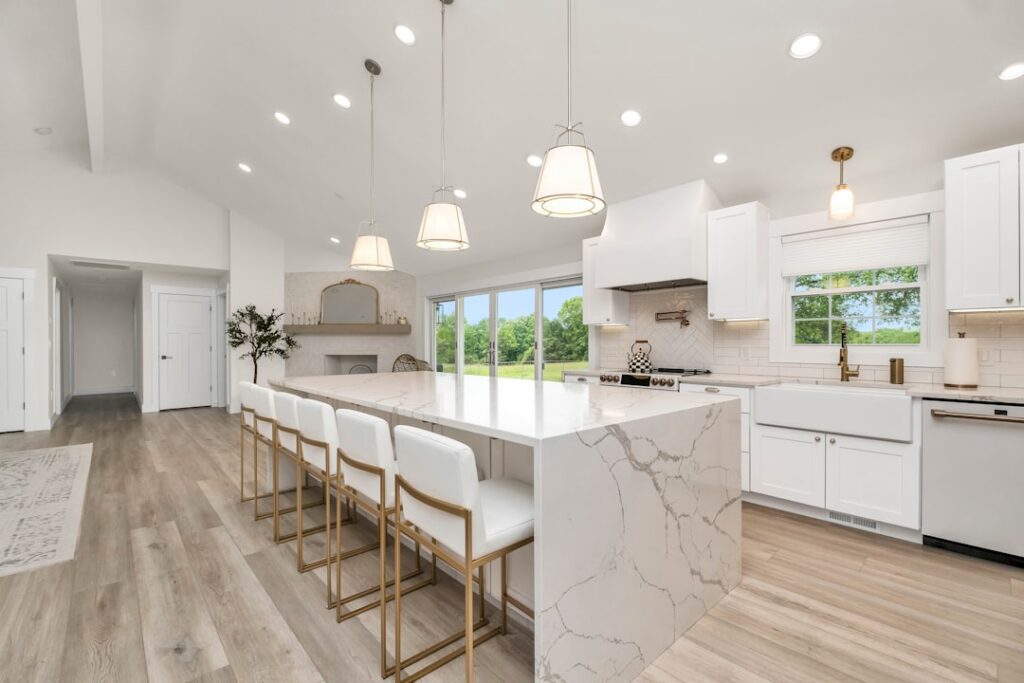
If you’ve been shopping for a durable, low-maintenance kitchen counter, you’ve almost certainly run into the Cambria name. Quartz Cambria countertops are engineered surfaces made by a family-owned American company, and they’ve earned a loyal following for their marble-look designs and genuine lifetime warranty. Unlike natural stone, these slabs never need sealing, and unlike some import brands, every one is manufactured in the United States. This guide covers what Cambria is, its most popular designs, what you’ll pay, how to care for it, and how it stacks up against competitors.
Part of our Countertops guide — explore the full guide →
- Quartz Cambria: What Makes Cambria Different
- Popular Cambria Designs
- What Quartz Cambria Costs
- How to Care for Cambria Countertops
- Durability in a Real Kitchen
- Cambria vs. Caesarstone and Silestone
- The Cambria Warranty and What It Covers
- Where Cambria Works Best in the Home
- Is Cambria Right for Your Home
Quartz Cambria: What Makes Cambria Different
Cambria is produced in Le Sueur, Minnesota, by a company that has stayed family-owned since it started making quartz surfaces in 2000. That’s a meaningful point of difference in a market crowded with overseas manufacturers. The slabs are made from roughly 93 percent natural quartz, one of the hardest minerals on earth, bound with a small amount of resin and pigment to form a dense, non-porous surface.
Because the surface is non-porous, it doesn’t absorb liquids, which means it resists staining and never needs the annual sealing that granite and marble require. The company backs every installation with a transferable lifetime limited warranty, something natural stone simply can’t offer. For homeowners who want the look of marble without the fuss, this combination is the main draw.
Popular Cambria Designs
Cambria offers well over 100 designs, but a handful show up in kitchens again and again. Knowing the flagship patterns helps you talk to your fabricator with confidence.
- Brittanica: A bright white background with bold, flowing grey veins. It’s the go-to for a classic Calacatta-marble look.
- Torquay: Modeled after Carrara marble, with soft grey veining on a warm white base. Understated and hugely popular.
- Ella: A cooler white with dramatic dark veins and subtle metallic flecks that catch the light.
- Swanbridge and Skara Brae: Warmer, browner tones for homeowners who want movement without the stark white look.
Cambria groups its designs into collections and finishes, including high-gloss and matte options. Always view a full slab in person, because large veining patterns look very different at counter scale than they do on a small sample chip.
What Quartz Cambria Costs
Cambria sits at the premium end of the engineered quartz market. Expect to pay roughly $60 to $120 per square foot installed, with most kitchens landing between $70 and $100. The spread depends on the design tier, your edge profile, and local labor rates.
- Material only: $45 to $85 per square foot, higher for premium veined designs.
- Fabrication and installation: $20 to $45 per square foot on top of material.
- Upgraded edges: An ogee or mitered waterfall edge can add $20 to $60 per linear foot.
For a typical 40-square-foot kitchen, a complete Cambria job commonly runs $3,000 to $4,800. It’s pricier than budget quartz brands, but the domestic manufacturing and lifetime warranty are part of what you’re paying for.
How to Care for Cambria Countertops
One of the biggest selling points is how little maintenance these counters need. Because the surface is non-porous, daily cleanup is genuinely simple. Follow a few basic habits and the counter will look new for decades.
- Wipe spills with warm water, a mild dish soap, and a soft cloth. No special stone cleaner is required.
- Skip abrasive pads and harsh chemicals like bleach, oven cleaner, or drain cleaner, which can dull the finish.
- Use a trivet or hot pad under pots and pans. Quartz resists heat but sudden extreme temperature changes can cause thermal shock.
- Use a cutting board. The surface is hard, but knives dull quickly and can leave fine marks over time.
Never seal a Cambria counter. Sealing is unnecessary and can actually leave a hazy residue on the non-porous surface. That’s it, warm soapy water is the whole maintenance routine.
Durability in a Real Kitchen
Quartz rates around 7 on the Mohs hardness scale, which makes Cambria highly resistant to scratches and chips under normal use. The non-porous surface also resists common kitchen stains from coffee, wine, oil, and citrus, giving you time to wipe up spills without panic.
Heat is the one area to respect. Cambria tolerates warmth, but a pan straight off a 400-degree burner set directly on the slab can cause a discolored spot or a hairline crack from thermal shock. Keep trivets handy near the stove and you’ll avoid the only real weakness. For families with kids and heavy daily cooking, few surfaces hold up better.
Cambria vs. Caesarstone and Silestone
Cambria competes head-to-head with Caesarstone (an Israeli-founded brand with US manufacturing) and Silestone (made by Spain’s Cosentino). All three are excellent engineered quartz surfaces, but there are differences worth weighing.
Cambria’s main pitch is that it’s American, family-owned, and offers some of the most convincing marble-look veining in the industry. Silestone offers a broader color range and pioneered antimicrobial and low-silica formulations, while Caesarstone is often slightly more budget-friendly and known for clean, minimalist patterns. On price, Cambria and Silestone sit close together at the premium tier, with Caesarstone sometimes a touch lower. If domestic manufacturing and dramatic veining top your list, Cambria usually wins; if you want maximum color variety or a lower entry price, the others deserve a look.
The Cambria Warranty and What It Covers
The transferable lifetime limited warranty is one of Cambria’s strongest selling points, but it’s worth understanding what it actually protects. The warranty covers manufacturing defects in the material for as long as you own the home, and because it transfers to a new owner, it can be a genuine selling feature at resale. That’s something no natural stone can offer, since granite and marble come with no manufacturer warranty at all.
To keep the warranty valid, the counter generally must be installed by a certified fabricator and used as intended, meaning normal residential kitchen or bath use. Damage from abuse, such as setting a red-hot pan directly on the surface or using it as a cutting board, isn’t covered. Register your installation and keep the paperwork, because a future buyer will appreciate documented proof when you sell.
Where Cambria Works Best in the Home
Cambria isn’t just a kitchen product. The non-porous, stain-resistant surface makes it a strong fit almost anywhere you want durable stone-look surfaces without the maintenance headaches. Consider it for these spots.
- Kitchen counters and islands: The flagship use, where its heat and stain resistance shine.
- Bathroom vanities: Non-porous quartz resists toothpaste, cosmetics, and water spots.
- Full-height backsplashes: A seamless slab backsplash in the same design creates a high-end continuous look.
- Fireplace surrounds and shower walls: The durability and moisture resistance hold up well in these demanding areas.
Because it comes in the same slab dimensions as other quartz, your fabricator can plan waterfall islands, mitered edges, and integrated surrounds using a single material throughout the home for a cohesive design.
Is Cambria Right for Your Home
Quartz Cambria makes the most sense for homeowners who want a high-end, marble-inspired look with essentially zero maintenance and a warranty they can pass to the next owner. It’s a strong choice for busy kitchens, bathroom vanities, and even commercial spaces where durability matters. The trade-off is cost, since you’ll pay more than for entry-level quartz or basic granite.
Before you commit, order a large sample, view a full slab at your fabricator, and compare at least one competing brand in the same design family. When you weigh the lifetime warranty, the non-porous surface, and the American manufacturing, many homeowners find the premium is worth it. A well-installed Cambria counter is the kind of upgrade you install once and never think about again, which is exactly what most people want from a kitchen surface.