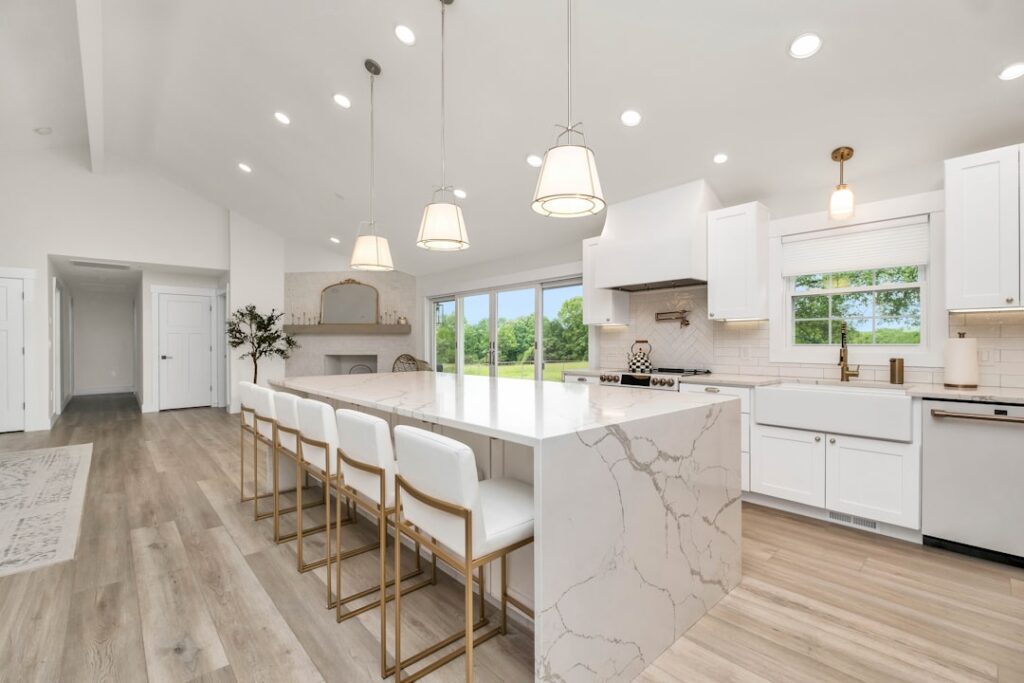
When a client tells me they want a countertop that feels warm and lived-in rather than cold and clinical, Cambria Lakedale quartz is one of the first designs I pull up on the samples. It is a soft, warm neutral with gentle movement, the kind of surface that quietly anchors a kitchen without shouting for attention. As an American-made premium quartz, it also comes with the durability and warranty backing that make it easy to recommend to homeowners planning to stay put for decades.
Part of our Countertops guide — explore the full guide →
What Lakedale Looks Like
Lakedale reads as a creamy, warm-toned background carrying subtle veining and soft tonal drifts in taupe, greige, and pale gold. It is not a dramatic, high-contrast marble imitation. The movement is understated, more like a calm sedimentary stone than a bold statement slab. That restraint is exactly why it works in so many kitchens: it plays well with almost any cabinet color and does not fight your backsplash or flooring for attention.
In natural daylight the warm undertones come forward and the counter feels inviting. Under cooler LED lighting it settles into a more neutral putty tone. If you are torn between a stark white quartz and something with personality, Lakedale sits comfortably in the middle.
Which Cambria Collection It Belongs To
Cambria organizes its designs into collections, and warm, low-movement neutrals like Lakedale live among the brand’s more understated, cabinetry-friendly patterns rather than its bold marble-look Marble Collection headliners. When you visit a Cambria dealer, ask to see it beside comparable warm neutrals so you can judge the tone in your own lighting. Colors shift noticeably between the showroom and your kitchen, so always borrow a large sample and live with it for a few days near your cabinets and under your actual bulbs.
Pairing With Cabinets
Because Lakedale is warm and neutral, it is genuinely versatile. Here is how I steer clients:
- White cabinets: creates a soft, cohesive look; the warm counter keeps an all-white kitchen from feeling sterile.
- Cream or off-white: a natural, harmonious match that leans farmhouse or traditional.
- Natural wood or walnut: the greige and gold notes echo the timber tones beautifully.
- Sage green or muted blue: the neutral counter grounds a colored base without clashing.
- Gray cabinets: pick a slab sample carefully, since Lakedale’s warmth can read slightly at odds with cool grays.
For hardware, brushed brass and matte black both flatter the warm palette. Polished chrome can feel a touch too cold against it.
Cost Per Square Foot
Cambria is a premium brand, and the pricing reflects that. Installed, most Cambria designs run $60 to $120 or more per square foot depending on the design tier, slab thickness, edge profile, and your local labor rates. Lakedale typically lands in the mid-to-upper part of that range.
- A 40 square foot kitchen counter commonly totals $2,400 to $4,800 installed.
- Waterfall edges and mitered thick edges add several hundred dollars each.
- Undermount sink cutouts, cooktop cutouts, and long seams add to labor.
Always get itemized quotes from at least two or three certified Cambria fabricators. The slab price is only part of the story; template, fabrication, and installation labor can vary by 30 percent or more between shops in the same city.
American Manufacturing and Warranty
One reason I trust Cambria is that it is made in the United States, produced in Minnesota by a family-owned company rather than imported. That matters for consistency and for support if something ever goes wrong. Cambria backs its countertops with a transparent limited lifetime warranty for residential installations, covering the material against defects for as long as you own your home, provided it is professionally installed. Register your countertop after installation and keep your paperwork, because the warranty applies to the original purchaser in a residential setting.
Maintenance
This is where Cambria Lakedale quartz earns its keep. The surface is nonporous, so it never needs sealing, unlike natural marble or granite. Daily care could not be simpler:
- Wipe with warm water and a mild dish soap or a pH-neutral cleaner.
- Blot spills, though the nonporous surface resists staining from wine, coffee, and oil.
- Avoid bleach, abrasive pads, and high-pH degreasers, which can dull the finish.
- Always use a trivet under hot pans; quartz resin can scorch around 300°F to 350°F.
Do that and the counter looks new for the life of the kitchen, with none of the annual resealing that stone demands.
Lakedale vs. Marble-Look Alternatives
If you are cross-shopping Lakedale against a dramatic marble-look quartz like Cambria’s Brittanicca or a competitor’s Calacatta imitation, the decision comes down to mood. Marble-look slabs deliver bold gray veining on a bright white field, a striking, high-contrast statement. Lakedale offers the opposite: warmth, calm, and quiet movement that hides crumbs and fingerprints better and dates less quickly. For a showpiece island, many homeowners choose a bold marble look. For a warm, timeless everyday kitchen they plan to live in for 20 years, Cambria Lakedale quartz is the safer, more forgiving choice, and one I rarely see anyone regret.
Durability and Heat Resistance
Like all Cambria, Lakedale is engineered quartz that scores a 7 on the Mohs hardness scale, harder than a steel knife blade, so everyday cutting, sliding pots, and heavy use will not scratch the surface under normal conditions. It resists chips far better than natural marble, which is one reason I steer clients with young kids and busy kitchens toward quartz over softer natural stone. The nonporous surface also means it will not absorb wine, coffee, or cooking oil the way an unsealed stone can.
The one real limitation is heat, and it applies to every quartz brand, not just Cambria. The polymer resin binding the quartz can scorch or discolor somewhere around 300°F to 350°F, and a cast-iron pan straight off a hot burner easily exceeds that. Never set hot cookware directly on the counter. Keep trivets and hot pads near the range and the coffee maker. Sudden thermal shock, like pouring boiling water onto a cold slab in winter, can also risk hairline cracking, so give the surface a moment and use common sense.
Installation and What to Budget For
Cambria is sold and installed through certified fabricators, not as a slab you pick up yourself. The process starts with a template visit, where the fabricator measures your cabinets precisely, often with a laser. From there, expect one to three weeks before the finished countertop is installed. Slabs are heavy and require professional handling, so this is not a DIY material.
- Confirm your cabinet bases are level before template day; shims may be needed for a flat install.
- Discuss seam placement in advance, ideally near a sink or an inside corner.
- Decide on your edge profile early, since ogee and mitered thick edges add labor and cost.
- Ask whether sink and cooktop cutouts are included in the quote or billed separately.
Because Lakedale is a warm neutral with soft movement rather than dramatic veining, seams tend to be forgiving and blend well, which is another quiet advantage over bold marble-look slabs where a mismatched vein at the seam jumps out.