
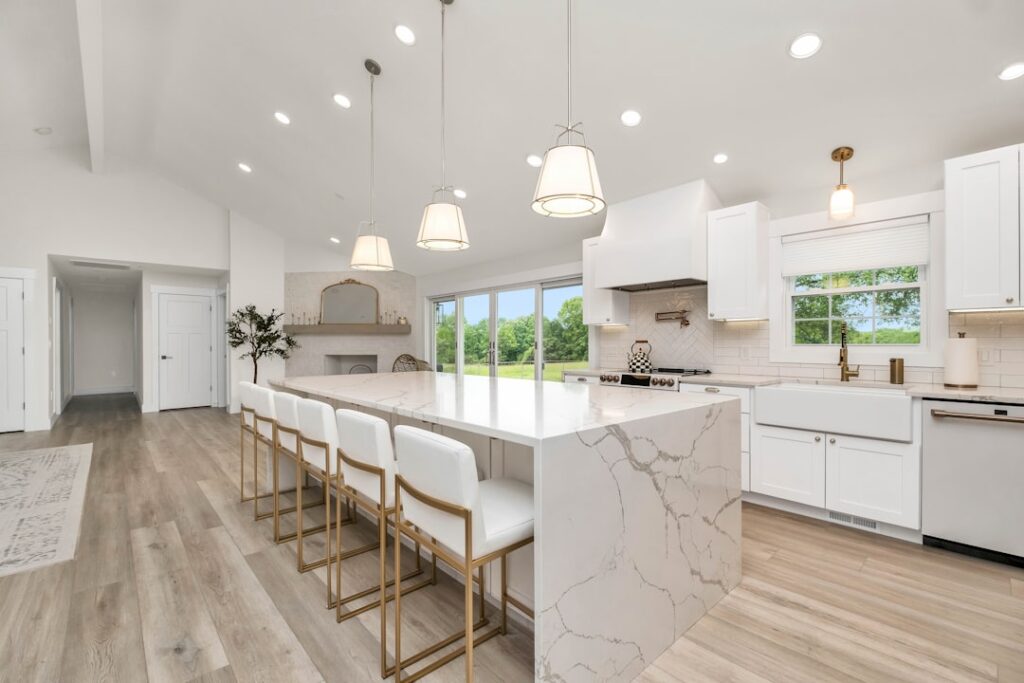
Walk into any countertop showroom and you will find a dozen slabs that look nearly identical, yet the price tags swing from $50 to well over $120 per square foot installed. The difference almost always comes down to which of the major quartz brands made the slab. Understanding what separates these quartz brands from one another saves you from overpaying for a name or, worse, buying a bargain slab that yellows in a sunny kitchen. This guide breaks down the leading manufacturers so you can match a brand to your budget, your design taste, and how hard your kitchen actually gets used.
Part of our Countertops guide — explore the full guide →
Engineered quartz is roughly 90 to 94 percent ground natural quartz bound with resins and pigments. That composition makes every slab nonporous, so it never needs sealing like granite or marble does. What changes from brand to brand is pattern realism, color range, warranty length, and how consistent the slabs are from one batch to the next.
- What Actually Separates the Quartz Brands
- Cambria: The US-Made Premium Option
- Caesarstone and Silestone: The Widely Available Workhorses
- MSI Q Quartz and LG Viatera: Strong Value Plays
- Corian Quartz and Other Names to Know
- Durability and Care Across Every Brand
- Warranty and Registration Details Worth Reading
- How to Choose Among Quartz Brands
- Final Thoughts on the Best Quartz Brands
What Actually Separates the Quartz Brands
Since the raw material is similar across manufacturers, the real differences show up in three places. First is pattern technology: higher-end lines use printing and particle-layering methods that mimic the veining of natural marble far more convincingly. Second is color and finish selection, which ranges from a couple dozen options to well over 150 shades. Third is warranty and support, which signals how much a company stands behind its product over a 15 to 25 year span.
Country of manufacture matters too. Some brands fabricate domestically, which can shorten lead times and simplify warranty claims. Others import slabs, which occasionally means longer waits when a specific color is on backorder. None of this makes a slab better or worse in your kitchen, but it affects the buying experience and the timeline for your remodel.
Cambria: The US-Made Premium Option
Cambria is the standout American manufacturer, producing all of its quartz in Minnesota. That domestic footprint is a genuine selling point if you want to keep the supply chain stateside and value shorter fabrication timelines. Cambria offers well over 150 designs, many engineered to imitate high-end marbles like Calacatta and Statuario with dramatic, flowing veins.
Expect to pay a premium. Cambria typically runs $75 to $120 per square foot installed, placing it at the upper end of the market. In exchange you get a lifetime limited warranty for the original homeowner, which is longer than most competitors offer. If your priority is a marble look without marble maintenance and you do not mind spending more, Cambria earns its reputation.
Caesarstone and Silestone: The Widely Available Workhorses
Caesarstone and Silestone are two of the most widely sold quartz brands in the US, and for good reason. Both have deep distribution, so you can see slabs in person at most kitchen showrooms and big-box design centers rather than ordering blind.
Caesarstone
An Israeli company with a long track record, Caesarstone leans into clean, contemporary color palettes alongside realistic marble-look lines. Pricing generally lands between $60 and $100 per square foot installed. The brand backs its residential countertops with a limited lifetime warranty, and its concrete-look and solid neutral tones are popular in modern kitchens.
Silestone
Made by Cosentino in Spain, Silestone is another heavyweight with a huge color range and multiple finish options, including matte and textured surfaces. Many Silestone lines carry an antimicrobial component and, more recently, low-silica formulations developed in response to fabricator health concerns. Installed pricing typically falls in the $55 to $100 per square foot range, with a 25-year limited warranty on most products.
MSI Q Quartz and LG Viatera: Strong Value Plays
If Cambria sits at the premium end, MSI Q Quartz and LG Viatera compete hard on value without feeling like a compromise. MSI is a large surfaces distributor whose Q Quartz line offers a broad selection of marble-look and solid colors, frequently at $50 to $85 per square foot installed. Availability is strong through fabricators nationwide, which keeps competitive bids realistic.
LG Viatera, made by LG Hausys, is another dependable mid-market choice with a solid spread of colors and a 15-year limited warranty on many lines. Pricing tends to run $55 to $90 per square foot installed. Both brands are smart picks for a full kitchen where you need 40 to 60 square feet of counter and want to control costs without dropping to an unknown import.
Corian Quartz and Other Names to Know
Corian Quartz, produced under the DuPont-associated Corian brand, brings the recognition of a legacy surfaces name to engineered quartz. It offers a respectable color range and is often specified when a homeowner already trusts the Corian name from solid-surface products. Pricing is broadly comparable to other mid-to-upper lines, generally $60 to $100 per square foot installed.
Beyond these, you will encounter regional and private-label quartz brands sold through individual fabricators. These can offer real savings, sometimes $45 to $70 per square foot installed, but scrutinize the warranty terms and ask to see a full slab rather than a small sample. A 4-inch chip cannot show you how veining flows across a 10-foot island.
Durability and Care Across Every Brand
Here is the reassuring part: the day-to-day performance of quartz is remarkably consistent from brand to brand. Because engineered quartz is nonporous, none of these surfaces need annual sealing, and all of them resist stains from wine, coffee, and oil far better than natural marble. Everyday cleanup is nothing more than warm water, a soft cloth, and a little dish soap or a pH-neutral cleaner.
The shared weakness across all quartz brands is heat and prolonged UV exposure. The resins that bind the quartz can scorch or discolor if you set a 400-degree pan directly on the surface, so always use trivets. Some lighter or pure-white colors can also yellow slightly over many years in a kitchen flooded with direct sunlight, which is worth weighing if you have a wall of south-facing windows. Avoid abrasive scouring pads and harsh solvents like paint thinner, and any of these countertops will look new for 15 to 25 years.
Warranty and Registration Details Worth Reading
Warranties are a real differentiator among quartz brands, but only if you actually use them. Cambria’s lifetime limited warranty, Silestone’s 25-year coverage, and the 15-year terms common to LG Viatera all apply to the original homeowner and usually require registration within 30 to 60 days of installation. Skip that step and a future claim can be denied on a technicality.
Read what the warranty covers, too. Most protect against manufacturing defects, not damage from heat, impact chips, or improper cleaning. Keep your receipt, note the exact color name and lot number your fabricator used, and file the registration promptly. That small bit of paperwork is the difference between a covered replacement and an out-of-pocket repair down the road.
How to Choose Among Quartz Brands
Start with your budget per square foot, then measure your actual counter area to get a realistic total. A typical kitchen uses 40 to 55 square feet, so a $20 per square foot difference between brands can swing your project by $800 to $1,100 before you even factor in edge profiles or a waterfall island.
Next, prioritize what matters most to you. If you want the most convincing marble veining, look hard at Cambria and the premium lines from Caesarstone and Silestone. If broad availability and competitive bids matter more, MSI Q Quartz and LG Viatera deliver. Always view the specific slab your fabricator will cut, confirm the warranty is registered to you as the homeowner, and ask whether the color is current or being discontinued, since a discontinued line makes future repairs difficult.
Final Thoughts on the Best Quartz Brands
There is no single winner among the top quartz brands, only the right match for your kitchen and wallet. Cambria leads on US manufacturing and warranty, Caesarstone and Silestone dominate on availability and selection, and MSI Q Quartz, LG Viatera, and Corian Quartz cover the value-conscious middle. Because engineered quartz is nonporous and stain-resistant across all of these makers, you can shop confidently on look, price, and warranty rather than worrying about basic performance. Get two or three fabricator quotes on the same slab, inspect the full piece in daylight, and you will land a countertop that looks great and holds up for decades.


