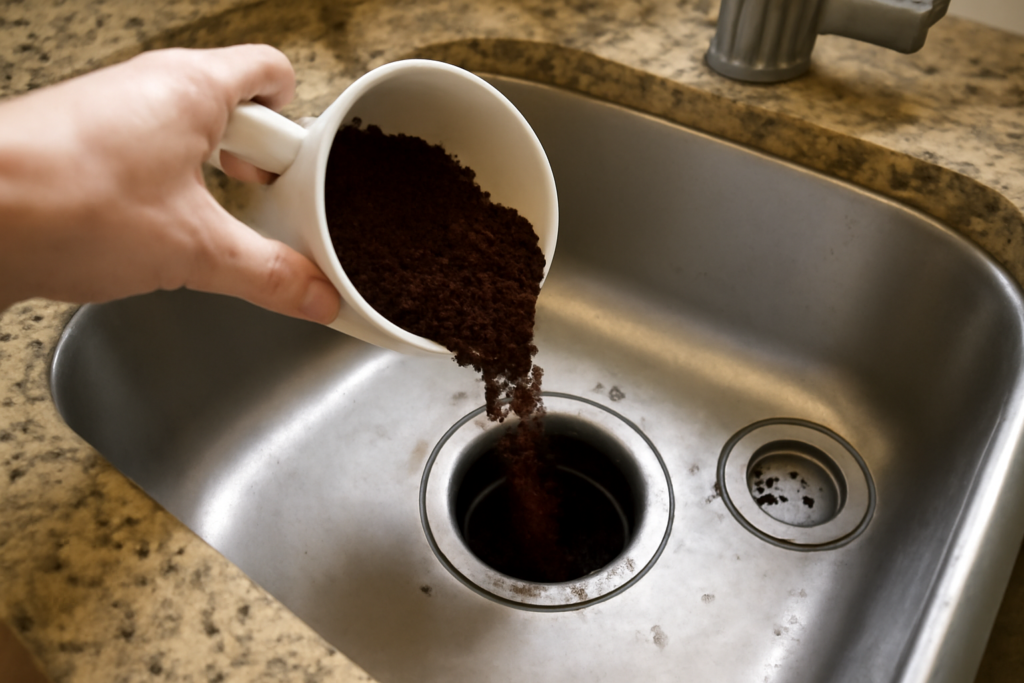
Ask three people and you’ll get three answers, but here’s the short version: can you put coffee grounds in the garbage disposal without regret? Technically the blades will chew them, but that’s not the same as the grounds leaving your pipes. Spent coffee doesn’t dissolve. It clumps, sinks, and hardens into a gritty sludge that plumbers pull out of P-traps by the fistful. I’ve snaked drains where the blockage looked like wet coffee cake. If you brew every morning, this is a habit worth breaking.
- Why Coffee Grounds Wreck Your Drain
- What the Manufacturers Actually Say
- The One Exception Worth Knowing
- Better Places for Your Spent Grounds
- How to Toss Grounds the Right Way
- Signs Grounds Have Already Built Up
- A Simple Monthly Drain Flush
- The Grease Connection Explained
- What About the “Grounds Sharpen the Blades” Myth?
- Quick Answers to Related Questions
- The Bottom Line
Why Coffee Grounds Wreck Your Drain
A garbage disposal doesn’t actually make waste disappear. It grinds food into small pieces so water can carry them through a 1.5-inch drain line to the sewer. That system relies on solids that either dissolve or stay suspended long enough to flush away. Coffee grounds do neither. They’re dense, they clump together when wet, and they settle in the low points of your plumbing.
The real trouble starts when grounds meet the grease and oils already coating your pipes. Bacon fat, salad dressing, cooking oil that got rinsed down last week — coffee grounds bind to that film like sand mixing with paste. Over a few months the buildup narrows a two-inch pipe to the width of a pencil. Then one Sunday the sink backs up and you’re standing in gray water wondering what changed. Nothing changed suddenly. It was the daily half-cup of grounds doing quiet damage.
What the Manufacturers Actually Say
Here’s a twist that surprises people. InSinkErator, the largest disposal maker in the country, lists coffee grounds as acceptable in small amounts and even suggests they help control odor. So who’s right — the manufacturer or the plumber? Both, in a way. The disposal itself won’t be harmed by grounds, and the grinding chamber may smell fresher. The disposal is not the vulnerable part. Your drain line is.
Think of it like this: your car engine can technically run on the wrong oil for a while, but that doesn’t make it a good idea for the transmission downstream. The disposal survives. The pipes six feet later pay the price. That gap between “the appliance tolerates it” and “your plumbing tolerates it” is exactly why the advice conflicts.
The One Exception Worth Knowing
If you have older plumbing, cast iron pipes, or a home on a septic system, treat coffee grounds as an absolute no. Cast iron develops interior rust ridges that catch grounds like a net. Septic tanks rely on bacterial breakdown, and coffee grounds resist decomposition for years, adding to the solid layer that forces early pumping. On a septic system, every scoop of grounds shortens the interval between $400 tank services.
Newer PVC drain lines in a home on city sewer are more forgiving, but “more forgiving” is not the same as “fine.” The physics of settling solids don’t care what your pipe is made of.
Better Places for Your Spent Grounds
The good news is that coffee grounds are one of the most useful kitchen scraps you can save. Instead of sending them down the drain, put them to work:
- Compost pile: Grounds are nitrogen-rich “green” material. Mix them with dry leaves or shredded paper at roughly a 1:3 ratio and they break down beautifully.
- Garden soil: Worked lightly into beds, they improve texture and feed acid-loving plants like blueberries, azaleas, and hydrangeas.
- Odor absorber: Dry them on a baking sheet, then set a small open jar in the fridge or freezer. They pull odors like baking soda does.
- Deck and grill scrub: Their mild grit cuts baked-on grease without scratching cast iron grates.
- Plain trash or green bin: When in doubt, a paper towel folded around the grounds goes straight into the garbage. Zero drama.
How to Toss Grounds the Right Way
The cleanest method takes about ten seconds. Keep a lidded container — an old yogurt tub or a countertop compost caddy works — next to your coffee maker. Knock the wet puck or dump the filter into it right after brewing. Empty it into your compost or trash every day or two. Rinse the portafilter or basket into that same container, not the sink, so even the loose grounds never touch the drain.
If a stray spoonful does end up in the sink, run cold water hard for 20 to 30 seconds to flush it fully past the trap. Cold water, not hot — hot water softens grease and helps it grab the grounds. This is the opposite of what most people assume.
Signs Grounds Have Already Built Up
Maybe you’ve been feeding the disposal grounds for years and want to know if damage is brewing. Watch for these early warnings:
- Water drains slower than it used to, with a faint gurgle as it clears
- A musty or sour smell that returns a day after you clean the disposal
- The disposal runs fine but the sink pools before emptying
- Occasional backups in the dishwasher, which shares the same drain line
Catch it early and a monthly flush can hold things off. Ignore it and you’re looking at a $150 to $350 drain-cleaning call, more if the clog reaches the main line.
A Simple Monthly Drain Flush
Whether or not grounds have been going down, a routine flush keeps your disposal and line healthy. Pour half a cup of baking soda into the drain, follow with a cup of white vinegar, and let it foam for 10 to 15 minutes. Then run hot tap water for a full minute to rinse. Once a week, grind a few ice cubes with a handful of coarse salt to scour the grinding chamber, and drop in a wedge of lemon or orange peel afterward for a fresh scent. Skip chemical drain openers — they can warp disposal seals and rarely clear a grease-and-grounds clog anyway.
The Grease Connection Explained
It’s worth spending an extra minute on why grease makes grounds so much worse, because this is the mechanism most people miss. When you rinse a greasy pan, the fat travels down the drain as a warm liquid. A few feet along, the pipe is cooler, so the fat congeals and clings to the pipe wall as a waxy layer. On its own, that layer builds slowly. But coffee grounds are the perfect aggregate — like gravel in concrete, they give the grease something to grab, and the two form a dense composite that no amount of hot water will melt away once it sets.
Municipal sewer departments have a name for the worst version of this: “fatbergs,” the massive congealed masses that clog city mains, and coffee grounds are a documented contributor. Your home plumbing faces the same chemistry on a smaller scale. That’s why the single best habit isn’t just keeping grounds out of the drain — it’s keeping grease out too. Pour cooled bacon fat into a jar for the trash, and wipe oily pans with a paper towel before washing. Do both and your drain line stays remarkably clean.
What About the “Grounds Sharpen the Blades” Myth?
You’ve probably heard that running coffee grounds, eggshells, or ice through a disposal sharpens the blades. Let’s put that to rest. A garbage disposal doesn’t actually have blades in the knife sense — it uses two blunt metal impellers (called lugs) that fling food against a stationary grind ring. There’s nothing to sharpen, and grounds do nothing to improve grinding. Ice can help knock debris off the impellers and clean the chamber, which is genuinely useful, but that’s mechanical scouring, not sharpening. So don’t justify feeding grounds to the disposal on the theory that it maintains the unit — it doesn’t. The disposal’s grinding ability comes from its motor and the geometry of the grind ring, neither of which coffee grounds affect.
Quick Answers to Related Questions
- What if I only rinse a little coffee residue? A small amount of liquid coffee or a stray fleck of grounds is fine when chased with plenty of cold water. It’s the accumulation of solid grounds that causes trouble.
- Are eggshells okay instead? No — eggshells create the same gritty sediment and offer no benefit. Compost them too.
- Can hot water flush grounds through? No. Hot water softens grease and helps it trap grounds. Always use cold water in a disposal.
- Do enzyme drain treatments help? Monthly enzyme or bio-based cleaners can slow grease buildup, but they won’t dissolve packed coffee grounds. Prevention beats treatment.
The Bottom Line
So, can you put coffee grounds in the garbage disposal? You can, but you shouldn’t make a habit of it, and you definitely shouldn’t on a septic system or older cast iron plumbing. The disposal will grind them, the manufacturer may even bless small amounts, yet the grounds don’t dissolve and they team up with grease to choke your drain over time. Keep a small caddy by the coffee maker, send the grounds to your compost or trash, and give your drain a monthly baking-soda flush. Your pipes will run clear, your kitchen will smell better, and your garden will thank you for the spent grounds you would have wasted. It’s a five-second change that saves you a plumber’s bill down the road.