
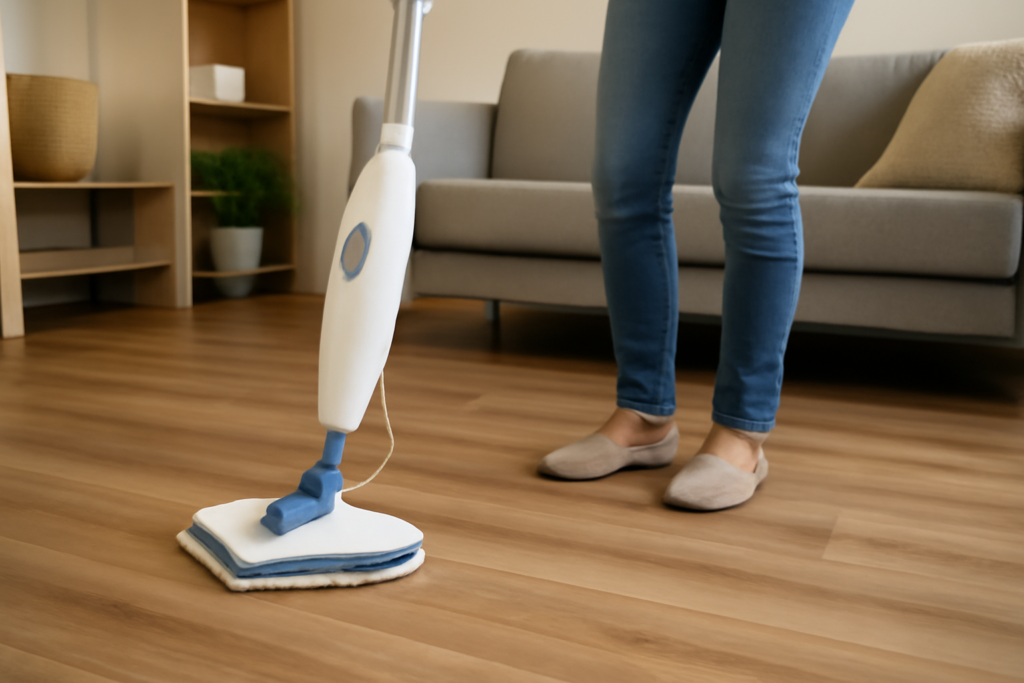
Steam mops promise chemical-free, sanitizing cleaning, so it is natural to want to use one everywhere. But can you use a steam mop on laminate floors without wrecking them? The honest answer from nearly every laminate manufacturer is no — steam and laminate are a bad match, and using one can void your warranty. I have pulled up too many buckled, delaminated floors caused by well-meaning owners steaming them to give any other advice. Here is why, and what to do instead.
What Laminate Flooring Actually Is
To understand the problem, you need to know what is under your feet. Laminate is not solid wood. It is a layered product: a high-density fiberboard (HDF) core, a printed photographic layer that mimics wood, and a clear melamine wear layer on top. That HDF core is essentially compressed wood fibers — and wood fibers swell when they absorb moisture.
The planks click together with tongue-and-groove edges. Those seams are the vulnerability. Even a well-made floor has microscopic gaps at every joint, and that is exactly where steam finds its way in.
Why Steam Is the Enemy of Laminate
A steam mop forces hot vapor into the floor under pressure. Steam is far more penetrating than a damp mop because it is hot, pressurized, and its fine particles drive into seams a splash of water would never reach. Once that moisture gets into the HDF core, three things happen:
- Swelling and edge peaking: the core absorbs water and expands, pushing plank edges up so seams feel raised
- Delamination: the layers separate as the adhesive bond breaks down
- Buckling and warping: whole planks lift or cup, and there is no fixing it short of replacement
The heat can also cloud or dull the melamine wear layer over time. The damage is usually gradual, so people steam happily for months before the floor suddenly starts peaking at the seams — and by then it is too late.
What the Manufacturers Actually Say
This is not just my caution — it is written into the fine print. The major laminate brands are explicit in their care guides: do not use steam mops or wet mops. Most warranties specifically exclude water and moisture damage, and steam cleaning is frequently called out by name as a warranty-voiding action.
Before you steam any laminate floor, pull up the manufacturer’s care and maintenance sheet for your specific product. If you no longer have it, search the brand and product line online. The overwhelming majority prohibit steam. Defer to that documentation over any generic advice, including a mop maker’s claim that its unit is “laminate safe.”
But My Steam Mop Says It’s Safe for Laminate
Some steam mops advertise a laminate or “sealed floor” setting. Read this carefully: those settings lower the steam output, but they do not eliminate moisture and heat. The mop maker’s marketing does not override your flooring warranty. If your floor manufacturer prohibits steam and you steam anyway, a warranty claim will be denied regardless of what your mop box said.
My rule is simple: the flooring warranty wins. When two manufacturers disagree, side with the one who has to replace your floor.
The Right Way to Clean Laminate
The good news is that laminate is genuinely easy to clean without steam. Its sealed wear layer resists staining, so it does not need aggressive cleaning to look great.
- Dry clean first. Dust mop, sweep, or vacuum on a hard-floor setting (no beater bar) to remove grit that scratches the surface.
- Use a barely damp microfiber mop. Damp, not wet. Wring it until no water drips.
- Use a laminate-specific cleaner. Products formulated for laminate leave no residue. A spray-and-wipe approach controls moisture far better than a bucket.
- Dry any wet spots immediately. Never let standing water sit on the seams.
Avoid vinegar-and-water mixes, oil soaps, and wax — they either etch or leave a dulling film on the wear layer.
Handling Spills and Sticky Messes
Wipe up spills the moment they happen; time is the real enemy. For dried or sticky spots, lay a damp cloth over the area for a minute to soften it, then wipe — do not gouge with a metal scraper. For scuffs, a pencil eraser or a dab of laminate cleaner on a soft cloth usually lifts them.
Place mats at entries to catch grit and moisture, and add felt pads under furniture legs. These small habits do more to protect laminate than any cleaning gadget.
The Bottom Line
So, can you use a steam mop on laminate floors? Technically the mop will glide across the surface, but you should not — the moisture and heat threaten the HDF core, risk buckling and delamination, and typically void your warranty. Stick with a dry dust mop and a barely damp microfiber pad with a laminate-safe cleaner. Your floor will look just as clean, last far longer, and keep its warranty intact.
The Risk to Laminate Explained
The reason this question comes up so often is that the answer runs against what steam-mop marketing implies. Laminate flooring is a fiberboard core topped with a photographic layer and a wear coat, and that core is essentially compressed paper that swells permanently when moisture reaches it. Steam is hot water vapor under pressure, and it can drive moisture down through the seams between planks to the vulnerable core. The result is swelling, warping, and lifted edges that cannot be undone.
This is why most laminate manufacturers explicitly void the warranty if you use a steam mop, regardless of how the mop is advertised.
Safer Ways to Clean Laminate
You can get laminate spotless without any steam. Dry methods do most of the work: sweep, dust-mop, or vacuum with a hard-floor setting to lift the grit that dulls the finish. For a deeper clean, lightly mist a microfiber pad with a laminate-safe or pH-neutral cleaner and damp-mop, drying any excess immediately so no water sits on the surface or pools in the seams. Wipe spills the moment they happen. If your specific floor is a newer waterproof laminate with sealed edges, check the manufacturer’s guidance, since a few explicitly permit limited steam use, but the safe default for standard laminate is to keep the steam mop away and rely on a barely damp microfiber instead.
Prefer to explore on your own?
See how new flooring looks in your actual room in seconds — free, no signup.
Try the free Floor Studio →

