The single most expensive mistake in carpet buying happens before any installer arrives — and it usually comes down to misunderstanding how the product is sized. Carpet dimensions work differently than tile, vinyl, or hardwood: rolls come in fixed widths, seams are inevitable in larger rooms, and a 5 percent measurement error can turn into 50 percent more material on the order. After laying out hundreds of rooms and helping homeowners avoid both over- and under-buying, here is the complete reference for sizing carpet correctly.
Standard Roll Widths in the US
Broadloom carpet (the wall-to-wall product most homeowners install) ships from the mill in fixed roll widths. The dominant width in the US market is 12 feet, with 15 foot rolls available as a special order on many SKUs. A handful of premium and commercial products come in 13 foot 6 inch rolls.
- 12 ft — standard residential, widest selection, almost every SKU
- 13 ft 6 in — some commercial and broadloom imports
- 15 ft — premium residential, special order from most mills
- 9 ft, 6 ft, 4 ft — specialty narrow widths, mostly for stair runners
The carpet dimensions that come off the roll are continuous in length — your installer cuts to room dimension. Rolls are ordered in linear feet, not square feet, even though pricing is quoted per square foot or per square yard.
Why Roll Width Drives Layout
Any room wider than 12 feet (or 15 feet, depending on the product) requires at least one seam. Where that seam falls is a real design decision. The goal is to put seams in low-traffic areas, parallel to the longest run, and not perpendicular to the main entry of the room.
Imagine a 14 ft by 18 ft master bedroom. With 12 ft wide carpet, the installer needs a 14 x 12 main field plus a 14 x 6 fill strip. The seam runs along the 14 foot dimension. Where that seam ends up — under the bed, behind the dresser, or across the doorway — is critical to long-term appearance.
Measuring Rooms Correctly
Skip the marketing of “free room measurement” and check the work yourself. Pro installers usually get it right, but verify before approving an order.
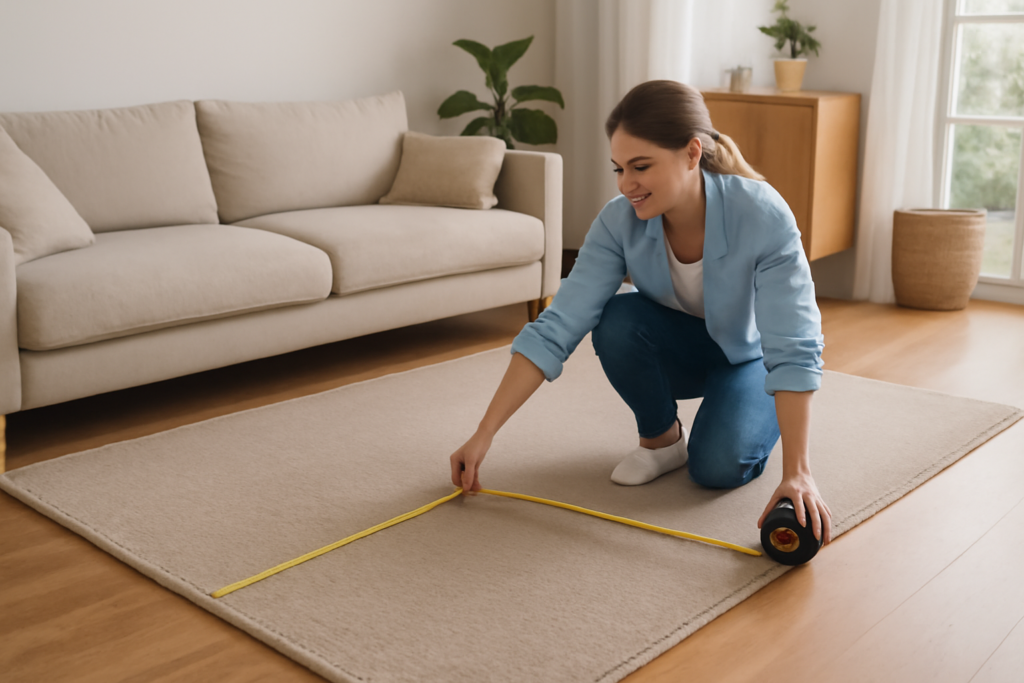
- Measure each room in feet and inches at its widest point
- Add 3-4 inches per dimension for trimming
- Round up to the nearest 6 inches
- Account for closets, alcoves, and bay windows separately
- Add 5-10 percent overage for pattern matching and future repairs
For pattern carpets (geometric, floral, or repeating designs), the overage jumps to 15-25 percent depending on the repeat dimension. This is where carpet dimensions math gets expensive — a 30 inch pattern repeat in a 14 foot room nearly doubles your fill strip waste.
Common Room Carpet Yardage
For quick estimating, here are typical yardages for common US room sizes (using 12 ft wide carpet, 5 percent waste):
- Bedroom 10 x 12 — 13 sq yd, single piece, no seam
- Bedroom 12 x 14 — 19 sq yd, single piece, no seam
- Bedroom 14 x 16 — 30 sq yd, one seam parallel to 14 ft wall
- Living room 16 x 20 — 39 sq yd, one seam parallel to 20 ft wall
- Family room 20 x 24 — 56 sq yd, multiple seams, careful planning required
- Hallway 4 x 16 — 8 sq yd, single piece, ran lengthwise
Stair Runner Dimensions
Stair runners follow different math entirely. Standard runner widths run 26, 27, 30, and 36 inches. The runner length is calculated by measuring the tread depth plus riser height for every step, then adding 6 inches per landing.
For a typical 14-step straight flight: 14 steps x (10 in tread + 7.5 in riser) = 14 x 17.5 in = 245 inches, plus 12 inches for top and bottom landings = 257 inches total, or about 21 feet. Add 10 percent for fitting and you order 23 feet of runner.
Area Rug Standard Sizes
For area rugs (separately purchased products, not wall-to-wall), the US market standardizes on these dimensions:
- 2 x 3 ft — accent or door-side
- 3 x 5 ft — small entry, foot of bed
- 4 x 6 ft — small living room or under coffee table
- 5 x 8 ft — standard living room area rug
- 6 x 9 ft — medium living room or bedroom
- 8 x 10 ft — most common large rug, full living room
- 9 x 12 ft — large living room, formal dining
- 10 x 14 ft — open-concept great rooms
- 12 x 18 ft — premium oversized, full furniture coverage
Rug Sizing Rules of Thumb
Living room: rug should extend at least 6 inches under the front legs of all major seating. For most US rooms that means 8×10 or larger.
Dining room: rug should extend 24 inches beyond the table on all sides so chair legs stay on the rug when pulled out. A standard 6-seat table needs 8×10; a 10-seat needs 9×12 or larger.
Bedroom: standard rule is 18-24 inches of rug visible past every side of the bed. A queen bed (60×80) on a 9×12 rug centered with foot extension works well; a king bed (76×80) typically needs 10×14.
Carpet Tile Dimensions
Modular carpet tile is the alternative to broadloom for commercial and increasingly residential applications. Standard tile sizes are 18×18 inches, 19.7×19.7 inches (50×50 cm), 24×24 inches, and 9×36 inch plank format.
Tile installs eliminate seams as a structural concern (every joint is a “seam” by design) and make replacement of damaged areas trivial. The trade-off is appearance — tile patterns are visible at any decent lighting, where broadloom seams disappear when properly installed.
Common Mistakes to Avoid
Ordering by square footage without checking roll width. A 16×16 room needs 256 sq ft of carpet by area, but with 12 ft rolls it actually consumes 16 x (12+4) = 256 sq ft of roll plus the fill strip — roughly 320 sq ft of order quantity.
Forgetting closets and transitions. Closet floors and door transitions add 5-15 percent to room totals.
Ordering exact quantity. Always add 5-10 percent for waste, repairs, and dye lot match. Buy from the same dye lot to ensure color consistency for any future repairs.
Bottom Line
Carpet dimensions are governed by mill roll widths, room geometry, and pattern repeats — and getting them right starts at the measurement stage. Verify every measurement, plan seams intentionally, account for waste honestly, and buy the same dye lot for any reserve material. Done right, you end up with a clean install, minimal waste, and reserves on hand for the inevitable repair five years down the road.