When carpet gets soaked from a spill, an overflowing tub, or a small leak, the clock starts immediately. Mold and mildew can take hold in as little as 24 to 48 hours, and a regular box fan rarely moves enough air to beat that window. A carpet fan, more accurately called an air mover, is built specifically to force a high-velocity, low-profile stream of air across and under wet carpet so it dries before damage sets in.
Understanding how these fans work, where to point them, and whether to rent or buy can be the difference between a quick recovery and a costly subfloor replacement.
What a Carpet Fan Actually Is
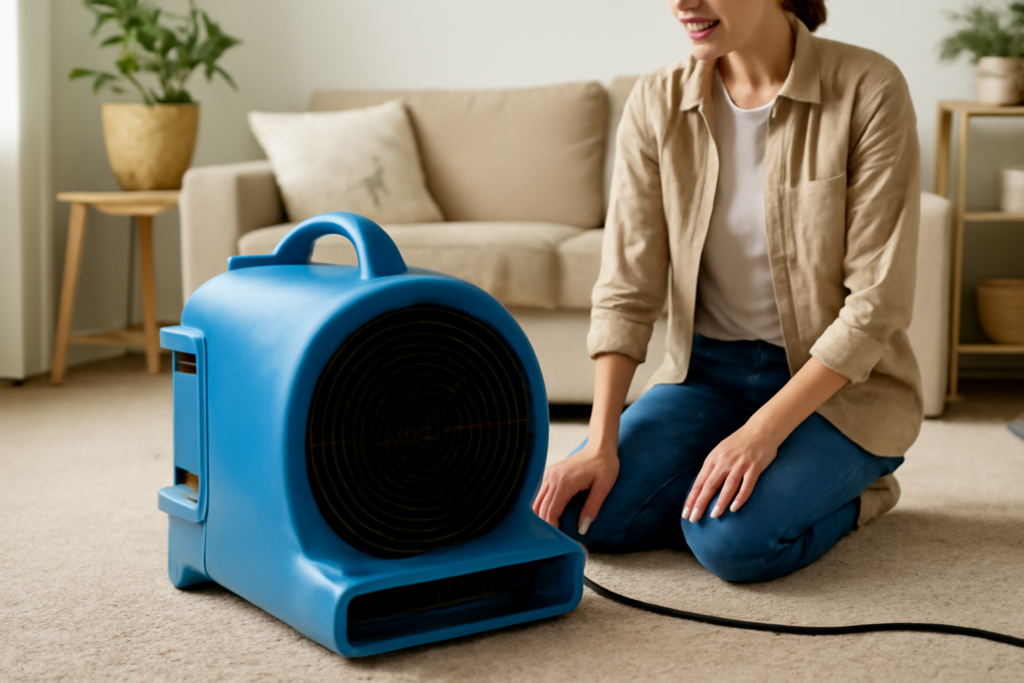
A carpet fan, or air mover, is a compact, powerful blower designed to dry surfaces fast. Unlike a household fan that pushes air outward in a wide cone, an air mover concentrates airflow into a focused, horizontal sheet that hugs the floor. Many models tilt to several angles, including a snorkel position that lifts the carpet edge and pushes air beneath it.
Restoration pros rely on these units after floods and leaks because moving air accelerates evaporation dramatically. The faster water evaporates, the less time microbes have to colonize the padding and subfloor.
Types of Air Movers
Choosing the right style depends on how much water you are dealing with and the size of the area.
- Centrifugal air movers: The classic drum-shaped units that deliver focused, high-pressure airflow ideal for soaked carpet.
- Axial air movers: Lighter and more energy efficient, they move a larger volume of air across bigger open areas.
- Low-profile floor dryers: Compact units that slide tight against baseboards and under furniture overhangs.
For most household incidents, a centrifugal air mover offers the best drying power for a single room.
How to Dry Wet Carpet Step by Step
- Stop the water source and remove any standing water with a wet/dry vacuum or extractor first; a fan cannot dry a puddle.
- Lift the carpet at a corner if possible and pull back the padding, since soaked padding holds water and slows drying dramatically.
- Position the air mover at a shallow angle so it sweeps air across the carpet surface and under the lifted edge.
- Add a dehumidifier in the room to pull the evaporated moisture out of the air rather than letting it resettle.
- Run the equipment continuously and check progress after several hours, repositioning the fan to target damp spots.
For a typical room, expect drying to take anywhere from 12 to 48 hours depending on how saturated the carpet was and the humidity in your area.
Smart Placement for Faster Drying
Airflow direction matters more than raw fan count. Aim air movers so they push moisture in one consistent direction around the room, ideally toward an open window or a running dehumidifier. In a larger space, stagger multiple units in a circular pattern so the air keeps moving rather than colliding head-on.
Point at least one fan to lift and dry the carpet edge and the padding beneath, since trapped subfloor moisture is what leads to musty odors and mold weeks later.
Rent or Buy?
For a one-time spill, renting is the economical choice. Home improvement stores and equipment rental yards rent air movers for roughly $20 to $40 per day, often with a wet/dry vacuum and dehumidifier available alongside. For a single soaked room, a fan, an extractor, and a dehumidifier rented together usually handle the job.
If you live in a flood-prone area, have a finished basement, or simply want to be ready, buying a personal air mover runs about $80 to $200. Owning one means you can react within minutes instead of waiting for a rental, which is exactly when drying matters most.
When Fans Are Not Enough
Air movers excel at clean-water incidents caught early. But if the water came from sewage, a longstanding leak, or floodwater, the carpet padding and possibly the carpet itself often need to be removed and replaced rather than dried. The same is true if the area has been wet for several days, since hidden mold may already be growing in the padding and subfloor.
When you see staining spreading, smell a persistent musty odor after drying, or suspect contaminated water, bring in a water-damage restoration professional. They use moisture meters to confirm the subfloor is truly dry, something a fan alone cannot verify.
Pairing a Fan With a Dehumidifier
An air mover and a dehumidifier are a team, and using one without the other leaves the job half done. The fan speeds evaporation, lifting moisture out of the carpet and into the air. But that water has to go somewhere; without a dehumidifier, the humid air simply resettles onto cool surfaces and slows the whole process. Run them together and the dehumidifier captures the moisture the fan releases, dropping the room’s humidity and accelerating drying dramatically.
In an enclosed room, close the windows and run both units together so the dehumidifier can do its work. In a space where you can ventilate to drier outdoor air, an open window paired with the fan can substitute in a pinch. For serious water events, restoration crews always run both, and renting them as a pair is the most effective approach for a homeowner tackling a soaked room.
Using Air Movers Beyond Wet Carpet
While drying flooded carpet is the headline use, air movers earn their keep on other projects too. They speed the drying of freshly cleaned carpet after shampooing, cutting the wait from hours to a fraction of that. They are useful for drying mopped hard floors before foot traffic returns, for accelerating paint and joint-compound drying, and for airing out musty basements and closets.
Contractors also use them to dry walls and baseboards after minor leaks. Because the airflow is focused and powerful, a single unit can handle tasks that would take several household fans. If you buy one for emergency water response, you will likely find yourself reaching for it for these everyday drying jobs as well.
The Bottom Line
A carpet fan is the single most useful tool for rescuing wet carpet, but it works best as part of a system: extract the water, lift the padding, run the air mover, and pair it with a dehumidifier. Move fast, dry thoroughly, and you can often save the carpet entirely. Hesitate, and a minor spill can turn into a full replacement, so it pays to have a plan and the right fan ready before you ever need it.