
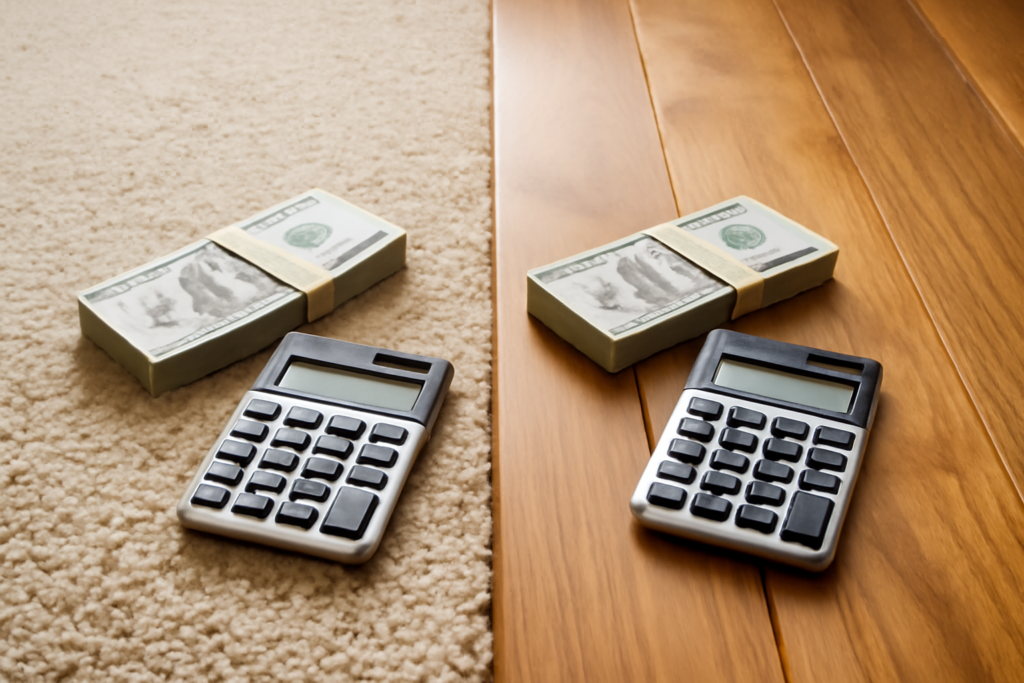
The price tag on the showroom display is rarely what shows up on your final invoice. Real carpet vs hardwood cost includes material, pad or underlayment, removal of the old floor, subfloor prep, installation labor, transition pieces, sales tax, and waste factor. After estimating both floor types in dozens of remodels, the honest answer is that carpet wins on upfront price but hardwood wins on lifetime cost — and the gap closes faster than most homeowners expect.
- The Headline Numbers
- Carpet Material Costs Broken Down
- Hardwood Material Costs Broken Down
- Subfloor and Prep Costs
- Removal and Disposal
- Lifespan and Cost Per Year
- Hidden Costs That Skew the Math
- Where Carpet Still Wins
- Where Hardwood Pays Off Fastest
- Making the Decision for Your Budget
- Replace Carpet with Hardwood Cost: Conversion Factors That Change the Quote
The Headline Numbers
Installed carpet runs $3.50 to $11 per square foot in 2026, with the middle of the market around $5.50 per square foot for a mid-grade nylon over 8-pound rebond pad. Installed solid hardwood runs $9 to $22 per square foot, with the middle around $12.50 for 3/4-inch oak in a common species and grade. Engineered hardwood splits the difference at $7 to $16 per square foot installed. For a 1,000 square foot main level, you are comparing roughly $5,500 carpet against $12,500 hardwood — a $7,000 spread before any extras.
Carpet Material Costs Broken Down
Carpet itself ranges from $1.50 to $7 per square foot depending on fiber and construction. Polyester from Mohawk or Shaw at $2 to $3 per square foot covers entry-level. Nylon — SmartStrand from Mohawk or Anso from Shaw — runs $3.50 to $5.50 per square foot and offers better resilience. Wool from Karastan or Stanton sits at $7 to $15 per square foot for high-end installs. Pad is non-negotiable: 8-pound rebond at $0.45 to $0.75 per square foot under most installs, or memory foam at $1 to $1.50 per square foot for premium projects. Installation labor adds $0.75 to $1.75 per square foot.
Hardwood Material Costs Broken Down
Solid red oak in 2 1/4-inch strip costs $3.75 to $5.50 per square foot from Lumber Liquidators or a local hardwood dealer. White oak runs slightly higher at $5 to $8 per square foot. Premium domestic species like hickory and maple range from $5 to $9. Exotic species — Brazilian cherry, tigerwood, acacia — are $7 to $12 per square foot. Engineered hardwood from Bruce, Mohawk Revwood, or Mannington starts around $4 per square foot for 3mm wear layer and reaches $9 for 6mm wear layer with a 50-year residential warranty. Installation for nail-down solid is $3 to $5 per square foot. Glue-down engineered is $4 to $6. Floating engineered is $2.50 to $4.
Subfloor and Prep Costs
Carpet hides minor subfloor imperfections, which is one reason it remains popular in older homes. Hardwood does not forgive. Plan for $0.50 to $2 per square foot in floor leveling, plywood underlayment patches, or moisture barrier on slab installations. A plumb subfloor with deflection under 1/360 is the install standard for solid hardwood — if your joists are 24 inches on center or you have known sag, expect another $1,500 to $3,500 in framing reinforcement.
Removal and Disposal
Tearing out old carpet and pad runs $0.50 to $1.50 per square foot when contracted, or free if you DIY and haul to a transfer station. Removing old hardwood is $2 to $4 per square foot because the tongue-and-groove construction resists demolition. If you are going hardwood over a slab in a basement or southern home, add $1 to $2 per square foot for moisture barrier and underlayment.
Lifespan and Cost Per Year
This is where carpet vs hardwood cost flips dramatically. Mid-grade carpet lasts 8 to 12 years before replacement, even with regular cleaning. Solid hardwood lasts 50 to 100 years and can be sanded and refinished 4 to 6 times over that life. Engineered with a 4mm wear layer can be refinished 2 to 3 times and lasts 30 to 40 years.
Math out the cost per year for that 1,000 square foot space:
- Carpet at $5,500 installed, replaced every 10 years: $550 per year
- Engineered hardwood at $10,000, lifespan 35 years: $286 per year
- Solid hardwood at $12,500, lifespan 60 years with two refinishes at $3,500 each: $325 per year
Hardwood costs roughly half as much per year despite the higher sticker price.
Hidden Costs That Skew the Math
Carpet looks cheaper until you factor in professional cleaning every 12 to 18 months at $200 to $400 per cleaning, replacement of pad after major spills, and the typical 1 to 3 percent home value bump that hardwood provides over carpet at resale. A 2024 National Association of Realtors survey put hardwood floor return on investment at 118 percent, while wall-to-wall carpet sat below 75 percent. On a $400,000 home, the resale premium for hardwood can be $4,000 to $8,000 — closing a significant chunk of the upfront price gap.
Where Carpet Still Wins
Bedrooms and basements are honest carpet territory. Sound absorption, warmth underfoot in winter, and softer falls for kids or older adults matter more than resale value in private spaces. A king bedroom in carpet at $1,500 to $2,200 versus the same room in hardwood at $3,500 to $4,800 is a real-money difference when you would never see the floor anyway. Family rooms over unheated crawl spaces also favor carpet for comfort.
Where Hardwood Pays Off Fastest
Open-concept main floors, dining rooms, hallways, and front entries are hardwood-or-bust spaces. They show wear fastest, hold furniture marks worst on carpet, and are the visible square footage at resale. If you can only afford to install hardwood in part of the home, prioritize the public spaces and use mid-grade carpet in the bedrooms.
Making the Decision for Your Budget
If your renovation budget is under $5 per square foot, carpet stretches further and looks more finished than the cheapest laminate. If you can flex to $9 to $12 per square foot installed, engineered hardwood gives you the durability and look of solid wood at a controllable price. If you plan to stay 15 years or more, solid hardwood beats every alternative on total cost of ownership. The cheapest floor is the one you only have to buy once.
Replace Carpet with Hardwood Cost: Conversion Factors That Change the Quote
When you replace carpet with hardwood, the cost depends on more than the price of wood plus labor. Carpet has usually been hiding the subfloor for years, and hardwood is the least forgiving floor you can put over it. These are the conversion-specific factors that separate a smooth quote from one that grows after tear-out.
What Is Under the Carpet
Many carpeted homes, especially tract homes from past decades, have particleboard underlayment on top of the structural subfloor. Particleboard does not hold flooring nails well and swells if it gets wet, so most hardwood installers want it removed and replaced with plywood before a nail-down install. That can add a meaningful subfloor line item in rooms where the carpet estimate never mentioned it. On a concrete slab, solid nail-down hardwood usually is not an option at all. The project shifts to engineered flooring glued or floated over a moisture barrier, which changes both the material and labor pricing.
Solid Versus Engineered and Finishing On-Site
Prefinished boards are ready to live on the day they go down. Unfinished solid hardwood adds sanding, staining, and several coats of finish on-site, along with extra days of the room being off-limits. Site finishing costs more in labor but lets you choose a custom stain color and gives a smoother, sealed surface across the boards. Decide which route you want before comparing quotes, because bids that mix the two are not comparable.
Heights, Edges, and Details
- Floor height. Solid hardwood usually sits at a different height than the carpet and pad it replaces. That affects door clearance, transitions into kitchens or tiled bathrooms, and where the floor meets the stair nosing.
- Floor vents. Floor registers may need new flush-mount vent covers cut to match the boards.
- Baseboards. Baseboards are usually pulled or covered with new shoe molding to hide the expansion gap along the walls.
- Stairs. Carpeted stairs converted to hardwood need new treads and risers, or retrofit caps over the existing steps. Stairs are priced per step and are often the most expensive part of the job.
- Acclimation. Solid wood should sit in the home to adjust to indoor humidity before installation, so plan the schedule around the delivery date.
Ask for a quote that separates tear-out, subfloor work, flooring, finishing, trim, and stairs. When the carpet comes up, have the installer walk the bare subfloor with you before the boards go down. It’s the cheapest moment to fix squeaks, soft spots, or loose panels, and the last chance before they’re hidden under a floor built to last decades.


