The term carpet wall covers two distinct topics that homeowners search for: traditional wall-to-wall carpet flooring and the growing trend of mounting carpet on vertical walls for soundproofing and visual accent design. At DnG Flooring, we handle both applications regularly and can guide you through the materials, installation methods, costs, and design considerations for each. Whether you are carpeting your floors edge to edge or creating a statement wall with textile texture, this guide has you covered.
- Wall-to-Wall Carpet: The Complete Guide
- Choosing Wall-to-Wall Carpet by Room
- Wall-to-Wall Installation Process
- Carpet on Walls: Soundproofing and Accent Design
- Wall Mounting Methods for Carpet
- Soundproofing Performance
- Cost Comparison: Floor vs Wall Applications
- Pros and Cons of Each Application
- Frequently Asked Questions
Wall-to-Wall Carpet: The Complete Guide
Wall-to-wall carpet remains the most popular residential flooring choice in bedrooms and living areas across North America. A carpet wall-to-wall installation covers the entire floor surface from baseboard to baseboard, stretched taut over padding for a seamless, comfortable finish.
Why wall-to-wall carpet endures: Despite competition from hardwood, luxury vinyl, and laminate, wall-to-wall carpet offers unmatched warmth, comfort, noise reduction, and affordability. It is the softest flooring option underfoot, the best at absorbing sound (reducing noise transmission between floors by 25-35 dB), and one of the most affordable flooring types per square foot installed.
Best fibers for wall-to-wall: Nylon remains the top recommendation for whole-room carpet. Its resilience, stain resistance, and durability handle the demands of being the primary walking surface in a room. Triexta (SmartStrand) is a strong second choice, offering built-in stain resistance and soft texture at moderate cost. Polyester works well in bedrooms and guest rooms where traffic is light. Wool is the luxury choice for formal rooms and homeowners who appreciate natural materials.
Styles that work best: Textured (also called trackless) carpet is the most practical wall-to-wall style because it hides footprints, vacuum marks, and minor soiling. Frieze works well for casual rooms. Plush looks elegant but shows every mark. Berber (loop) provides excellent durability but requires caution in pet households due to snagging risk.
Padding selection: Wall-to-wall carpet requires separate padding underneath. An 8-pound, 7/16-inch rebond pad is the industry standard for residential use. Thicker padding is not necessarily better because excessive cushion causes carpet to flex underfoot, stressing seams and backing. Follow the carpet manufacturer’s padding recommendation for warranty compliance.
Choosing Wall-to-Wall Carpet by Room
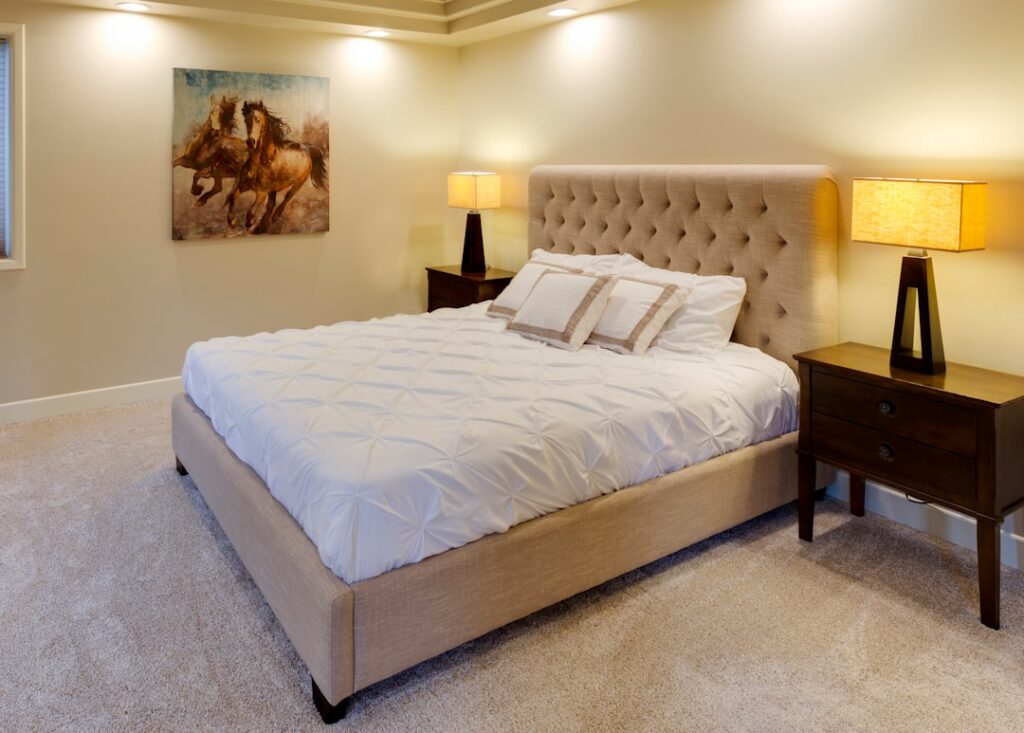
Master bedrooms: Comfort is the priority. Choose soft fibers (polyester, triexta, or plush nylon) in medium tones. Upgrade padding to memory foam for a luxurious underfoot feel. Wall-to-wall carpet in the master bedroom is the one room where you can prioritize softness over durability because traffic is light and concentrated.
Children’s bedrooms: Stain-resistant fibers (triexta or treated nylon) in textured styles with mid-tone or heathered colors. Children’s rooms see more spills, roughhousing, and furniture rearranging than adult bedrooms. The carpet needs to be practical as well as comfortable.
Living rooms and family rooms: Nylon or triexta in textured or frieze styles. These rooms see the most varied activity in the home. Choose dense construction with good face weight (40+ ounces per square yard) for longevity. Mid-tone colors in gray, beige, or taupe families hide soiling between cleanings.
Hallways: The highest-traffic carpet in your home needs the most durable fiber and densest construction. Nylon in a tight textured or commercial-style loop handles hallway demands best. Dark or medium colors are practical. Hallways are narrow enough to avoid seams with standard 12-foot rolls, simplifying installation.
Basements: Moisture considerations dominate basement carpet selection. Choose synthetic fibers (polyester, olefin, or triexta) on moisture-resistant padding. Avoid wool. Consider carpet tiles instead of wall-to-wall if water intrusion is a concern because individual tiles can be removed and dried. A vapor barrier between the concrete slab and padding is essential.
Wall-to-Wall Installation Process
Professional wall-to-wall carpet wall installation follows a specific sequence that ensures longevity and appearance:
Room preparation: All furniture is removed. Old flooring is pulled up and disposed of. The subfloor is cleaned, repaired, and checked for moisture (on concrete slabs). Baseboards may be removed or left in place depending on the installer’s method and the homeowner’s preference.
Tack strip installation: Wood strips with angled tacks are nailed around the room perimeter, approximately 1/2 inch from the walls. The tacks angle toward the wall to grip carpet edges. Tack strips are not installed across doorways where transition strips will go.
Padding: Carpet padding is rolled out, cut to fit within the tack strips, and stapled to wood subfloors or adhered to concrete. Padding seams are taped with duct tape. The padding should not overlap tack strips.
Carpet placement and seaming: Carpet is cut from the roll with several inches of excess on all sides. For rooms requiring seams, pieces are cut, aligned for nap direction, and joined using hot-melt seam tape and a seaming iron. Seam placement avoids high-traffic paths and is positioned where least visible.
Power stretching: This is the critical step. A power stretcher hooks into the carpet and pushes it tight across the room onto the tack strips. The carpet must be stretched in both directions for a wrinkle-free fit. Inadequate stretching is the number one cause of carpet wrinkles and premature wear. This step alone justifies hiring a professional installer.
Trimming and finishing: Excess carpet is trimmed at the walls with a wall trimmer or utility knife. The edges are tucked between the tack strip and the wall using a stair tool. Transition strips are installed at doorways. Any remaining furniture is moved back into position.
Carpet on Walls: Soundproofing and Accent Design
Installing carpet on vertical walls is a growing trend for two practical reasons: acoustic treatment and visual design. This is the other meaning of carpet wall that homeowners search for.
Soundproofing applications: Carpet on walls absorbs sound waves that hard surfaces reflect. In home theaters, recording studios, podcast rooms, and apartments with noise complaints, wall-mounted carpet can reduce echo and reverberation by 30-50%. It is one of the most affordable acoustic treatments available, far cheaper than professional acoustic panels per square foot.
Accent wall design: A single wall covered in textured carpet creates a striking visual and tactile accent in bedrooms, living rooms, and commercial spaces. The textile texture adds warmth and dimension that paint, wallpaper, and wood paneling cannot replicate. Popular styles for accent walls include plush, shag, and tightly looped textures in bold or contrasting colors.
Headboard walls: One of the most popular carpet wall applications is covering the wall behind a bed as a giant, soft headboard. This creates a cozy, enveloping feel and eliminates the need for a separate headboard. Plush or thick textured carpet works best for this application.
Commercial applications: Restaurants, hotels, and offices use wall carpet for acoustic control and design distinction. The texture absorbs noise in busy spaces while adding visual warmth. Commercial-grade loop carpet handles the higher maintenance requirements of public spaces.
Wall Mounting Methods for Carpet
Several methods work for mounting carpet on walls, each with different complexity and permanence:
Tack strip method (most permanent): Install tack strips along the top, bottom, and sides of the wall area. Stretch carpet taut and hook onto the tacks, similar to floor installation. This creates the tightest, most professional finish. It works with any carpet type and is the preferred method for permanent installations. Tack strips can be nailed into studs or adhered to drywall with construction adhesive.
Adhesive method: Apply construction adhesive (Liquid Nails Heavy Duty or similar) directly to the wall surface. Press carpet into the adhesive, working from top to bottom. Weight or brace the carpet until adhesive cures (24-48 hours). This method works on textured walls where tack strips do not grip well. The carpet is very difficult to remove without wall damage.
Furring strip and staple method: Mount horizontal furring strips (1×2 lumber) at the top, bottom, and every 2 feet vertically. Staple carpet to the furring strips using a heavy-duty staple gun. The furring strips create an air gap behind the carpet that improves acoustic performance. This is the best method for soundproofing applications.
Hook-and-loop (Velcro) method: Mount industrial-strength Velcro strips on the wall perimeter. Attach the mating strips to the carpet backing. Press the carpet onto the wall. This method allows easy removal for cleaning or replacement. Best for carpet panels on accent walls where you may want to change the carpet later. Not strong enough for heavy carpet or large wall areas without additional support strips.
Fabric panel method: Build a frame from 1×2 lumber, stretch carpet over it, and staple to the back of the frame. Hang the finished panel like a large picture. This creates removable acoustic panels that double as visual accents. Multiple panels can cover a wall with gaps between them for a gallery-style look.
Soundproofing Performance
Carpet on walls provides meaningful acoustic improvement, but understanding its limitations prevents unrealistic expectations:
What wall carpet does well: Absorbs mid-to-high frequency sounds (voices, TV audio, music above 500 Hz). Reduces echo and reverberation time in rooms with hard surfaces. Decreases sound reflection that makes rooms feel loud and chaotic. A carpeted wall absorbs 50-70% of sound energy that would bounce off a bare wall.
What wall carpet does not do well: Block low-frequency sounds (bass, subwoofer, traffic rumble). Prevent sound transmission between rooms through the wall structure. Replace proper soundproofing construction (double drywall, decoupled walls, mass-loaded vinyl). Wall carpet treats acoustic quality within a room but does not meaningfully reduce sound traveling through walls.
Carpet type for best acoustic performance: Thick, dense carpet with a separate underlayment mounted on furring strips provides the best sound absorption. The air gap behind the carpet acts as an additional absorption layer. Open-cell foam or acoustic batting behind the carpet further improves performance. For maximum acoustic benefit, cover at least 40-60% of the wall surface area.
NRC ratings: Noise Reduction Coefficient measures how much sound a material absorbs. Carpet on walls with an air gap achieves NRC 0.40-0.65 depending on thickness and backing. For comparison, acoustic foam panels rate NRC 0.60-0.90, and bare drywall rates NRC 0.05-0.10. Carpet provides meaningful improvement over bare walls at lower cost than dedicated acoustic panels.
Cost Comparison: Floor vs Wall Applications
Wall-to-wall floor carpet costs:
- Carpet materials: $2-$8/sq ft
- Padding: $0.50-$1.50/sq ft
- Installation: $1.50-$3.00/sq ft
- Total for a 12×15 room (180 sq ft): $720-$2,250
Carpet on wall costs:
- Carpet materials: $2-$8/sq ft (same as floor carpet)
- Mounting materials (furring strips, adhesive, or tack strips): $0.50-$1.50/sq ft
- Installation labor: $2-$5/sq ft (more labor-intensive than floor installation)
- Total for a single 10×8 accent wall (80 sq ft): $360-$1,160
Comparison to acoustic panels: Professional acoustic panels cost $4-$15 per square foot installed. Covering an 80-square-foot wall with acoustic panels runs $320-$1,200. Carpet achieves 60-75% of the acoustic performance at comparable or lower cost with the added benefit of visual texture and warmth.
Comparison to other accent wall treatments: Shiplap ($6-$12/sq ft installed), stone veneer ($10-$25/sq ft installed), and wood paneling ($5-$15/sq ft installed) all cost more per square foot than carpet wall treatment. Carpet is one of the most affordable accent wall materials available.
Pros and Cons of Each Application
Wall-to-wall carpet (floor) pros:
- Warmest, softest flooring option
- Best sound absorption of any floor covering (reduces floor-to-floor noise by 25-35 dB)
- Affordable per square foot installed
- Safe (non-slip, cushioned falls for children and elderly)
- Wide variety of fibers, styles, colors, and price points
Wall-to-wall carpet (floor) cons:
- Harder to clean than hard flooring
- Traps allergens (though regular vacuuming mitigates this)
- Shows wear in high-traffic areas over time
- Susceptible to permanent staining if spills are not treated quickly
- Shorter lifespan than hardwood or tile (10-20 years vs 25-100 years)
- Not recommended for kitchens or bathrooms
Carpet on walls pros:
- Effective, affordable acoustic treatment
- Unique visual texture as an accent element
- Adds warmth and coziness to any room
- Hides imperfect wall surfaces
- Can be DIY installed with basic tools
Carpet on walls cons:
- Collects dust (requires regular vacuuming with an upholstery attachment)
- Difficult to clean stains on vertical surfaces
- Can look dated if the wrong style or color is chosen
- Removal may damage drywall underneath
- Fire code considerations in some commercial applications
- May harbor allergens in sensitive households
Frequently Asked Questions
How long does wall-to-wall carpet last?
Quality nylon wall-to-wall carpet lasts 12-20 years with regular vacuuming and periodic deep cleaning. Polyester averages 8-12 years. High-traffic areas like hallways may need replacement sooner than bedrooms. Proper padding, professional installation with power stretching, and consistent maintenance are the three biggest factors in carpet longevity.
Can you put carpet on any wall?
Carpet can be mounted on drywall, plaster, concrete, brick, and wood walls. Each surface requires a different mounting approach. Drywall accepts tack strips nailed into studs. Concrete and brick work better with adhesive or masonry anchors for furring strips. Avoid installing carpet on exterior walls in humid climates because the lack of air circulation behind the carpet can promote mold growth. Always ensure the wall is dry and free of moisture issues before covering with carpet.
Does carpet on walls help with soundproofing between rooms?
Wall carpet helps with acoustic treatment within a room (reducing echo and reverberation) but provides minimal soundproofing between rooms. Sound travels through wall structures (studs, drywall, air gaps), and surface-mounted carpet does not address these transmission paths. For actual sound blocking between rooms, you need mass-added construction (double drywall, mass-loaded vinyl, insulated wall cavities). Wall carpet is an acoustic treatment, not a sound barrier.
Is wall-to-wall carpet going out of style?
Wall-to-wall carpet has declined in some rooms (kitchens, entryways, and living rooms are trending toward hard surfaces), but it remains the dominant choice for bedrooms and is holding steady in family rooms. The carpet industry has responded with softer, more stain-resistant fibers and modern colors that suit contemporary interiors. Carpet is not going away. It is evolving. High-quality carpet in bedrooms and family rooms remains the most comfortable, affordable flooring choice for those spaces.
How do I clean carpet mounted on a wall?
Vacuum wall carpet monthly using an upholstery attachment on your vacuum. Work from top to bottom in overlapping strokes. For dust in tight-loop or textured carpet, a soft-bristle brush attachment works better than a flat upholstery tool. Spot clean stains immediately with a carpet spot cleaner applied to a cloth, then blotted onto the carpet. Deep cleaning wall carpet is challenging due to gravity pulling moisture downward. For deep cleaning needs, removable carpet panels are easiest because you can lay them flat for cleaning and reattach when dry.