The empty space inside your walls is quietly costing you money every month. Cavity insulation fills the gap between the inner and outer layers of a wall — the void between the studs, or between two masonry leaves — with material that slows the flow of heat, and it is one of the highest-return efficiency upgrades a home can get. Uninsulated walls can account for a third or more of a home’s heat loss. Fill that cavity correctly and you cut heating and cooling bills, kill drafts, and make rooms feel evenly comfortable instead of warm by the vent and cold by the wall.
What “Cavity” Means in Your Walls
The term covers two common wall types. In a typical wood-framed American home, the cavity is the space between the studs, behind the drywall and inside the exterior sheathing — usually 3.5 inches deep in a 2×4 wall or 5.5 inches in a 2×6 wall. In masonry construction, especially older brick homes, the cavity is the deliberate air gap between an outer and inner wall.
Either way, that space is where insulation earns its keep. An empty cavity lets heat conduct straight through and convection currents circulate, carrying warmth out in winter and pulling it in during summer. Filling it interrupts both.
Understanding R-Value
Every insulation is rated by R-value, the measure of resistance to heat flow — higher is better. Recommended wall R-values vary by climate, but many U.S. walls target R-13 to R-21 depending on stud depth and zone. Two things drive the total performance: the R-value per inch of the material, and how completely it fills the cavity without gaps.
Gaps matter more than people expect. Insulation that is compressed, sags, or leaves voids around wiring and outlets loses a big share of its rated value. A material with a modest R-per-inch that fills perfectly often outperforms a higher-rated one installed sloppily.
Types of Cavity Insulation
Several materials fill cavities, each with a niche. The right one depends on whether the wall is open (during construction or a remodel) or closed (an existing finished wall).
Fiberglass Batts
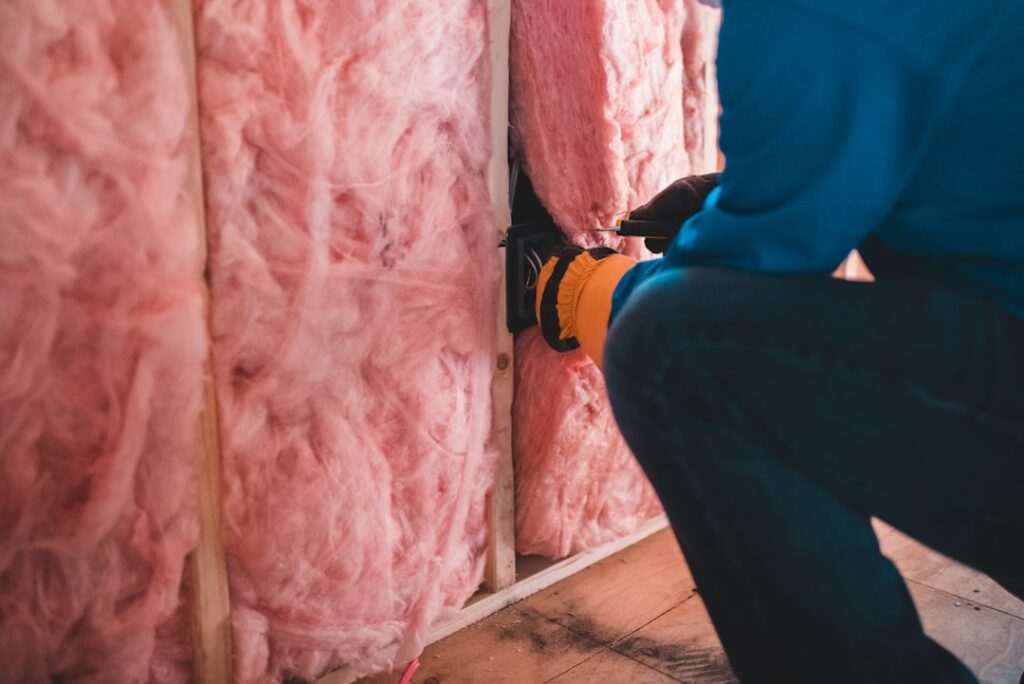
The familiar pink or yellow rolls, cut to fit between studs. Cheap at roughly $0.30 to $0.80 per square foot, easy to DIY in open walls, and rated around R-3 to R-4 per inch. The weakness is fit: batts must be cut precisely around wires, pipes, and boxes, or the gaps sabotage performance.
Blown-In Cellulose or Fiberglass
Loose fibers blown into the cavity through small holes, ideal for insulating existing closed walls without tearing them open. Cellulose (recycled paper treated for fire and pests) runs about R-3.5 per inch and packs densely around obstructions, making it excellent for retrofits at $1 to $2.50 per square foot installed.
Spray Foam
Liquid foam that expands to fill every crevice and hardens. Closed-cell spray foam delivers a high R-6 to R-7 per inch and also air-seals and adds rigidity, but it is the priciest option at $1.50 to $4-plus per square foot. Open-cell foam is cheaper and softer at around R-3.5 to R-4 per inch.
Mineral Wool (Rock Wool)
Dense batts spun from stone, offering R-4 to R-4.3 per inch plus strong fire resistance and sound dampening. It costs more than fiberglass but installs similarly and holds its shape better over time.
Benefits Beyond Lower Bills
Saving on energy is the headline, but cavity insulation delivers several comforts that owners notice daily. Rooms hold a steady temperature instead of swinging hot and cold, so the thermostat cycles less and the furnace and AC last longer. Exterior walls stop feeling cold to the touch in winter, eliminating the radiant chill that makes a well-heated room still feel drafty.
- Lower energy bills — often 10 to 25 percent off heating and cooling costs on a poorly insulated home
- Noise reduction — dense materials like mineral wool and cellulose muffle outside sound
- Condensation control — warmer wall surfaces resist the moisture and mold that form on cold walls
- Higher resale appeal — a documented efficiency upgrade buyers value
Where Cavity Insulation Works Best
Exterior walls are the primary target, since they separate conditioned space from the outdoors. But the cavity approach also pays off in a few other spots. Interior walls around bathrooms, laundry rooms, and home offices benefit from the sound control even without an energy motive. Walls between a house and an unheated garage act like exterior walls and deserve the same treatment.
The condition of the wall dictates method. During new construction or a gut remodel, open walls make batts or spray foam straightforward and cheap. For an existing home you do not want to demolish, blown-in cellulose or injection foam through small drilled holes lets you insulate without ripping off drywall.
Watch Out for Moisture
Insulation and water do not mix, and this is where retrofits go wrong. In masonry cavity walls especially, the air gap sometimes exists specifically to keep wind-driven rain from crossing to the inner wall. Filling such a cavity with the wrong material in a wet climate can bridge moisture inward and cause damp problems. This is why professional assessment matters for older brick homes before you fill anything.
In wood-framed walls, the concern is interior humidity condensing inside a cold wall. Proper vapor control — placement of a vapor retarder appropriate to your climate zone — keeps the cavity dry. Closed-cell spray foam sidesteps much of this by acting as its own air and vapor barrier, one reason it is favored in problem walls despite the cost.
Cavity Insulation vs. Other Insulation Types
Cavity insulation is one tool among several, and understanding where it fits helps you plan a whole-home strategy. It fills the space inside a wall, but a complete envelope also needs attention at the attic, floors, and air-sealing gaps that cavity insulation alone does not address.
- Cavity (wall) insulation: fills the space between studs or wall leaves — the focus here
- Attic insulation: usually the highest-return upgrade of all, since heat rises and escapes through the roof
- Continuous exterior insulation: rigid foam board over the sheathing that stops thermal bridging through the studs
- Air sealing: caulk and foam at gaps, penetrations, and the rim joist, which stops drafts insulation cannot
The most cost-effective plan usually tackles air sealing and attic insulation first, then cavity walls. Insulation and air sealing work together — filling a wall cavity while leaving big air leaks around outlets and trim only captures part of the benefit. A blower-door test from an energy auditor pinpoints exactly where a home leaks and helps prioritize the spending.
Signs Your Walls Need Insulation
Older homes, especially those built before modern energy codes, frequently have uninsulated or under-insulated walls, and the symptoms are easy to spot once you know them. Exterior walls that feel noticeably cold to the touch in winter are the clearest tell, along with rooms that never quite hold their heat despite a working furnace.
Other clues include drafts near outlets and baseboards on outer walls, uneven temperatures from room to room, and high heating and cooling bills relative to similar homes. A thermal camera, or even a simple hand check on a cold day, reveals cold spots where insulation is missing or has settled. Many energy auditors and insulation contractors will bore a small inspection hole in an inconspicuous spot to see directly what is inside the cavity. If your walls test empty, filling them is often one of the better efficiency investments available, especially in a home you plan to keep.
DIY or Hire a Pro
Open-wall batt installation is well within reach for a careful homeowner: measure, cut snug, fit around obstructions, and avoid compressing the material. It is a satisfying weekend job during a remodel and the cheapest route.
Blown-in and spray foam applications, and any masonry cavity fill, generally call for a professional. The equipment is specialized, the material behavior is unforgiving, and a pro’s density and coverage make the difference between rated performance and a wall full of voids. Get two or three quotes, ask what R-value they will actually achieve, and confirm they address air sealing too — because insulation without air sealing still leaks warmth around the edges. Done right, filling that hidden cavity is one of the quietest, most durable upgrades your house will ever get, paying you back in comfort and lower bills for decades.