When a ceiling fan hums but refuses to spin, or spins slowly no matter which speed you pick, the culprit almost always traces back to the motor. The ceiling fan coil is the tightly wound loop of copper wire inside the motor housing that turns electricity into the rotating magnetic force that drives the blades. Understanding how the ceiling fan coil works, and how it interacts with the capacitor that feeds it, saves you from tossing a repairable fan or paying an electrician for a ten-minute fix. This guide breaks down the parts, the failure symptoms, and the tests you can run with a basic multimeter.
What the Coil Actually Does
Inside every AC ceiling fan sits a stationary set of windings called the stator, and the coil is the copper wound around its iron core. When current flows through those windings, they generate a rotating magnetic field. That field pushes against the rotor attached to the blade assembly, and the whole thing spins. Most residential fans use a single-phase induction motor, which cannot start on its own without a phase shift, and that is where the capacitor comes in.
The coil is essentially the muscle of the fan. It is not a moving part, so it does not wear out from friction the way a bearing does. Instead it fails from heat, age, and voltage stress that break down the thin enamel insulation on the copper wire until adjacent turns short together.
The Coil and Capacitor Work as a Team
A ceiling fan motor has two sets of windings: the main run winding and the start winding. The capacitor sits in series with the start winding and shifts the current’s phase by about 90 degrees, creating the offset magnetic field the motor needs to begin turning. Without that phase shift the fan just sits and hums.
This partnership matters because a huge share of fans blamed on a “burned-out coil” actually have a dead capacitor, which is a $5 part rather than a whole new motor. The capacitor is the more common failure by a wide margin, so always rule it out first before condemning the coil itself.
Symptoms of a Failing Ceiling Fan Coil
A genuinely bad coil produces a distinct set of clues. Learn to tell them apart from a capacitor or switch problem:
- Fan hums but will not turn even after you spin the blades by hand. This most often points to the capacitor, but a shorted start winding shows the same behavior.
- Burning smell or visible scorch marks on the motor housing. Overheated enamel gives off an acrid odor, and this strongly indicates coil damage.
- Fan runs hot to the touch after just fifteen or twenty minutes. Shorted turns draw excess current and dump it as heat.
- Only some speeds work or the fan trips a breaker. Internal shorts can cause both.
- Motor is completely dead with confirmed power at the fixture, no hum at all, which suggests an open winding.
A scorched smell combined with heat is the most reliable sign the coil itself is finished. A silent hum with a cool motor almost always means the capacitor.
Testing the Coil with a Multimeter
You can check a coil for continuity and shorts without special tools. Kill the power at the breaker first, then drop the fan and open the motor housing. Set a multimeter to the ohms setting and probe the motor lead wires.
- Measure resistance across the run winding leads. A healthy winding reads a low but non-zero value, often between 5 and 50 ohms depending on the motor.
- A reading of zero or near zero indicates a dead short between turns, which means the coil is toast.
- A reading of infinite resistance, or OL on the display, means the winding is open and broken internally.
- Test each winding lead to the bare metal frame. Any continuity to the frame means the insulation has failed and the coil is grounding out.
If every winding reads a sensible mid-range resistance and none of them shows continuity to the frame, the coil is fine and your problem lies with the capacitor, the pull-chain switch, or the wall control.
Replacing the Capacitor First
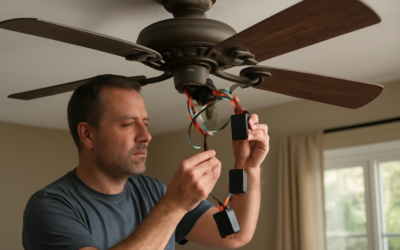
Because the capacitor fails far more often, swap it before doing anything drastic. The part is a small rectangular block wired to the pull-chain switch, usually stamped with values like CBB61 and a rating such as 4.5 microfarads plus 6 microfarads. Match those numbers exactly when you order a replacement, since the wrong capacitance changes the fan’s speed and torque.
A new capacitor costs $4 to $12, and the swap takes about fifteen minutes: cut power, splice the new capacitor in place of the old one matching wire colors, and reassemble. Many fans that seemed dead spring right back to full speed with this cheap fix.
When to Repair the Coil Versus Replace the Fan
Rewinding a ceiling fan coil is technically possible but rarely worth it. The labor to strip and rewind a stator by hand costs far more than a new fan, and few shops even offer the service anymore for residential units. If your testing confirms a shorted or open winding, or you see scorch marks, the practical move is a new motor or a new fan.
Consider the value of the fixture. A high-end designer fan or a discontinued model matched to your decor may justify sourcing a replacement motor from the manufacturer for $60 to $150. A basic builder-grade fan is cheaper to replace outright, since a new one runs $50 to $120 and comes with fresh bearings, a new capacitor, and a warranty. Weigh the parts cost against a whole new unit before committing.
DC Motors and Modern Fans
Newer high-efficiency ceiling fans use DC motors instead of the traditional AC induction design, and their coil arrangement works differently. A DC fan includes a small transformer and control module that converts household AC into low-voltage DC, then energizes the coils in a precisely timed sequence to spin the rotor. These motors use roughly 70 percent less electricity, run cooler, and are quieter because there is no continuous magnetic hum.
The trade-off is that a DC fan’s electronics are more complex than a simple capacitor. When a DC fan fails, the culprit is often the receiver or the driver module rather than the coil itself, and those parts are model-specific. The upside is that DC coils run cooler and rarely burn out from heat the way an overloaded AC winding can. If you are shopping for a new fan and want the longest motor life with the lowest running cost, a DC model is the smart pick despite the higher upfront price.
Reading Motor Labels and Specs
Every fan motor carries a label with information that helps when you order parts or diagnose a fault. Look for the motor’s voltage, typically 120 volts for US fans, and the amperage draw, which tells you how hard the motor works. A fan that suddenly draws more amps than its label rating is straining, often because of failing bearings or a partially shorted coil pulling excess current.
The label or the fan’s manual also lists the correct capacitor value, which you must match exactly when replacing it. Snap a photo of this label before you start any repair so you have the model number, capacitor rating, and motor specs handy when ordering parts. Having the right numbers turns a guessing game into a fifteen-minute fix.
Preventing Coil Failure
Heat is what kills windings, so keep the motor running cool. Clean dust off the blades and motor housing twice a year, because caked dust acts as insulation and traps heat. Make sure the fan is not straining against wobbly, unbalanced blades, which forces the motor to draw more current. Use a balancing kit if the fan shakes.
Also avoid running a fan on a dimmer switch unless it is specifically rated for fan speed control. A standard lamp dimmer chops the voltage waveform in a way that overheats fan windings and destroys coils prematurely. With clean blades, a matched control, and a healthy capacitor, a quality ceiling fan motor easily lasts fifteen to twenty years.