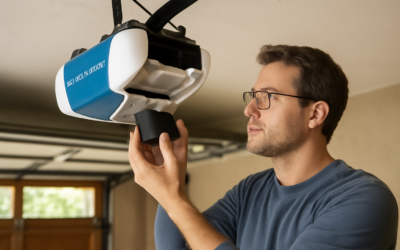
If you have ever wanted overhead storage racks in your garage but a bulky ceiling-mounted opener was in the way, the Chamberlain wall mount garage door opener solves exactly that problem. Instead of hanging a motor and rail from the ceiling, this design, also called a jackshaft opener, mounts compactly on the wall beside the garage door and turns the torsion bar directly. The result is a completely open ceiling, near-silent operation, and a premium look that has become the go-to for high-end and space-conscious garages. But it has specific requirements that not every garage meets, so understanding what it needs before you buy is essential. Here is the full picture.
Part of our Garage Doors guide — explore the full guide →
How a Wall Mount Opener Works
A traditional opener pulls the door up and down with a trolley riding along a long ceiling rail. A wall mount jackshaft opener works completely differently. It mounts to the wall next to the door, connects to the torsion bar (the horizontal shaft above the door that the springs wind around), and rotates that shaft to raise and lower the door.
Because there is no ceiling rail, motor, or trolley overhead, the entire ceiling stays open. That is the single biggest reason people choose this design: it frees the overhead space for storage racks, tall vehicle lifts, or simply a cleaner look. The compact motor also runs remarkably quietly since it is not vibrating a long metal rail.
The Requirements: Not Every Garage Qualifies
This is the part to check before you get excited. A wall mount opener has firm prerequisites that a standard opener does not.
- Torsion spring system: Your door must use a torsion spring system (the horizontal bar and springs above the door), not the older extension springs that run along the ceiling tracks. Jackshaft openers turn the torsion bar and cannot work without one.
- Side clearance: You need adequate wall space beside the door to mount the unit, typically on the side where the cable drum sits.
- A properly balanced door: The door must be well-balanced on its springs, since the opener assists rather than muscles the whole weight.
If your garage uses extension springs, you would need to convert to a torsion system first, an added cost. Many single-car and older doors use extension springs, so verify yours before buying.
Key Features Worth Knowing
Chamberlain’s wall mount models pack in the brand’s best features, since this is a premium product line.
- Integrated battery backup: Most wall mount units include battery backup so the door works during a power outage, and in some states this is legally required on new installs.
- Built-in Wi-Fi and myQ: Control and monitor the door from your phone anywhere, get open-door alerts, and integrate with smart-home platforms without a separate hub.
- Automatic deadbolt lock: Many models throw a deadbolt when the door closes, adding real security against forced entry.
- Bright integrated or accessory LED lighting: Since there is no ceiling unit, a separate LED light module often mounts on the ceiling and links wirelessly.
- Security+ 2.0 rolling code: Changes the access code every use to defeat code thieves.
Installation Overview
A wall mount opener install differs from a standard one and is a bit more particular, but it is achievable for an experienced DIYer comfortable working near garage door springs.
- Confirm the door is balanced and uses a torsion system. Fix any balance issues first.
- Mount the motor unit to the wall beside the door, aligned with the torsion bar.
- Connect the drive to the torsion shaft per the instructions, ensuring it engages the bar securely.
- Install the cable tension monitor and door sensors as specified.
- Mount the safety photo-eye sensors near the floor on each side of the door, facing each other precisely.
- Wire in the wall control, then set the open and close travel and force limits.
- Add the ceiling LED light module and pair remotes and the myQ app.
The important caution: this opener works intimately with the torsion spring system, which stores dangerous energy. If you are not fully confident around torsion springs, hire a professional. The safety sensors, as with any opener, must be aligned so both lights glow steady, or the door will refuse to close.
Advantages Over a Standard Opener
Wall mount openers win on several fronts that matter in the right garage:
- Open ceiling: Room for overhead storage, car lifts, and tall vehicles.
- Quietest operation: No rail to rattle; the compact motor is among the quietest available, ideal below a bedroom.
- Clean, premium look: Nothing spanning the ceiling gives a tidy, modern appearance.
- Space for tall doors: Works well with high-lift and cathedral-track door configurations that a standard rail cannot accommodate.
Downsides and Cost
The tradeoffs are price and requirements. Wall mount openers cost more than chain or belt drives, typically $350 to $550 for the unit alone, and the install can be more involved. They also demand the torsion spring setup and a well-balanced door, so they are not a universal drop-in replacement.
Professional installation, if you choose it, adds a few hundred dollars but ensures the torsion connection and spring balance are handled safely. Given the premium nature of the product, many buyers opt for professional install to protect the investment and their safety.
Reclaiming Ceiling Space the Right Way
The whole reason to buy a wall mount opener is the open ceiling, so plan how you will use that reclaimed space before you install. The most popular payoff is overhead storage racks, which need the full ceiling clear of a rail and motor to mount properly. If that is your goal, position the storage racks so they clear the door’s travel and leave room to walk and park, and mount them into the joists or trusses just as you would in any garage.
Other owners want the ceiling free for a car lift, a common upgrade for enthusiasts and anyone short on floor space. A four-post or two-post lift needs unobstructed height, and a ceiling-mounted opener rail would be directly in the way. The wall mount design makes lifts and high-lift door tracks possible where a standard opener could not coexist. Whatever you plan, sketch the clearances first so the freed ceiling actually serves the purpose you bought the opener to enable.
Maintenance and Cable Tension Monitoring
Wall mount openers include a feature standard openers lack: a cable tension monitor. Because the opener turns the torsion bar and relies on the lift cables staying taut, the system watches cable tension and stops the door if a cable goes slack, which can happen if the door binds or something obstructs it. This is an important safety feature, and if the door refuses to operate, a tripped tension monitor is a likely cause worth checking before anything else.
General maintenance mirrors any garage door but with extra attention to the spring and cable system the opener depends on. Keep the door well-balanced, since the wall mount opener assists a balanced door rather than forcing a heavy one, and an unbalanced door strains the motor and the torsion connection. Lubricate the rollers, hinges, and springs a couple of times a year, keep the photo-eye sensors clean and aligned, and periodically confirm the torsion-bar connection remains snug. Because the springs are central to how this opener works, any grinding noise, visible gap in the spring, or sudden change in operation is a reason to call a professional promptly rather than keep cycling the door.
Who Should Buy One
A Chamberlain wall mount garage door opener is the right choice when you want to reclaim ceiling space for storage or a lift, when quiet operation matters because a room sits above or beside the garage, or when you simply want the cleanest, most premium setup available. It is especially popular in garages with high ceilings, tandem storage plans, or homes where the garage doubles as a workshop.
It is the wrong choice if your door uses extension springs and you are not willing to convert, if you lack the side clearance, or if budget is the top priority, in which case a belt-drive ceiling opener delivers similar quiet at a lower price. But for the garage that qualifies, the wall mount design is hard to beat: it disappears the opener from your ceiling entirely, runs whisper-quiet, and brings Chamberlain’s full suite of smart, secure features to a door you will enjoy using for years.