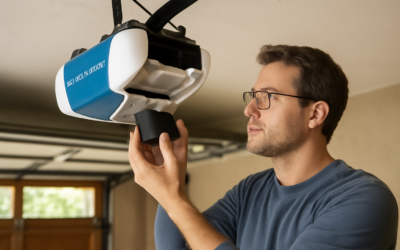
When your Chamberlain garage door opener battery starts failing, the opener usually warns you first with beeping, a blinking red light, or a door that won’t open during a power outage. There are actually two different batteries in play, the backup battery inside the motor unit and the small coin cell in your remote, and homeowners constantly confuse them. Sorting out which one is dead saves a wasted trip to the store and gets your garage working again in minutes.
Part of our Garage Doors guide — explore the full guide →
- Two Batteries, Two Different Jobs
- The Backup Battery: Signs and Part Numbers
- Replacing the Backup Battery Step by Step
- The Remote Battery: Quick and Cheap
- Keypad and MyQ Considerations
- Why the Backup Battery Beeps and Blinks
- Getting the Longest Life From Every Battery
- What to Keep on Hand
- Recycling and Safe Disposal
- Backup Battery vs. No Backup: Is It Worth It?
- Preventing Future Surprises
Two Batteries, Two Different Jobs
The backup battery lives inside newer Chamberlain and LiftMaster motor heads and keeps the opener running when the power goes out, a code-required feature in states like California. The remote battery simply powers the handheld or visor clicker. Diagnosing correctly starts with knowing which one is acting up.
If the door works fine on grid power but won’t move during an outage, and the unit beeps, that’s the backup Chamberlain garage door opener battery. If a single remote stops working while the wall button and other remotes still do, that’s the remote’s coin cell.
The Backup Battery: Signs and Part Numbers
The backup battery is a rechargeable 12-volt unit that sits behind a cover on the side of the motor head. A red or amber light and a periodic chirp are the opener telling you the battery has reached end of life, typically after one to three years.
Chamberlain and LiftMaster use the same battery across brands. The correct replacement is:
- Part number 485LM — the standard backup battery for most modern Chamberlain and LiftMaster openers.
- Roughly $40 to $60 from Chamberlain, hardware stores, or online.
- Genuine or quality equivalents are worth it, cheap knockoffs often fail within months.
Don’t ignore the low-battery warning. When the backup battery fully dies, some openers restrict features until it’s replaced, and you lose outage protection entirely.
Replacing the Backup Battery Step by Step
This is a genuinely easy DIY fix, no tools beyond maybe a step stool. Unplug the opener first as a safety habit.
- Locate the battery cover on the side of the motor head, usually marked or held by a single tab or screw.
- Open the cover and note how the two-wire connector clips into the old battery.
- Unplug the connector and slide the old 485LM battery out.
- Insert the new battery, click the connector on, and close the cover.
- Plug the opener back in. The warning light should clear once the new battery charges.
A new backup battery may take several hours to reach full charge, so the low indicator can linger briefly. Recycle the old sealed lead-acid battery at any auto parts store or hardware recycling drop, don’t toss it in the trash.
The Remote Battery: Quick and Cheap
Most Chamberlain remotes and visor clickers use a common coin cell, and swapping it takes under a minute. Range dropping off before the remote fully quits is the classic sign of a fading cell.
Common remote batteries include:
- CR2032 — the most common, in many visor and mini remotes.
- CR2016 — used in some slimmer keychain remotes.
- A23 12-volt — found in certain older single-button remotes.
Slide or unscrew the remote’s cover, note the orientation of the old cell, and drop in a fresh one positive-side matching. These cells cost a couple dollars in a multipack and last one to two years.
Keypad and MyQ Considerations
Chamberlain wireless keypads mounted outside the garage run on their own battery, often a 9-volt or coin cell behind the flip-up keypad cover. A dim backlight or unresponsive keys usually means it’s time to swap that battery.
MyQ smart hubs and internet gateways are powered by the opener or an adapter, so they don’t have a user-replaceable battery. If MyQ drops offline, that’s a Wi-Fi or power issue, not a battery, reboot the unit rather than hunting for a cell.
Why the Backup Battery Beeps and Blinks
The chirping and blinking that send homeowners searching for answers are deliberate warnings built into the opener, not a malfunction. Learning to read them tells you exactly how urgent the situation is.
Here’s what the signals typically mean on a Chamberlain unit:
- Amber or red LED with periodic chirps: the backup battery is low or near end of life, order a 485LM replacement soon.
- Faster or continuous beeping: the battery has failed and the opener is running on grid power only.
- Green LED: the backup battery is charged and healthy.
- No LED and the opener won’t run during an outage: the battery is fully dead and needs immediate replacement.
The chirp is intentionally annoying so you won’t ignore it. Replacing the battery clears the warning within a few hours as the new unit charges, and the beeping stops.
Getting the Longest Life From Every Battery
Batteries are cheap, but nobody enjoys replacing them, so a few habits stretch their service. The backup battery is a sealed lead-acid unit, and heat is its worst enemy.
Keep the garage as temperature-stable as you reasonably can, since a battery baking in a 110°F summer garage may last only a year while the same battery in a mild climate lasts three. For remotes, buy quality name-brand coin cells rather than bargain multipacks, cheap cells self-discharge faster and leak more often. And don’t leave a remote clipped to a sun-baked dashboard, where heat degrades the cell and can warp the plastic housing.
What to Keep on Hand
The frustration of a dead battery is almost always about not having the replacement ready, not the swap itself. A small stash of the right parts turns a lockout into a two-minute fix.
- One spare 485LM backup battery so you can clear a warning the day it starts.
- A multipack of CR2032 coin cells, the most common remote battery.
- A couple of CR2016 and one A23 cell if your remotes use them.
- A fresh 9-volt for a wireless keypad.
Stored in a cool drawer, these last for years and cost under $30 total, cheap insurance against being stranded outside your own garage.
Recycling and Safe Disposal
The backup battery is a sealed lead-acid unit, and it should never go in the household trash, both for environmental and legal reasons. The good news is that recycling it is free and easy.
Handle the old battery this way:
- Auto parts stores like AutoZone and O’Reilly accept sealed lead-acid batteries for free recycling.
- Home improvement stores and hardware stores often have battery recycling drop-offs.
- Municipal hazardous waste days take them along with paint and chemicals.
- Coin cells and 9-volts from remotes and keypads can go to the same battery recycling bins.
Keep the old battery upright and out of a hot car until you drop it off, since a damaged or leaking sealed battery can spill acid. It takes five minutes to recycle it properly, and it keeps lead and acid out of the landfill.
Backup Battery vs. No Backup: Is It Worth It?
If your opener didn’t come with a backup battery, you might wonder whether it’s worth adding one, and for many homeowners the answer is yes. The whole point is getting your car out during a power outage, exactly when you may need to leave.
Without a backup, an outage means pulling the manual release cord and lifting a heavy door by hand, which is difficult and sometimes unsafe for a large or double door. A backup battery, around $40 to $60 for the 485LM, lets the opener cycle the door normally through a blackout. In storm-prone regions and in states that mandate battery backup on new installs, it’s simply part of a properly functioning garage door opener rather than an optional extra.
Preventing Future Surprises
A little routine keeps you from getting locked out. Test the backup battery once a year by unplugging the opener briefly and confirming the door still cycles. Keep a spare 485LM and a couple of CR2032 cells on a shelf so you’re never stuck.
Extreme heat shortens battery life, and garages get hot, so batteries in a Phoenix garage simply won’t last as long as ones in a Seattle one. Replace the backup battery proactively every two to three years rather than waiting for failure. Stay ahead of your Chamberlain garage door opener battery and the opener will reward you with quiet, reliable service through every storm and outage.