Somewhere between brass that shouts and bronze that broods sits the finish that quietly took over kitchen design. A champagne bronze kitchen faucet delivers warm, muted gold — softer than polished brass, lighter than oil-rubbed bronze, with a satin sheen that flatters nearly every cabinet color on the market. Champagne Bronze is technically Delta’s trademarked name, but it has become the category shorthand for the entire soft-gold family, the way Kleenex means tissue. This guide covers what the finish actually is, how to match it across brands and hardware, which faucets wear it best, and how to keep it from becoming the dated regret some gold tones turned into.
Part of our Kitchen Remodeling guide — explore the full guide →
What Champagne Bronze Actually Is
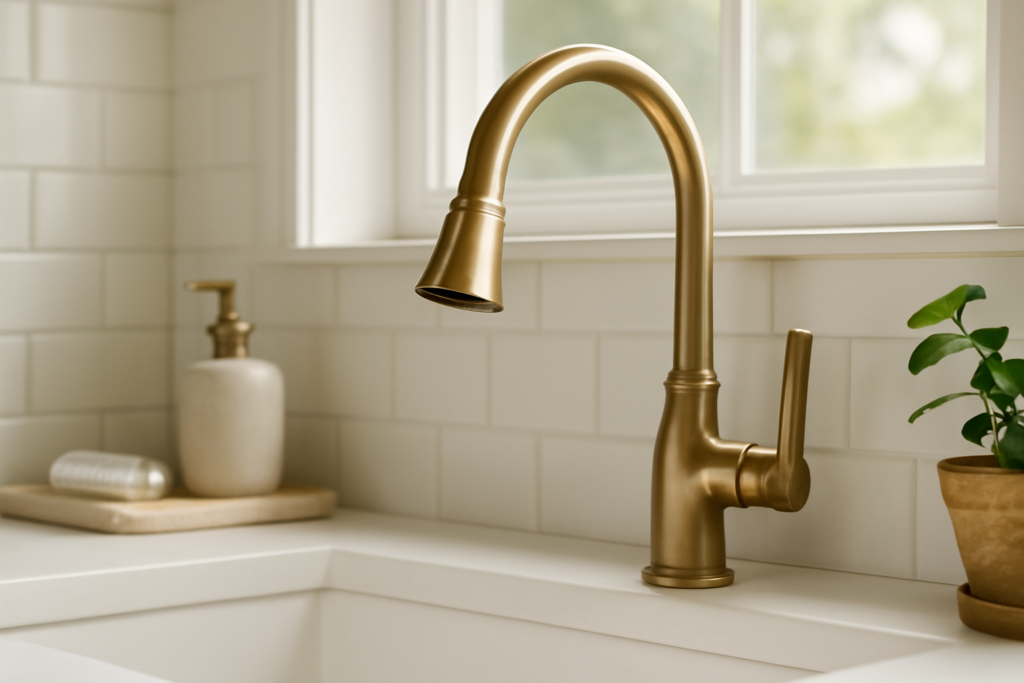
Despite the name, there is no bronze in it. Champagne Bronze is a PVD (physical vapor deposition) finish — a metallic coating vacuum-bonded to the brass faucet body at the molecular level, producing a surface many times harder than traditional electroplated brass tones. The color sits in the muted-gold band: warmer and pinker than raw brass, grayer and softer than polished gold, with a brushed satin texture that scatters light instead of mirroring it. That PVD hardness matters more in a kitchen than anywhere else in the house, because a faucet that gets grabbed 40 times a day with wet, gritty hands will strip a cheap gold electroplate in two or three years. A genuine PVD champagne tone shrugs that abuse off for decades.
The Cross-Brand Matching Problem
Here is the trap that catches half the people who fall in love with this finish: every manufacturer mixes its soft gold differently, and the names do not line up. Delta’s Champagne Bronze runs warm with a distinct pink-copper cast. Moen’s Brushed Gold is yellower and brighter. Kohler’s Vibrant Brushed Moderne Brass is paler and grayer. Brizo’s Luxe Gold — the parent company’s luxury mix — is deeper and richer than Delta’s own. Put a Delta faucet next to a Kohler soap dispenser and the mismatch is visible from across the kitchen.
Three rules keep a kitchen coherent. First, buy every plumbing item in the finish family — faucet, soap dispenser, pot filler, bar faucet — from one brand. Second, cabinet hardware does not need to match the faucet exactly; a near-tone knob reads as intentional layering, while a near-miss faucet-to-faucet clash reads as a mistake. Champagne-adjacent pulls from Amerock (Golden Champagne) and Top Knobs (Honey Bronze) pair comfortably with Delta’s finish. Third, order a physical sample or a single knob before committing to fifty pulls — screens lie about gold tones more than any other finish.
What It Pairs With
Champagne bronze earns its popularity by being the most forgiving gold in the kitchen palette:
- White and cream cabinets: the classic pairing — the warm metal keeps an all-white kitchen from feeling clinical
- Navy, forest green, and black cabinets: the high-contrast designer look that dominates current kitchen photography
- Marble and quartz with warm veining: gold tones echo taupe and beige veining beautifully
- Stainless appliances: yes, this works — mixed metals are established practice; keep stainless as the “workhorse” tone and champagne as the “jewelry” tone
- Matte black accents: black hardware or lighting with a champagne faucet is the most durable two-metal scheme of the last decade
Where it struggles: cherry-toned wood cabinets (too much competing warmth) and cool blue-gray palettes under 4000K lighting, which drain the finish toward beige.
The Faucets to Buy
Because the finish name is Delta’s, the deepest catalog is Delta’s. The Trinsic pull-down in Champagne Bronze (around $400-$500) is the definitive modern version — the cylindrical profile in soft gold is arguably the most photographed faucet of recent years. The Essa ($300-$380) delivers a similar curve for less, and the traditional Cassidy brings the finish to classic kitchens. All carry DIAMOND Seal cartridges and MagnaTite docking, so the pretty finish sits on serious internals. Outside Delta, Kraus offers Brushed Brass Boldens near $200 for budget builds, Moen’s Brushed Gold Align is the pick if the rest of your fixtures are Moen, and Brizo’s Litze in Luxe Gold ($700-plus) is the step-up when the faucet is the room’s centerpiece. If you are still deciding between the whole spectrum of warm metallics — polished gold, brushed brass, satin bronze — our gold kitchen faucet guide maps the full family and where champagne bronze sits within it.
Care and Long-Term Durability
PVD champagne finishes are low-drama: warm water, a drop of dish soap, soft cloth, done. Water spots show more on satin gold than on chrome, so a quick towel pass after dish duty keeps it showroom-fresh. The forbidden list is short but absolute — no abrasive pads, no scouring powders, no bleach or ammonia cleaners, and no leaving acidic foods (lemon halves, tomato splatter) sitting on the finish. One honest warning: verify the finish is PVD before buying budget brands. Some sub-$100 “champagne” faucets are lacquered electroplate, and kitchen duty will wear through the lacquer at the handle within a few years. The phrase “PVD” on the spec sheet is your quality gate.
Building Out the Full Kitchen in the Finish
A faucet rarely stays lonely in this finish, so plan the supporting cast early. Delta’s Champagne Bronze catalog extends to soap dispensers ($40-$60), air gaps, pot fillers ($350-$500), bar faucets, and even garbage-disposal flanges — ordering them together guarantees batch-consistent tone. Beyond plumbing, the finish pairs with lighting more forgivingly than with other faucets: aged-brass and satin-brass pendants sit close enough in tone to read as a family, which is why the classic scheme of champagne faucet, brass lighting, and black-accented hardware keeps appearing in designer kitchens. Appliance handles are the new frontier — several ranges and panel-ready refrigerators offer brushed-brass handle kits that echo the faucet across the room.
Sinks matter to the composition too. Champagne bronze glows against white fireclay farmhouse sinks and looks equally deliberate over matte black granite composite; over a standard stainless bowl it works but loses some of its jewelry effect. If a sink replacement is in the project anyway, that pairing decision belongs in the same shopping cart.
Will It Date Your Kitchen?
The fair question, given what oil-rubbed bronze and polished brass did to kitchens past. The case for confidence: champagne bronze has now held mainstream popularity for over a decade — unusual staying power — precisely because it is muted. It behaves like a warm neutral rather than a statement, the metallic equivalent of greige. Trend risk concentrates in the accessories, not the faucet; if gold cools off, swapping cabinet pulls costs $150, while the faucet itself reads as “warm metal” rather than “2020s gold.” Buy it with a white, wood, or deep-color kitchen and it will age the way brushed nickel did: quietly.
Touch-Up and Repair Realities
Unlike paintable finishes, a damaged PVD gold cannot be spot-repaired — there is no touch-up pen that convincingly matches a vacuum-deposited metal coating, so prevention is the whole strategy. Keep cast-iron cookware from banging the spout, never let a stainless scrubbie near the finish, and lift rather than drag anything metal across the deck plate. If damage does happen, warranty is the recovery path: Delta and Brizo cover finish defects for life for original owners, and both have replaced visibly worn Champagne Bronze and Luxe Gold components under claim. Physical damage from impact falls outside coverage, but replacement spouts, handles, and wands are all orderable parts, so a scarred component rarely means a whole new faucet.
The Bottom Line
A champagne bronze kitchen faucet is the safest way to put gold in a kitchen — warm enough to transform white cabinetry, muted enough to survive trend cycles, and in PVD form, tough enough for the busiest sink in the house. Anchor the finish with one brand’s plumbing family, sample before you match hardware, and let it be the jewelry of the room.