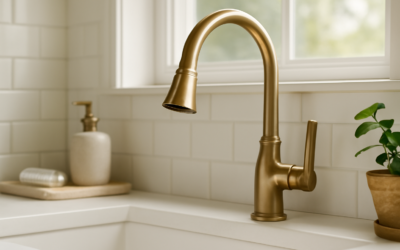
Champagne bronze cabinet hardware is one of the most requested finishes right now. It reads as a soft, warm rose-gold with a hint of bronze underneath, and it splits the difference between a bright polished brass and a muted matte gold. On the right cabinets it looks custom and expensive without shouting for attention.
Part of our Kitchen Remodeling guide — explore the full guide →
One thing worth clearing up before you shop: “Champagne Bronze” is a finish name Delta Faucet uses on its kitchen and bath fixtures. Cabinet-hardware makers sell nearly identical tones under names like champagne gold, satin brass, or warm brass. If you are matching a Delta faucet, the tips that follow will help you get the pulls close without paying a premium for a name.
- What the Finish Actually Looks Like
- Living Finish vs. Coated Finish
- Pairing With Cabinet Colors
- Choosing Pull Sizes and Center-to-Center
- What It Costs
- Champagne Bronze vs. Champagne Gold
- Installing Pulls Straight Every Time
- Mixing Metals Without It Looking Off
- Care and Cleaning
- Champagne Bronze Kitchen Hardware: Building a Matched Set
What the Finish Actually Looks Like
Champagne bronze lives in a narrow color band. It is warmer and pinker than a cool satin nickel, but noticeably more restrained than a shiny yellow polished brass. Under warm 2700K kitchen lighting it glows a little rosier; under cooler 4000K daylight bulbs it leans more neutral gold. That shift matters, so buy one sample pull and live with it under their own lights for a couple of days before ordering a full set.
The finish typically has a brushed or satin texture rather than a mirror polish. That brushing hides fingerprints and minor scratches far better than gloss, which is exactly why it works so well on drawers people touch fifty times a day.
Living Finish vs. Coated Finish
This is the single most important spec to check, and most product listings bury it. Hardware comes two ways:
- Coated (lacquered/PVD): A clear protective layer, often PVD (physical vapor deposition), locks the color in place. The finish stays exactly the same for years and resists tarnish. This is what you want in a busy kitchen. PVD is extremely durable.
- Living (unlacquered/raw brass): The metal is left exposed and slowly patinas from oils, moisture, and handling. Fans love the way it ages; it develops darker low spots and bright high spots over time. It is not for anyone who wants their hardware to look identical in year five.
For most families, a coated PVD champagne bronze is the better pick. If you love the lived-in look and understand it will change, unlacquered brass is a legitimate choice, just go in with eyes open.
Pairing With Cabinet Colors
Champagne bronze is a chameleon that flatters both dark and light cabinets. A few pairings that reliably land well:
- Navy blue: The classic. Warm bronze against a deep navy is high-contrast and rich, one of the most requested combinations of the last few years.
- Crisp white or off-white: Softens an all-white kitchen and keeps it from feeling cold or clinical.
- Sage or forest green: Green and warm metals share an earthy, organic feel; this looks especially good with wood countertops.
- Walnut and other warm woods: Bronze picks up the wood’s amber tones and ties the whole run together.
Be cautious against very cool gray cabinets. The warm metal can look slightly out of place unless you repeat it elsewhere, in a faucet or light fixtures, so the eye reads it as intentional.
Choosing Pull Sizes and Center-to-Center
Getting proportions right matters more than the finish itself. “Center-to-center” is the distance between the two mounting screw holes, and it is the measurement you actually order by. Overall length runs about an inch longer than the center-to-center spec.
- Knobs (1 to 1.25 in diameter): Best on small doors and upper cabinets. Some designers use knobs on doors and pulls on drawers.
- 3 to 4 in center-to-center pulls: Standard for average doors and small drawers.
- 5 to 6 in center-to-center: Good for standard 12 to 18 in drawers.
- 8 to 12 in appliance pulls: For panel-ready dishwashers, refrigerators, and wide 30 in-plus drawers.
A common rule of thumb: the pull should span roughly one-third of the drawer width. For big pot drawers, some homeowners run two matching pulls side by side, which looks deliberate and gives a better grip.
What It Costs
Champagne bronze sits in the mid-price tier. Typical price ranges:
- Knobs: roughly $3 to $9 each for solid options.
- Standard pulls (4 to 6 in): about $5 to $15 each.
- Large appliance pulls: $18 to $40 each.
For a typical kitchen with 40 to 50 pieces, budget $250 to $600 for good coated hardware. Solid brass or zinc with a PVD coating costs more than thin plated steel but survives daily abuse far longer, so it is money well spent. Many cabinet hardware brands sell champagne-toned finishes under their own names, so compare samples and check each maker’s current finish list.
Champagne Bronze vs. Champagne Gold
Shoppers mix these up constantly. Champagne gold typically runs brighter and cooler, closer to a pale yellow-gold with less bronze depth. Champagne bronze carries more warmth and a rose undertone. Neither is “better,” but they should not be mixed in the same room, the mismatch reads as a mistake. If you have a Delta Champagne Bronze faucet, lean toward hardware labeled champagne bronze or warm satin brass, not champagne gold.
Installing Pulls Straight Every Time
Nothing undermines nice hardware like crooked pulls, and drilling 40 of them by eyeball guarantees a few will drift. The fix is a hardware jig, an inexpensive template that indexes off the door edge and gives repeatable hole positions. Work through the kitchen the same way every time:
- Decide placement first, knobs typically 2.5 to 3 inches from the door corner, pulls centered on drawer fronts or aligned to the bottom rail on doors.
- Set the jig, clamp it, and drill with a sharp bit backed by a strip of tape to prevent tear-out on the finished face.
- Test-fit one pull before drilling the whole run so you catch a spacing error early.
- Drive the machine screws by hand; an impact driver strips the soft brass or cracks a knob fast.
Standard hardware screws are 8-32 thread; keep a few longer 1.5-inch and 2-inch screws on hand for thick shaker drawer fronts, since the screws in the box often come up short.
Mixing Metals Without It Looking Off
Champagne bronze rarely lives alone, so plan how it plays with your faucet, lighting, and plumbing fixtures. The safe approach is to let bronze be the dominant warm metal and pair it with a single quiet contrast, matte black on the faucet or window hardware reads as intentional, while random chrome, nickel, and gold thrown together looks accidental. Repeating the bronze in at least two spots, say the cabinet pulls plus the pendant lights or the faucet, anchors it so the eye reads a deliberate scheme.
If you already own a stainless appliance suite, do not panic; brushed stainless is neutral enough to sit alongside warm bronze pulls without clashing. The combinations that actually fight are two competing warm golds at slightly different tones, which is exactly why matching your pulls to a Delta Champagne Bronze faucet, rather than a generic champagne gold, is worth the effort. Keep the finish consistent across every knob, pull, and appliance handle in the room, and the hardware ties the whole kitchen together instead of reading as a set of near-misses.
Care and Cleaning
Coated champagne bronze is nearly maintenance-free. Wipe pulls with a soft, damp microfiber cloth and dry them; that removes cooking film and fingerprints. Skip abrasive pads, bleach, ammonia glass cleaners, and anything acidic, since these can dull or strip the coating over time. For unlacquered brass, do nothing if you want the patina, or buff it back with a brass polish like Bar Keepers Friend if you want the shine back.
In short, champagne bronze cabinet hardware is a warm, forgiving finish that pairs beautifully with navy, white, green, and walnut cabinets. Confirm whether your pieces are coated or living, order by center-to-center measurement, buy one sample first, and you will end up with a kitchen that looks like it cost far more than it did.
Champagne Bronze Kitchen Hardware: Building a Matched Set
Champagne bronze kitchen hardware looks best when the cabinet pulls and knobs, faucet and a few accents all sit in the same warm tone. Delta uses the Champagne Bronze name on its faucets and bath accessories, but its own support answers say it does not make drawer knobs or pulls. To get Delta champagne bronze cabinet pulls, you match a cabinet hardware finish to the faucet rather than buying the same brand.
Champagne, Honey Bronze and Their Neighbors
Shoppers searching for champagne drawer pulls or honey bronze cabinet pulls often land on finishes that look close in a photo but read differently in a kitchen. Finish names are not standardized, so use these as general descriptions and compare real samples.
| Finish name | General tone | Pairs well with |
|---|---|---|
| Champagne bronze | Soft warm gold with a rose undertone | Navy, white, sage, walnut |
| Honey bronze | Deeper, more amber gold | Warm woods, cream, dark green |
| Champagne gold | Paler, cooler yellow gold | White and light gray |
| Satin or warm brass | Brushed yellow gold | Most cabinet colors |
Honey bronze is the most common near miss. Next to a champagne bronze faucet it can look a shade darker and browner, which is fine if the two sit far apart but obvious when the pulls are right under the faucet.
Champagne Bronze Cabinet Pulls and Knobs Together
Buy the knobs and pulls from one collection so the finish batch, sheen and edge detail match. Order one knob, one standard pull and one appliance pull as samples, then hold them against the faucet under your own kitchen lights before ordering the full count. If you plan knobs on doors and pulls on drawers, check that the knob’s diameter and the pull’s bar thickness look related, since a chunky knob beside a slim bar pull reads as two different sets.
Where Else Champagne Kitchen Hardware Shows Up
- Faucet and soap dispenser: the anchor pieces that set the target tone.
- Pot filler and sink drain: small details that complete the run near the sink.
- Pendant lights and sconces: repeat the warm metal at eye level.
- Appliance pulls: keep these in the same finish as the cabinet pulls so the panels blend in.
Coated finishes keep their color, so choose a coated or PVD finish on every piece in the set. Mixing a coated faucet with unlacquered hardware means the two will drift apart over time.