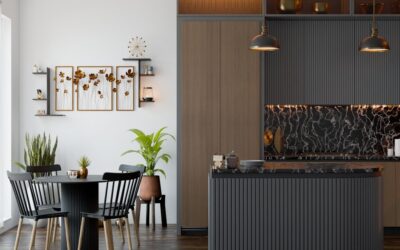
The cabinet boxes in most American kitchens are perfectly fine. It is the doors and drawer fronts that look dated, scuffed, or just wrong for your style. Changing doors on kitchen cabinets — without touching the boxes — is the most cost-effective kitchen refresh on the market, typically running 15 to 25 percent of a full cabinet replacement. The catch is precision. Door replacement only works if the existing boxes are square, the hinges are reusable or upgradeable, and you measure correctly the first time.
Part of our Kitchen Remodeling guide — explore the full guide →
Here is exactly how to plan, order, and install replacement doors without ending up with a $3,000 pile of mismatched wood.
Step One: Verify Your Boxes Are Worth Keeping
Pull out the bottom shelf of two cabinets and inspect the interior. Quality stays in plywood, MDF with vinyl wrap, or solid wood. Cheap construction shows up as 1/4-inch particle-board sides and stapled corners. If the boxes feel loose when you push the front face frame side to side, no door upgrade will save them. Replace the entire cabinet.
Check that face frames are flat and square. Run a level across the top of each cabinet and a straight edge along the front face. Anything more than 1/8-inch out of square will telegraph through the new doors and look amateur. Minor warping can be shimmed with face-frame washers; major warping cannot.
Measuring Doors Correctly
Two cabinet construction styles drive two different measuring approaches. Face-frame cabinets (the American standard) have a rectangular wood frame on the front of the box, with doors mounted either flush, partial overlay (1/2 inch), or full overlay (1 1/4 inch). Frameless cabinets (the European standard, also used by IKEA SEKTION) have no front frame and doors that overlay the box edge.
For face-frame partial overlay, measure the opening of the face frame and add 1 inch in both width and height. For full overlay, add 1 1/4 inch. For frameless, measure the cabinet box outer dimension and subtract 1/8 inch on all four sides for a 1/16-inch reveal between doors. Write each measurement down in a spreadsheet with cabinet location, opening size, and door order size. Triple-check before placing the order.
Where to Order Replacement Doors
Three online retailers dominate replacement-door sales in 2026. Cabinet Door Depot ships paint-grade and stain-grade doors in 4 to 6 weeks at $25 to $80 per door, with custom sizes priced the same as standard. Conestoga (semi-pro shop sales) requires a small business account but offers higher-end species and finishes for $80 to $150 per door.
Local cabinet shops can match almost any style, take 6 to 10 weeks, and run $90 to $200 per door for custom work. Big-box stock options (Lowe’s, Home Depot) carry limited sizes and styles, work only for very common configurations, and price between $25 and $60 per door.
Door Style and Finish Choices
Three style families cover 95 percent of modern kitchens. Shaker doors (flat center panel with a square frame around it) read transitional and work in nearly any home. Slab doors (flat, no framing) feel modern and minimal but show every dent and require flawless surface prep. Raised panel doors with arched tops and applied molding lean traditional and look dated in most 2026 contexts.
For finish, paint grade in white, soft black, or muted green dominates the market. Expect to pay $35 to $50 extra per door for factory paint versus DIY paint, which is almost always worth it because factory finishes use catalyzed conversion varnish that DIY brushes cannot match. Stain grade in white oak, walnut, or rift-sawn cherry runs $55 to $90 extra per door but ages better and is harder to date.
Hinge Decisions That Matter
If you keep your existing hinges, the new doors must match the old mounting pattern. Most American cabinets use a 35mm Euro cup hinge, the most common being Blum or Salice. Check the hinge cup diameter and bore depth before ordering. Mismatch the bore and you’ll be drilling new holes into expensive new doors.
If you replace the hinges, Blum CLIP top BLUMOTION soft-close hinges ($8 to $12 per pair) are the gold standard. Salice Series 200 are nearly identical at a slightly lower price point. Specify the overlay (full, half, inset) when ordering to match your door configuration. Soft-close upgrades alone make the kitchen feel newer than the door refresh itself.
What Replacement Doors Actually Cost
A typical 10×10 American kitchen has 18 to 24 doors and 6 to 10 drawer fronts. At Cabinet Door Depot pricing in paint-grade MDF Shaker, expect roughly $1,400 to $2,200 for all doors and fronts shipped. Add $200 to $300 for new soft-close hinges and drawer slides. Total project cost lands between $1,800 and $3,000 if you install yourself.
Compared to full cabinet replacement ($8,000 to $25,000 installed), this is the math that drives most kitchen refresh decisions. Add $400 to $700 for a contractor to do the install for you if heights or weights are awkward.
Installation Day Tips
Order one extra door of each style and size, total. Cabinet shops occasionally miscut by 1/16 inch, and finding out three weeks in means delaying the install for another four weeks. Use Blum’s free template tool for hinge cup placement if you are boring new doors yourself. A DeWalt 35mm Forstner bit ($24) does the job cleanly with a corded drill at 600 RPM.
Hang doors from the top center cabinet outward, alternating sides to keep the gap reveals even. Adjust each hinge for height, depth, and lateral position before moving to the next door. Plan for one full Saturday for a full kitchen if you have help, two if you’re working alone. The result, when it comes together, looks like a $15,000 remodel done for a quarter of the cost.