
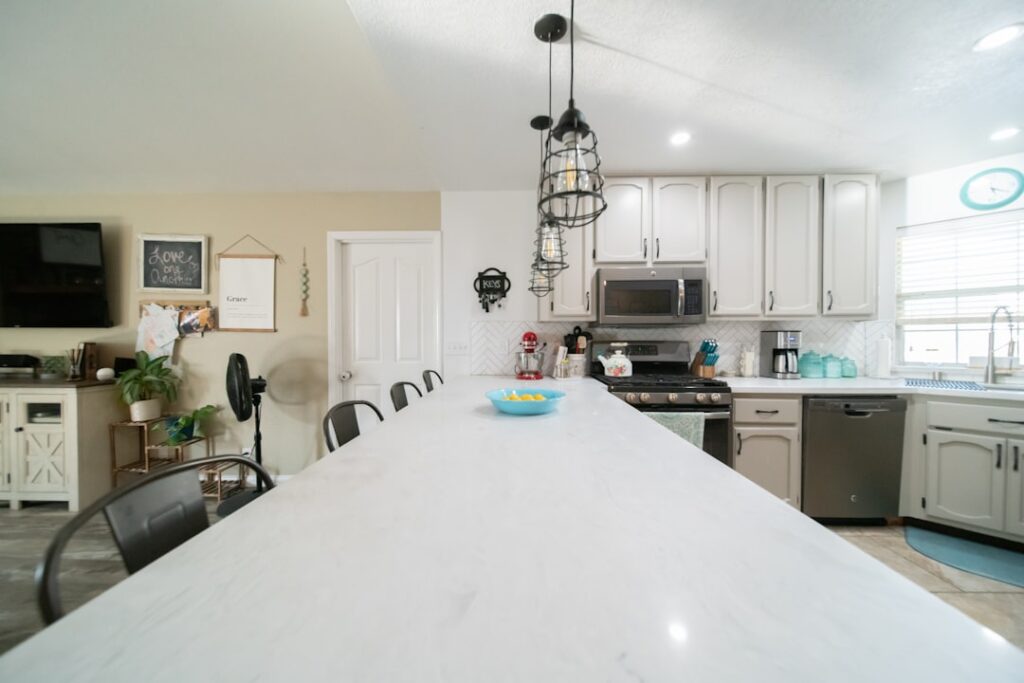
Finding cheap countertops that look good and last more than a few years is entirely possible if you know where to look. Not every kitchen renovation needs $5,000 worth of quartz or granite. Whether you are updating a rental property, working within a tight remodel budget, or just refuse to overpay for a functional surface, there are several affordable options that deliver real value.
Part of our Countertops guide — explore the full guide →
After decades in the home improvement industry, we have installed every countertop material on the market. This guide covers the most affordable options with honest assessments of their looks, durability, and limitations. We also include DIY possibilities for the handy homeowner who wants to save even more.
Laminate Countertops
Laminate remains the king of cheap countertops and for good reason. Modern laminate has come a very long way from the flat, obviously fake surfaces of past decades.
Cost: $10-40 per square foot installed. Pre-formed laminate countertops from home improvement stores start as low as $8-15 per linear foot, making them the single most affordable countertop option available. Custom laminate with built-up edges runs $20-40 per square foot installed.
Pros: Extremely affordable, huge selection of colors and patterns including realistic stone and wood looks, easy to clean, does not require sealing, lightweight and easy to install, resistant to stains with proper care.
Cons: Can be damaged by heat (hot pans will leave burn marks), visible seams on L-shaped layouts, edges can chip or peel over time, cannot be refinished, and still carries a “budget” reputation despite improved quality.
Best brands to consider: Formica’s 180fx line offers full-scale stone patterns that look remarkably realistic. Wilsonart’s HD and Dekora lines are also excellent. Both brands offer textures that mimic the feel of real stone.
Lifespan: 10-20 years with proper care. Avoid cutting directly on the surface, use trivets for hot items, and repair chips promptly to maximize longevity.
Tile Countertops
Tile countertops have fallen out of fashion in mainstream American kitchens, but they remain one of the best cheap countertops for budget-conscious homeowners willing to tolerate grout lines.
Cost: $10-35 per square foot installed. Ceramic tile starts at $1-5 per square foot for materials, and porcelain runs $3-10. Installation adds $10-20 per square foot for professional labor. Total project cost for a typical kitchen runs $400-1,500.
Pros: Heat resistant (you can place hot pots directly on tile), extremely durable individual tiles, huge range of colors, sizes, and patterns, easy to DIY, and individual damaged tiles can be replaced without redoing the entire counter.
Cons: Grout lines collect dirt, bacteria, and stains. Uneven surface makes rolling dough and similar tasks difficult. Grout requires periodic sealing. The look is dated in many design contexts. Items placed on the counter can wobble on grout lines.
Modern approach: Large-format tiles (12×24 or larger) minimize grout lines and create a more contemporary look. Rectified tiles with thin grout lines and epoxy grout (which resists staining) address many of the traditional complaints about tile countertops.
Lifespan: 20-50+ years for the tile itself. Grout may need replacement every 10-15 years.
Butcher Block Countertops
Butcher block delivers warmth and character that no other budget material can match. It is one of the few cheap countertops that can genuinely compete with premium materials on appearance.
Cost: $25-65 per square foot installed. Pre-made butcher block slabs from home improvement stores start around $20-40 per square foot for materials. Common wood species pricing: maple ($30-50/sq ft), oak ($25-45/sq ft), walnut ($50-80/sq ft), birch ($20-35/sq ft).
Pros: Beautiful, warm, natural appearance. Can be sanded and refinished multiple times. Naturally antibacterial (hardwoods like maple actively kill bacteria). Adds character as it ages. Can be cut to any size with standard woodworking tools. Pairs with virtually any kitchen style.
Cons: Requires regular oiling (monthly) to maintain moisture resistance. Susceptible to water damage if not properly maintained. Will develop scratches, dents, and knife marks over time. Can harbor bacteria in deep cuts if not properly maintained. Not heat resistant (hot pans will scorch the surface).
Best approach: Use butcher block on an island or a section of countertop rather than the entire kitchen. Pair it with a more durable surface around the sink and stove. This combination gives you the warmth of wood where you want it and durability where you need it.
Lifespan: 20+ years with proper maintenance. Can be sanded and refinished 3-5 times before the wood becomes too thin.
Concrete Countertops
Concrete countertops offer an industrial, modern aesthetic at a surprisingly reasonable price point, especially if you are willing to DIY.
Cost: $50-100 per square foot professionally installed. DIY concrete countertops can be made for $5-15 per square foot in materials, making them one of the cheapest options if you have the skills and patience to do the work yourself.
Pros: Highly customizable in color, shape, and texture. Heat resistant. Can be cast with integrated sinks, trivets, and drain boards. Unique appearance that gets attention. Extremely durable when properly sealed.
Cons: Heavy (about 18 pounds per square foot at 1.5 inches thick). Requires sealing every 1-3 years. Can crack if the substrate moves or settles. Professional installation is not cheap. DIY requires significant skill and effort. Porous if not properly sealed.
DIY reality check: Making concrete countertops is doable for handy homeowners, but it is not a weekend project. Expect to spend 3-5 days on forming, pouring, curing, and finishing. The learning curve is steep, and mistakes are difficult to fix. Practice on a small project (like a bathroom vanity or outdoor table) before tackling your kitchen.
Lifespan: 20-50+ years with proper sealing and maintenance.
Other Budget Options Worth Considering
Beyond the four main cheap countertops options, several other materials merit attention.
Stainless steel ($40-80/sq ft installed): Common in commercial kitchens, stainless steel is hygienic, heat resistant, and indestructible. The downside is visible scratches, fingerprints, and a cold industrial look that only works in certain kitchen styles. Custom fabrication makes it more expensive than some budget options, but restaurant supply surplus pieces can be very affordable.
Contact paper or peel-and-stick overlays ($1-5/sq ft): The absolute cheapest temporary solution. Modern peel-and-stick countertop covers feature realistic marble and granite patterns. They work well for rentals and temporary fixes but are not a permanent solution. Expect 1-3 years of decent appearance.
Epoxy resin over existing counters ($3-10/sq ft DIY): Applying epoxy resin over existing laminate creates a glossy, marble-like finish at very low cost. The technique requires careful preparation and a controlled environment, but YouTube tutorials make it accessible. Results vary widely based on technique.
Remnant stone ($20-50/sq ft installed): Leftover pieces from stone fabricators sell at 30-50% below regular pricing. If your kitchen is small enough, you may find granite or quartz remnants that cover your entire countertop at a fraction of the standard price.
Cost Comparison Chart
Here is a direct comparison of all budget countertop materials for a typical 35-square-foot kitchen.
Laminate (pre-formed): $350-700 total, DIY-friendly
Laminate (custom): $700-1,400 total, professional recommended
Ceramic tile: $350-1,200 total, DIY-friendly
Butcher block (birch/oak): $700-1,600 total, DIY-friendly
Butcher block (maple): $1,050-1,750 total, DIY-friendly
Concrete (DIY): $175-525 materials only
Concrete (professional): $1,750-3,500 total
Remnant granite/quartz: $700-1,750 total, professional only
For context, mid-range quartz or granite for the same kitchen would run $2,600-5,000, and premium stone would cost $4,500-8,000+.
DIY Countertop Options
Installing cheap countertops yourself eliminates $500-2,000 in labor costs. These materials are the most DIY-friendly.
Pre-formed laminate is the easiest DIY countertop project. Home improvement stores sell standard-depth countertops in lengths up to 12 feet. You cut them to size with a circular saw, join pieces with miter bolts, and secure them to the cabinets with screws. A competent DIYer can complete the job in a single day.
Butcher block is nearly as easy. Pre-made slabs need to be cut to length, sanded, oiled, and screwed down. The main challenge is cutting precise sink holes, which requires a jigsaw and a steady hand. Budget two days for a full kitchen.
Tile is moderately difficult. The tiling itself is straightforward if you have done any tile work before. The challenge is creating a smooth, level substrate and ensuring the front edge looks professional. Using bullnose edge tiles or metal edge trim makes a big difference in the finished appearance.
Concrete is the most challenging DIY option. Building the forms correctly, mixing the concrete to the right consistency, avoiding air bubbles, and achieving a smooth finish all require practice. Budget a full week for your first concrete countertop project including cure time.
Tips for Making Cheap Countertops Look Premium
Small details elevate budget countertops from looking cheap to looking intentional and stylish.
Upgrade the edge profile. A built-up or beveled edge on laminate looks dramatically better than a standard straight edge. For butcher block, routing a simple roundover or chamfer edge takes minutes and adds a professional touch.
Match the backsplash. A well-chosen tile backsplash draws the eye up and away from the countertop. Subway tile, penny tile, or glass mosaic in a complementary color makes even laminate counters look like part of a thoughtfully designed kitchen.
Invest in quality hardware. New cabinet pulls and a good faucet upgrade the entire look of the kitchen. A $200 faucet above a laminate counter looks better than a $30 faucet above granite.
Keep it simple. Solid colors and subtle patterns age better than busy designs. White, grey, and natural wood tones look modern and clean regardless of the material. Avoid patterns that try too hard to mimic expensive stone.
Maintain the surface. A well-maintained laminate counter looks better than a neglected granite counter. Keep surfaces clean, repair damage promptly, and replace worn caulk around sinks and backsplashes.
Frequently Asked Questions
What is the cheapest countertop material?
Pre-formed laminate is the cheapest countertop material at $10-25 per square foot installed. For DIY installations, contact paper overlays ($1-5/sq ft) and DIY concrete ($5-15/sq ft for materials) are even less expensive, though both require more effort or compromise on durability.
Are cheap countertops worth it or should I save for granite?
It depends on your situation. If you plan to stay in your home for 20+ years, investing in quality stone makes financial sense. For rental properties, starter homes, or kitchens you plan to fully renovate in 5-10 years, budget countertops are a smart choice that lets you allocate funds to higher-impact upgrades.
What cheap countertop looks the most like real stone?
High-end laminate from Formica’s 180fx collection and Wilsonart’s HD line produce the most convincing stone looks. The patterns are full-scale (not repeating) and include textures that mimic natural stone. From a distance of a few feet, they are difficult to distinguish from the real thing.
Can I put cheap countertops over existing countertops?
In some cases, yes. Laminate can be installed over existing laminate if the surface is flat and in decent condition. Tile can be laid over existing laminate with proper preparation. Concrete can be poured over an existing substrate with a bonding agent. Butcher block is typically installed fresh, with the old countertop removed first.
What is the most durable cheap countertop?
Tile is the most durable budget countertop material. Individual porcelain tiles are harder than granite, heat resistant, and scratch resistant. The weak point is the grout, not the tile. With epoxy grout and proper sealing, a tile countertop can easily last 30+ years.


